
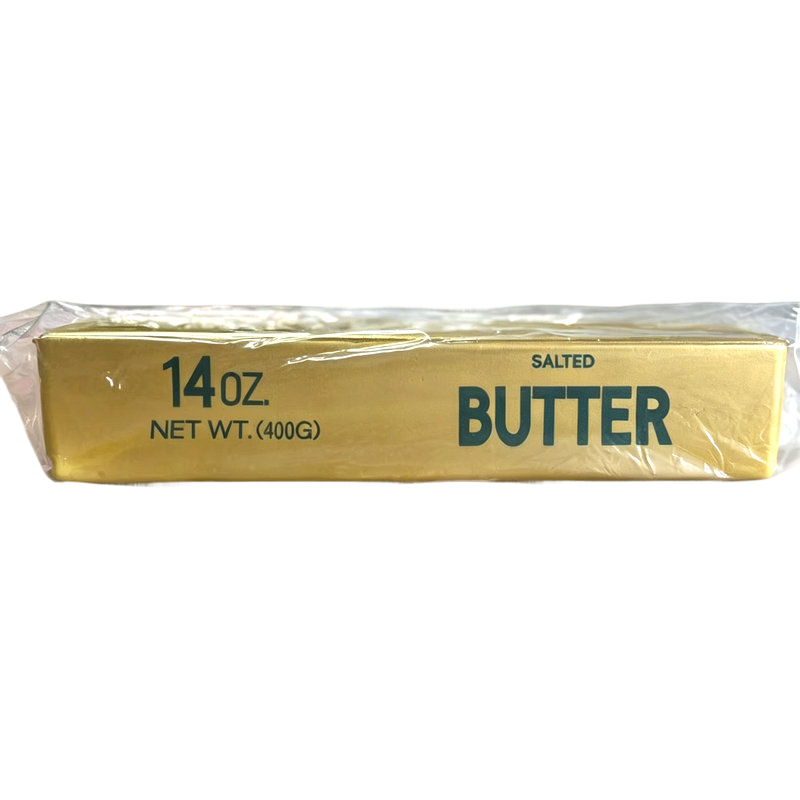
The material decides how a squishy feels, what it can hold, how it prints and what its tooling costs. Most squishies on the market are either TPR or slow-rise PU foam; silicone and TPE come up in special cases. SUKEAUTO works mainly in TPR and slow-rise PU.
TPR: Stretchy, Clear and Filled
TPR (thermoplastic rubber) is our default squishy material — dumplings, food shapes, cat paws and every liquid- or gel-filled style. It stretches, can be crystal clear, and holds jelly, maltose, flour and oil fills. Our compound carries UV, oxidation and heat-resistance additives as standard.
- New-mould minimum: 10,000 pcs per design; tooling USD 3,500–4,000.
PU Foam: Slow-Rise and Easy to Print
Slow-rise PU foam is what butter squishies and many character squishies are made of: a matte, creamy, airy feel that slowly rises back. It takes printed faces and graphics very well — faces are applied as printed transfers bonded with a tested adhesive layer, so they don’t peel or wrinkle.
- New-mould minimum: 5,000 pcs per design; tooling USD 2,000–3,000 — PU is cheaper to tool than TPR.
- Unit price for custom PU items: about USD 1.20–2.00 EXW; sampling 25–30 days.
Silicone and TPE: When They Make Sense
TPE behaves much like TPR and suits extra-soft or extra-clear shells. Silicone is heat-stable and durable but costs more and doesn’t hold squishy fills the same way; it is used for specific product briefs rather than mainstream squishies.
Odour, Grade and How to Spot Cheap Material
Second-grade TPR shows on the bottom — rough gate marks, flash and uneven finish — and often smells and turns sticky. Three checks: smell it, squeeze it hard, look underneath. See squishy quality checks.
Material Safety Documents
For TPR / TPE squishies: CE certificate with EN 71-1/2/3 (TST, August 2025); Children’s Product Certificate with ASTM F963-23 / CPSIA report (MTL, October 2024); REACH test report on TPE / TPR raw material (CPST). See squishy safety testing.
Choosing by Shape, Age and Budget
| If you need… | Choose |
|---|---|
| A filled, clear or stretchy squishy | TPR |
| Slow-rise feel with printed detail | PU foam |
| A new shape at 5,000–10,000 pcs | PU (lower minimum and tooling) |
| Extra-soft or extra-clear shell | TPE |
What Buyers Ask SUKEAUTO About Materials
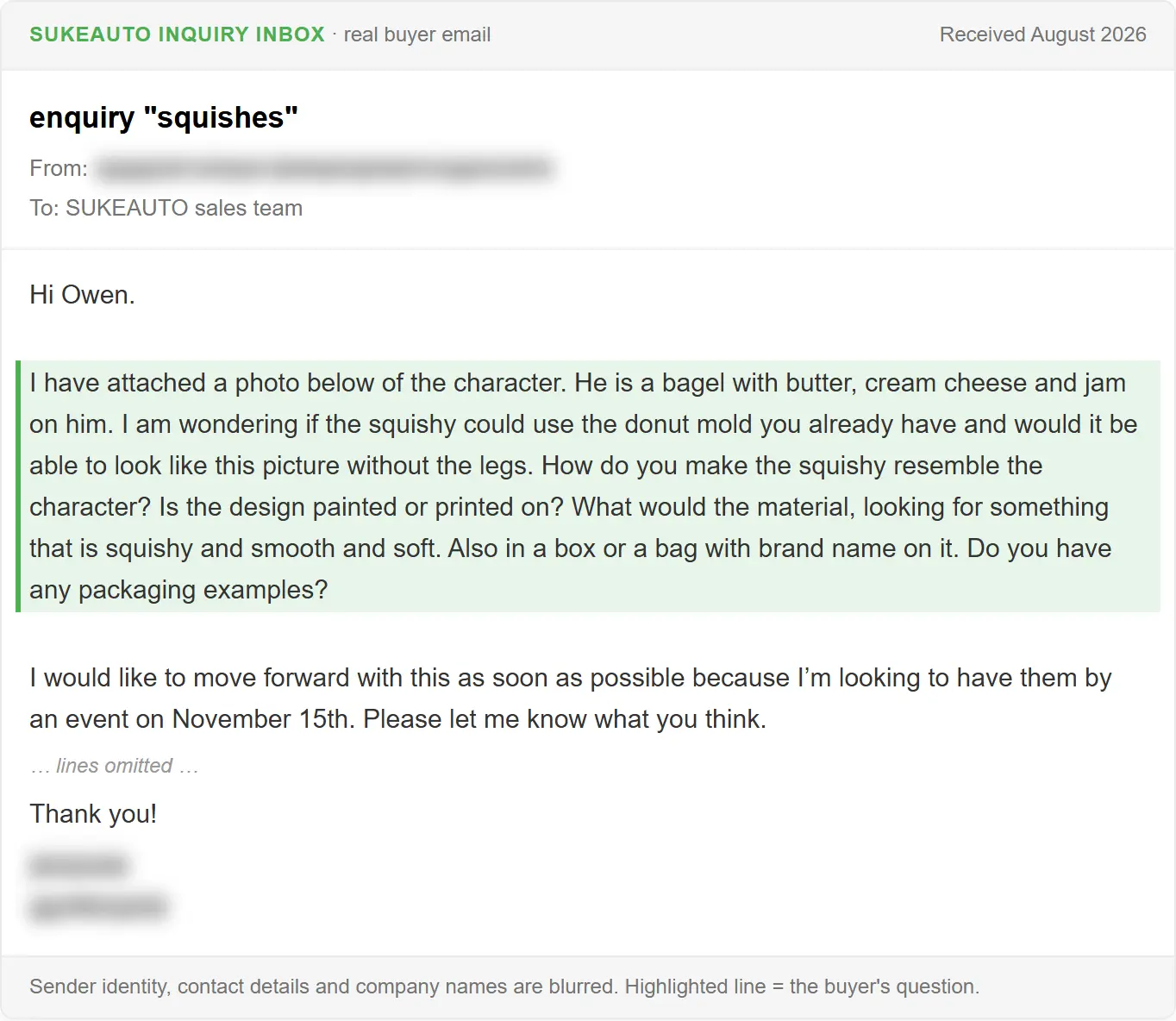
Material is one of the most-asked squishy topics: 67 of the 408 squishy buyers who wrote to SUKEAUTO between July and October 2026 asked about materials. Many describe a feel rather than a material — “squishy, smooth and soft” — and ask us which one gets them there, whether it can be painted or printed, and how it will hold up.
How Each Material Is Made
Slow-rise PU foam is formed when two liquid components react in a closed mould. Water reacts with one of them to release carbon dioxide, which builds an open-cell foam; when you squeeze it, air leaves slowly through the connected cells, so the foam rises back slowly. Freshly moulded foam needs time to rest and stabilise before it is painted and packed, and its slow rise depends on temperature — slower in the cold, faster in the warm.
TPR is a thermoplastic rubber: a block copolymer with hard and soft segments that gives rubber-like stretch while it can still be melted and injection-moulded. Colour runs through the material. TPR is moulded as a skin and can be filled with jelly, maltose, flour paste or oil, or moulded solid.
Silicone is a different elastomer with its own tooling and feel; it is used for specific products rather than as a direct swap for TPR.
How They Compare in Use
| Slow-rise PU | TPR | |
|---|---|---|
| Feel | Creamy, slow rise | Stretchy, bouncy or flowing when filled |
| Colour | Sprayed surface | Through the material; can be clear |
| Crisp on matte surface | Pad print inside or outside the skin | |
| Durability | Thin features can tear | Stretches without tearing; quality depends on grade |
| Cleaning | Wipe only | Mild soap and water for most items |
| Odour risk | Residues if rushed | Oil and additives in low grades |
Odour and Quality: What Testing Has Found
Independent testing has shown why material grade matters. The Danish Environmental Protection Agency tested squishies in 2018 and found volatile organic compounds released from PU foam toys, which led to recalls in Europe; consumer testing in China in 2025 linked strong smells to volatile compounds and found small parts that came off too easily. The lesson for buyers is practical: rushed curing, poor raw materials and missing tests show up as smell, stickiness and weak parts.
Choosing a Material, Step by Step
- Decide the feel your customers want.
- Decide how the design is applied — printed detail suits PU; clear and filled effects suit TPR.
- Check the age you sell to and the tests that apply.
- Consider the volume — PU new-mould minimum 5,000 per design, TPR 10,000.
- Feel samples of both before you commit.
More Material Questions
Which material does SUKEAUTO recommend for a printed character? Slow-rise PU for crisp printed detail; TPR when the character should be clear, filled or stretchy.
Is PU safe? Like TPR, it depends on the raw materials and the process; ask for test reports for the exact material.
Can SUKEAUTO combine materials? Some designs use a TPR skin with different fills; mixed-material constructions are reviewed case by case.
Which material lasts longest? In SUKEAUTO’s experience, solid TPR is the most robust; filled TPR and PU depend on design and storage.
Can SUKEAUTO make a squishy that is washable? Most TPR squishies can be wiped or washed with mild soap; PU should only be wiped.
Why do some squishies smell? Usually rushed curing or low-grade material; SUKEAUTO uses qualified TPR with additives as standard.
How Temperature Affects Each Material
Temperature matters to squishies more than to most toys:
- Slow-rise PU recovers more slowly in cold rooms and faster in warm ones. A sample that rises perfectly in an air-conditioned office can feel different in a hot shop window. Strong sunlight and high heat also age foam faster.
- TPR softens in heat and stiffens in cold. Poor-quality compound can “sweat” oil in hot storage, leaving a sticky surface.
- Filled TPR expands when warm; overfilled pieces are more likely to stress the skin.
For long sea transits and warm warehouses, choose qualified material, avoid overfilling and store cartons out of direct sun.
Surface and Scratch Behaviour
The two materials wear differently:
- PU foam is painted on the surface. Heavy handling can scuff the paint and show the lighter foam underneath.
- TPR is coloured all the way through, so a scratch does not show a different colour, and the material stretches without tearing.
For products that will be handled hard — classroom sets, clinic rewards, display testers — TPR’s coloured-through body is an advantage. For printed detail and a soft, slow feel, PU remains the favourite.
Warning Signs of Low-Grade Material
When comparing samples from different suppliers, look for:
- A strong chemical smell that does not fade after a day of airing.
- An oily or sticky surface on TPR.
- Pinholes, bubbles or silver streaks on the surface.
- Foam that collapses or stays dented.
- Colour that rubs off on a white cloth.
Each of these points back to raw material or process control, and each tends to get worse in transit and storage rather than better.
Material and Price Positioning
Material choice also shapes your price position on the shelf. Slow-rise PU characters are often seen as premium, display-worthy pieces, while filled TPR shapes sell well as impulse and counter items. Choosing the material to match the price point you want saves margin later.
The Chemistry Difference in One Paragraph
TPR is a thermoplastic: it arrives as pellets, melts when heated, takes the shape of a mould and becomes a rubbery solid as it cools. It can be melted again. Slow-rise PU foam is made by a chemical reaction: two liquids are mixed, water in the mix reacts to release carbon dioxide, the gas blows the liquid into an open-cell foam, and the foam cures into its final form. It cannot be melted and reshaped. That single difference explains most of what follows: TPR can be clear, stretchy and filled; PU is light, opaque, slow-rising and paintable.
How Each Behaves Over Time
| Factor | TPR | Slow-rise PU foam |
|---|---|---|
| Density | Relatively heavy for its size | Very light, because most of its volume is air |
| Cold weather | Stiffens and rebounds more slowly | Stiffens and rises much more slowly |
| Heat | Softens; oils can migrate and make it tacky | Softens; prolonged high heat ages the foam faster |
| Sunlight | Light colours can yellow | Paint and foam can yellow or fade |
| Tearing | Stretches a long way before tearing | Tears more easily at thin points; not made for stretching |
| New-product smell | Low with good grades | A mild smell when new that fades as the foam airs out |
Freshly made PU foam keeps releasing traces of its reaction for a while. Airing new foam pieces before packing, and storing them in ventilated areas, reduces that new smell.
Freight and Size
Because PU foam is so light, large PU squishies cost less to ship per piece than equally large TPR ones, where freight is charged on volume rather than weight in both cases. For jumbo sizes, the material choice affects the landed cost as much as the unit price.
Choosing for Your Customers
- Young children and shared use: solid TPR or PU, with no detachable parts and no liquid filling.
- Stress relief for adults: slow-rise PU for the slow, satisfying recovery; filled TPR for the heavy squeeze.
- Clear and glitter effects: TPR, because PU foam is opaque.
- Detailed painted shapes and large prints: PU, which paints and prints well on its smooth skin.
- Cold climates: test samples cold. PU’s slow rise can become very slow in a cold shop or outdoor market.
Signs of Low-Grade Material
The August 2026 US warning about counterfeit squishies listed signs that also apply to material quality: a strong chemical smell, an oily or unusually sticky surface, leaks and skins that tear easily. UK border rejections in 2026 included a butter-shaped squishy in which testing found volatile organic compounds such as xylenes and styrene, with no technical documentation behind it. Good material is not just a feel; it is a documented recipe with test results.
Key Terms
- Thermoplastic — a plastic that softens when heated and sets when cooled, repeatably.
- Open-cell foam — foam whose cells connect, letting air move through it.
- Volatile organic compounds (VOCs) — chemicals that evaporate at room temperature and can cause odour.
- Off-gassing — the release of traces of chemicals from a new product.
Which material does SUKEAUTO recommend for jumbo sizes? SUKEAUTO makes jumbo dumplings in TPR and slow-rise styles in PU; for freight-sensitive jumbo orders, ask SUKEAUTO to compare both.
Why does new PU foam need time before packing? Slow-rise PU must rest after moulding before it is painted and packed at SUKEAUTO; the rest also lets the new smell fade.
Can PU squishies be clear? No. SUKEAUTO uses TPR for clear and glitter skins, because PU foam is opaque.
Sources: SUKEAUTO inquiry inbox — 408 squishy buyers by email and WhatsApp, July–October 2026 · The Nation Thailand: squishy toys and chemical exposure (Danish EPA findings) · CNR: consumer test of trending squeeze toys (Chinese) · CPSC: warning about fake and counterfeit squishy toys (August 2026) · GOV.UK: butter squishy rejected over VOCs and missing documentation.
Not sure? Send your shape and target feel. Related: squishy fillings and feel · solid vs filled TPR squishies · back to custom squishy toy manufacturer.
Send Your Inquiry
Tell us the style, quantity, logo or packaging you need and your target date — we reply with the right route and a price range.
Leave A Comment