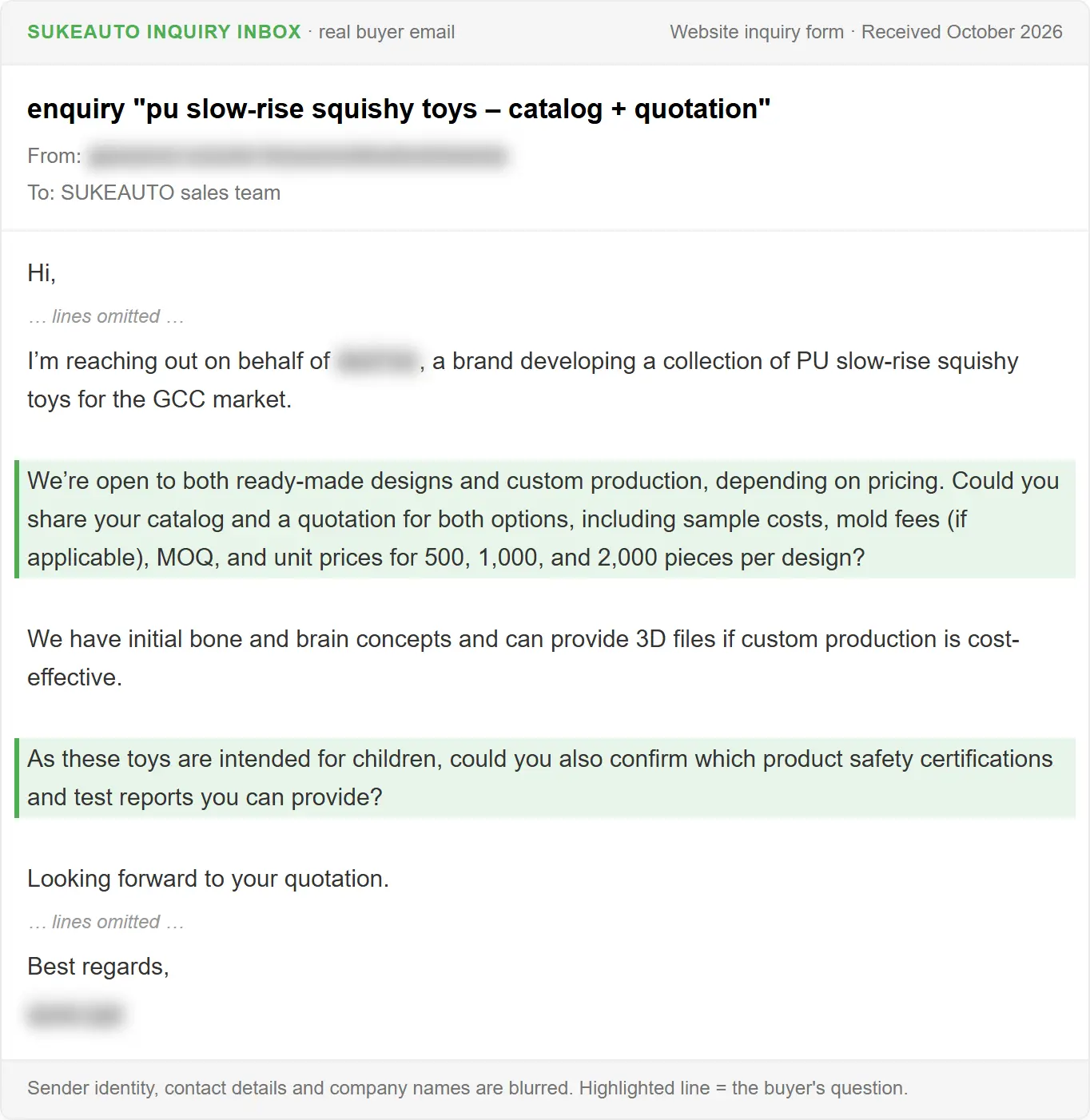
Between July and October 2026, 46 of the 408 squishy buyers who wrote to SUKEAUTO asked for certificates or test reports, and 26 asked about safety. The right answer starts with a question many buyers skip: who is the product for? The age you put on the label decides which tests apply.
Age Grading: Kids, Teens or Adults
A squishy labelled for children is a toy under toy-safety law and must pass toy tests. A product clearly designed and labelled as a stress-relief item for adults sits under general product-safety rules instead. Most buyers sell to a mixed audience and test to toy standards — the safest choice, because squishies are attractive to children whatever the label says.
Compression, Rupture and Small-Parts Tests
Toy standards test what happens when a child squeezes, bites, pulls or drops the product:
- Small parts — nothing that detaches may fit the small-parts cylinder (choking hazard).
- Compression and tension — attachments, faces and appendages must not come off under force.
- Seams and fills — a filled squishy must not split and expose fill that could be swallowed.
Chemical Tests: Lead, Phthalates and Heavy Metals
- US: CPSIA limits total lead in accessible substrates and lead in paint, and restricts eight phthalates in children’s toys.
- EU: EN 71-3 limits the migration of heavy metals; REACH restricts substances in materials.
Which Report Covers Which Product
For our TPR / TPE squishies we hold:
| Document | Lab | Date | Market |
|---|---|---|---|
| CE certificate with EN 71-1/2/3 test report | TST | August 2025 | EU |
| Children’s Product Certificate + ASTM F963-23 / CPSIA test report (lead, phthalates, mechanical — all passed) | MTL | October 2024 | US |
| REACH test report on TPE / TPR raw material | CPST | — | EU |
These cover our TPR squishy line. We do not hold a California Prop 65 report; it can be arranged per order. We do not hold ISO 9001 or BSCI certificates.
When a New Test Is Needed
New material, new fill, new paint or ink, a new market, or your own new design → test again. Testing for your specific product is arranged per order through a third-party lab, and the fee is not included in the unit price. We provide production-grade samples for your own submission to labs such as SGS or ITS if you prefer.
Warnings and Labels on the Pack
Age grading, small-parts or choking warnings and the right conformity marks go on the packaging. Our stock dumpling display already carries CE marking and an Ages 3+ warning; for your own packs, the text comes from you for your market.
By market: US and Canada — CPSIA, ASTM F963, CPC and CCPSA · EU and UK — EN 71, CE, REACH and GPSR · toy safety certificates.
What Buyers Ask SUKEAUTO About Safety
Buyers increasingly ask about safety before they ask about price. Certificate questions grew from 6 in July to 19 in October 2026, and many of the buyers developing their own designs asked which reports would apply to a product made for children.
Small Parts and Age Grading in Practice
In the US, a toy intended for children under 3 must not contain small parts — anything that fits completely inside the small-parts test cylinder, about 5.7 × 3.2 cm (2.25 × 1.25 in), including pieces that break off during use-and-abuse testing. Toys for children aged 3 to 6 that contain small parts need a choking-hazard warning on the principal display panel of the package. Age grading is judged on the manufacturer’s stated intent, how the product is advertised and marketed, and how consumers reasonably see it — not only on the age printed on the box.
Expanding Materials and Water Beads
ASTM F963-23 includes a test for expanding materials: a toy part small enough to fit the small-parts cylinder must not expand beyond set limits when soaked. In 2026 CPSC announced several recalls and warnings for squishy buns containing water beads that expanded beyond the permitted size, a serious ingestion hazard. When you source any filled squishy, ask the supplier to state in writing what the filling is made of and to confirm it contains no expanding water beads.
Chemical Limits That Apply to TPR Squishies
- US: total lead in accessible substrate is limited to 100 ppm and lead in paint or surface coatings to 90 ppm; DEHP, DBP, BBP, DINP, DIBP, DPENP, DHEXP and DCHP are each restricted to 0.1% in children’s toys.
- EU: REACH Annex XVII restricts DEHP, DBP, BBP and DIBP to 0.1% in plasticised materials of toys, and further phthalates for toys that can be placed in the mouth; EN 71-3 limits the migration of certain elements.
These limits are tested by accredited third-party laboratories; the test report names the product, the material and the date.
How to Read a Test Report
- Product match — the report should name the product, or a product made of the same material and construction.
- Standard and edition — for the US, ASTM F963-23 and the CPSIA chemical limits; for the EU, the EN 71 parts listed.
- Result per clause — pass or fail for each test, not only an overall line.
- Lab and date — an accredited lab and a recent date; materials and suppliers change.
- Photos — many reports include photos of the tested sample; compare them with what you will receive.
A Safety Checklist Before You Order
- Decide the target age and keep packaging and marketing consistent with it.
- Ask for the test reports for the exact material and construction.
- Confirm in writing what the filling is.
- Plan warnings, tracking information and importer details for the pack.
- Budget for testing your own design if it differs from the tested product.
More Safety Questions
Can SUKEAUTO send its test reports before I order? Yes — SUKEAUTO shares the CE / EN 71 and ASTM F963-23 / CPSIA reports for its TPR squishy line on request.
Does a report for a stock item cover my custom design? Only if the material, fill and decoration are the same; a new design is tested on its own.
Who chooses the lab for my product? You can nominate an accredited lab; SUKEAUTO supplies production-grade samples.
Are squishies safe for children under 3? Most squishies are graded 3+ because of their size and construction; label for the age your test results support.
Do adult-only stress toys need toy testing? Products clearly designed and marketed for adults follow general product-safety rules, but squishies appeal to children, so most buyers test to toy standards anyway.
What is a tracking label? In the US, children’s products carry permanent information on the product and packaging — manufacturer or private labeler, location and date of production, and batch.
What 2026 Recalls and Border Rejections Show
Official records from 2026 give a clear picture of why squishies fail safety checks. From UK product safety reports and US regulator warnings:
| Problem found | Example from official records | What testing or documents would have caught it |
|---|---|---|
| Benzene in the material | A dumpling squishy recalled in the UK in June 2026 with 20 mg/kg benzene in the outer layer | Chemical testing of the skin material |
| Volatile chemicals and no paperwork | A butter-shaped squishy rejected at the UK border in September 2026: VOCs including xylenes and styrene, a declaration of conformity that did not match, no technical file | Chemical testing, a real technical file and matching declaration |
| Water beads | A dumpling squishy rejected at the UK border because it broke open and released water beads | Material checks and abuse testing |
| Contaminated filling | Liquid- and glitter-filled squishies destroyed for bacteria, yeast and mould | Microbiological testing of fillings |
| Small parts | A 24-piece holiday set removed from sale because pieces fitted the small-parts cylinder | Small-parts testing and correct age grading |
| Packaging parts | Net-bag clips on a squishy donut pack that fitted the small-parts cylinder | Testing the product as sold, packaging included |
In the US, the Consumer Product Safety Commission reported in August 2026 that it had stopped 55 shipments of violative squishies at the ports, 355,683 units in total, and listed the same themes: water beads, small parts, lead, phthalates and other hazardous substances, missing warnings and missing certification.
How Far One Test Report Stretches
A test report covers the samples that were actually tested. Whether it covers your product depends on what has changed since:
- Same material, same colours, same construction — the report generally applies.
- A new colour — new pigments can change heavy-metal results. Standards such as EN 71-3 test materials and colours separately, so a new colour may need additional testing.
- A new filling or material grade — a different recipe needs its own chemical testing.
- A new shape or accessories — mechanical tests such as small parts and abuse testing must be repeated.
- A new version of the standard — when a standard is revised and the new version becomes mandatory, older reports may no longer be enough. In the US, ASTM F963-23 became the mandatory toy standard in 2024.
Ask your supplier to show which samples a report covers, and match them to your exact item and colours.
Finding a Laboratory Your Market Accepts
For the US, children’s product testing must be done by a laboratory accepted by the Consumer Product Safety Commission. The CPSC publishes a searchable list of accepted laboratories, with the tests each one is accepted for. Checking that the laboratory on a report appears on that list, for the relevant test, takes a few minutes and avoids a certificate being rejected later.
Key Terms
- Benzene, xylene, styrene — volatile chemicals that must stay within strict limits in toys.
- Microbiological testing — testing fillings for bacteria, yeast and mould.
- Accepted laboratory — a testing laboratory recognised by the regulator for specific tests.
- Technical file — the manufacturer’s documents showing how a product meets safety rules.
Do SUKEAUTO’s reports cover every colour? A report covers the colours and materials tested; SUKEAUTO tells you which items and colours each report covers.
Can SUKEAUTO help with testing a new colour? Yes. SUKEAUTO provides production-grade samples for your own submission to the laboratory you choose.
Which laboratories does SUKEAUTO work with? SUKEAUTO’s reports come from recognised third-party laboratories; check the CPSC list for US testing.
Sources: SUKEAUTO inquiry inbox — 408 squishy buyers by email and WhatsApp, July–October 2026 · CPSC: Toy Safety business guidance · CPSC: final rule on phthalates in children’s toys · CPSC: tracking labels · CPSC recall notice: squishy buns with water beads · CPSC: list of accepted testing laboratories · GOV.UK: product safety reports for squishies · CPSC: warning about fake and counterfeit squishy toys.
Key Terms
- Small-parts cylinder — the US test fixture, about 5.7 × 3.2 cm (2.25 × 1.25 in), used to decide whether a part is a choking hazard for children under 3.
- Use-and-abuse tests — drop, torque, tension and compression tests that simulate how children treat toys.
- CPC — the US Children’s Product Certificate, issued by the importer based on third-party test results.
- EN 71 — the European toy-safety standards; parts 1, 2 and 3 are the core for squishies.
- Accredited lab — a laboratory accepted by the authority, such as a CPSC-accepted lab for US children’s products.
The Short Version
Decide the age you sell to, then test to match it. Ask for reports that name the material and construction you will receive, confirm in writing what any filling is made of, and print the right warnings, tracking information and importer details on the pack. SUKEAUTO shares its CE / EN 71 and ASTM F963-23 / CPSIA reports for the TPR squishy line before you order.
Tell us your market and target age and we’ll tell you which documents apply. Back to custom squishy toy manufacturer.
Send Your Inquiry
Tell us the style, quantity, logo or packaging you need and your target date — we reply with the right route and a price range.
Leave A Comment