
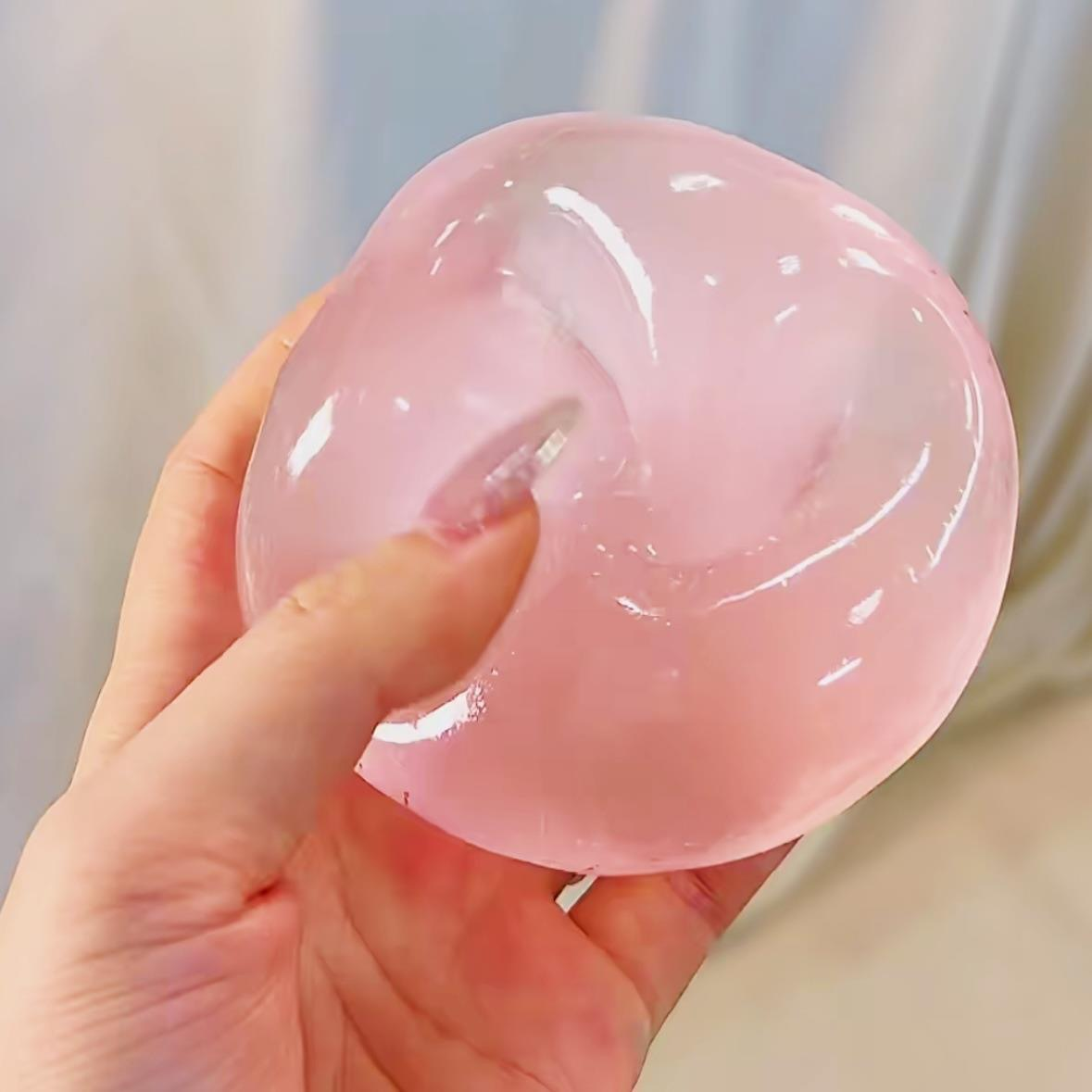
Two squishies with the same shape can feel completely different. The skin is usually TPR; what changes the experience is what’s inside. Of the 408 squishy buyers who wrote to SUKEAUTO since July 2026, 42 asked about jelly or maltose fills and 26 about coconut oil. Here is how the main fillings compare.
The Main Fillings Side by Side
| Filling | Feel | Rebound | Look |
|---|---|---|---|
| Flour (dough) | Soft, doughy, slightly grainy | Slow to medium | Opaque, matte |
| Jelly gel | Smooth, wobbly | Fast | Clear, can carry glitter |
| Maltose | Thick, slow, syrupy | Slow | Clear, glossy, glitter stays suspended |
| Coconut oil | Smooth, silky, mouldable | Slow, holds a shape | Bright translucent |
| Slow-rise PU foam | Creamy, airy | Slow rise | Matte, prints cleanly |
Our 8.5 cm (3.3 in) dumpling runs in three of these: flour, gold glitter with jelly, and gold glitter with maltose — all with a steamer.
Slow Squeeze vs Fast Rebound
Slow-squeeze fills (maltose, oil, PU foam) are calming and look good on video; fast-rebound fills (jelly, flour) are fidget-friendly. A simple rebound test — squeeze fully and time the return — is the fairest way to compare samples from different suppliers.
Skin Thickness, Stretch and Durability
The skin carries the fill. We keep a minimum wall thickness of about 2.8 mm; thinner skins feel softer but split earlier. Our TPR compound carries UV, oxidation and heat-resistance additives as standard, and we can share a video of the material being squeezed, stretched and pulled hard.
Glitter, Inserts and Visual Effects
Clear fills carry effects: glitter, snowflake flakes, marbling. Our 5 cm (2 in) cube runs in glitter, snowflake and marbled versions. A fully flowing marble is not stable in mass production; a controlled two-tone is. Characters or logos suspended inside need a custom insert and a new mould.
Which Fillings Suit Young Children
Choose by the age you label for. Toys for children must pass small-parts, compression and rupture tests, and every fill must pass chemical limits. Our TPR squishies are covered by EN 71-1/2/3 and ASTM F963-23 / CPSIA reports — see squishy safety testing.
Feel Samples Before You Decide
Feel is hard to judge from a photo. Order a mixed sample box — one or two pieces of each model, air freight included — and compare fills side by side. See the squishy sample policy.
Further reading: why some squishies leak, cloud or turn sticky · TPR vs PU vs silicone · solid vs filled TPR squishies.
What Buyers Ask SUKEAUTO About Fillings and Feel
Feel is the reason people buy a squishy, so it is one of the most detailed topics in our inbox. Between July and October 2026, 65 squishy buyers asked SUKEAUTO about fillings and 67 about materials. The questions cluster around:
- A specific feel they have already seen — “slow and doughy”, “jelly-like”, “the oily one that holds a shape”.
- Visual fills — glitter, rainbow, confetti or small shapes inside a clear skin.
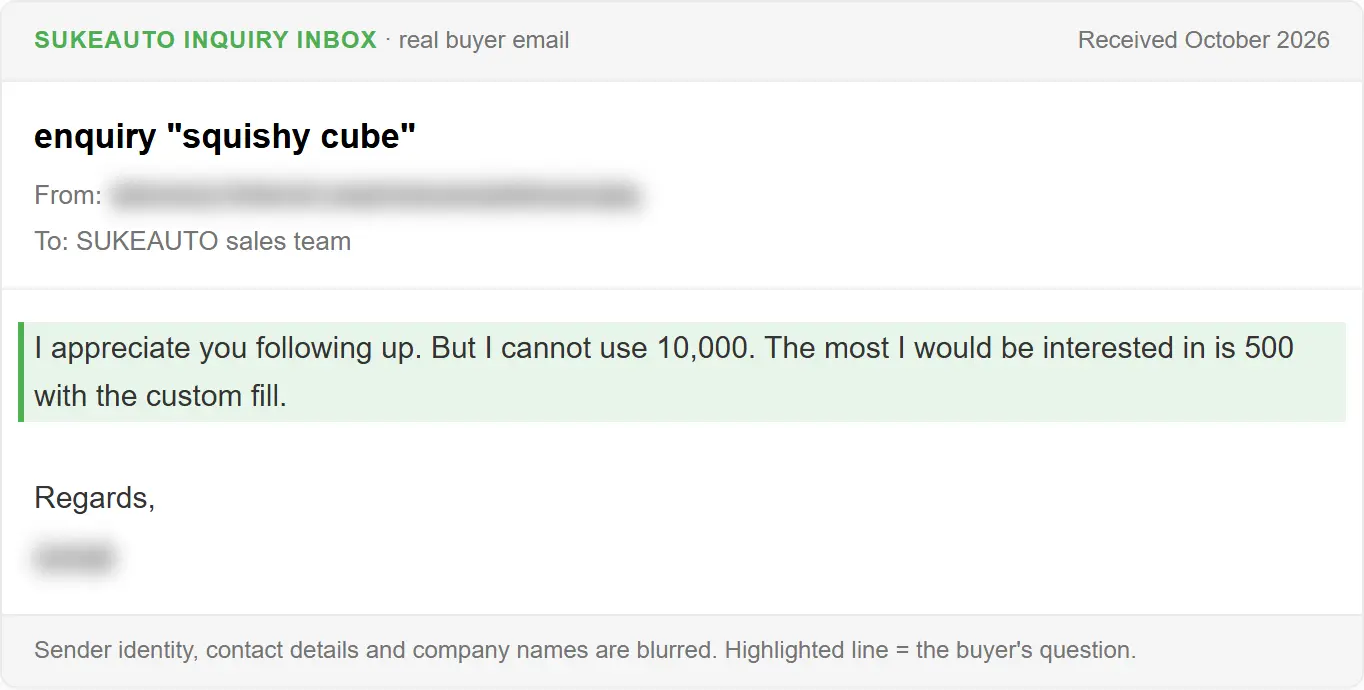
- Custom fills on small quantities — often the first sticking point, because a new fill on your own design is development work.
- Which fill is safest for young children.
How Each Filling Is Made to Behave
Flour (dough) fill is a soft paste sealed inside the TPR skin. It squeezes slowly, holds a little of the shape and recovers at medium speed. It is opaque, so it suits food shapes like buns and dumplings.
Jelly gel is a clear, elastic gel. It rebounds quickly and wobbles, and it can carry glitter — though heavy glitter settles over time in a thin gel.
Maltose is a thick, syrup-like fill. It moves slowly, looks glossy and keeps glitter suspended, which is why gold-glitter maltose dumplings stay sparkly.
Coconut oil fill gives a silky, mouldable feel: you can press a shape into it and it relaxes slowly. It suits balls and fruit shapes in bright translucent colours.
Slow-rise PU foam is not a fill but a solid foam body. It compresses deeply and rises back slowly, and its matte surface prints cleanly — the classic butter-squishy feel.
Matching a Filling to Your Channel
| Channel | Usually best | Why |
|---|---|---|
| Party bags and giveaways | Flour or jelly | Robust, low cost per piece |
| Shop counter impulse buys | Glitter maltose, coconut oil | Visual, satisfying in hand |
| Short-video sellers | Maltose, crunchy, slow-rise PU | Looks and sounds good on camera |
| Corporate and desk gifts | Slow-rise PU, solid TPR | Prints cleanly, keeps its shape |
| Young children | Choose by your age grade and tested items | Safety tests come first |
What Changes the Minimum
On SUKEAUTO’s stock items, the filling comes with the item: the 8.5 cm (3.3 in) dumpling runs in flour, gold glitter + jelly, and gold glitter + maltose. A different filling on your own design is development work on a new item — for TPR that means a new design at 10,000 pcs, quoted with the tooling. If you want a particular feel at a lower quantity, pick the stock item that already has it.
How to Judge Feel From Samples
- Rebound test — squeeze fully and time the return; compare samples side by side.
- Shape-hold test — press a thumbprint and watch how long it stays.
- Seam check — squeeze hard near the seal; there should be no movement of fill at the seam.
- Surface check — the skin should be smooth and non-tacky; stickiness or a strong smell points to second-grade material.
- Temperature check — leave a sample in a warm room for a day; a good fill keeps its feel.
More Questions About Fillings
Can SUKEAUTO match the feel of a squishy I already have? Send SUKEAUTO a sample or a video and we will tell you which stock filling is closest, or whether it needs a custom fill.
Will glitter settle? In thin gels it can over time; maltose keeps glitter suspended better.
Is the filling food-grade? No squishy filling is for eating. What matters is that the finished toy passes toy-safety tests — SUKEAUTO’s TPR squishies are covered by EN 71-1/2/3 and ASTM F963-23 / CPSIA reports.
Do fillings change in cold weather? Most become firmer in the cold and recover at room temperature.
Can I mix fillings in one order? Yes, as separate items — each filling counts as its own item with its own minimum.
Can SUKEAUTO add scent to a filling? Scent is quoted case by case; ask before planning around it.
How Buyers Describe the Feel They Want
Buyers rarely use technical words for feel. In our inbox the same wishes come back in everyday language, and each maps to a filling:
- “Slow and doughy, like bread” → flour fill or slow-rise PU foam.
- “Jiggly, like jelly” → jelly gel, fast rebound.
- “Thick and syrupy, with sparkle that stays” → maltose with gold glitter.
- “Holds a shape when I press it” → coconut-oil fill.
- “Crunchy, makes a sound” → crunchy-skin styles from our crunchy series.
- “Something to show on video” → maltose, glitter fills, crunchy and slow-rise PU.
When a buyer sends a feel description in their own words, SUKEAUTO replies with the closest stock item and a sample suggestion, so the feel can be confirmed in hand rather than argued over by email.
A Note on Feel and Temperature
Every filling changes a little with temperature: fills become firmer in a cold warehouse and softer in a hot one. When you compare samples, compare them at the same room temperature, and let goods that arrive in winter rest indoors before judging them.
The Short Version
Pick the feel first, then the item: flour for soft and doughy, jelly for bouncy, maltose for slow and sparkly, coconut oil for silky and mouldable, slow-rise PU for creamy and printable. Then order a mixed sample box from SUKEAUTO and compare them side by side in the same room.
Putting Numbers on Feel
“Soft” and “slow” mean different things to different people. When feel matters to your brand, these measurements turn it into a specification:
| Property | How it is measured | What it tells you |
|---|---|---|
| Rise or recovery time | Squeeze the squishy to half its height, hold for a set time, release and time how long it takes to come back to nearly full height, at room temperature | Fast rebound or slow rise, and whether batches match |
| Hardness | A durometer on the Shore 00 scale, which is designed for very soft materials | How firm the first squeeze feels |
| Weight | Each piece weighed against the approved sample | How much filling is inside; a light piece often feels hollow |
| Recovery after storage | Compress for a period, release and check that it returns to shape | Whether it will survive being packed tightly |
The useful habit is to measure the approved sample the same way, write the numbers down and check production against them. A sample that “feels right” is a good start; a sample with numbers is a reference that survives staff changes and reorders.
Why Feel Varies Between Batches
Even with the same mould and recipe, feel can drift. The usual reasons:
- The base material. Lower-grade soft polymers hold their oils less well, so the surface and squeeze change over time.
- The oil content. Very soft, dough-like feel comes from a high oil content; a small change in the ratio changes the hardness.
- Processing temperature. Soft compounds have a narrow processing window. Too hot or too cool changes the result.
- Several cavities in one mould. Each cavity can fill slightly differently, so pieces from one run are not always identical.
- Storage and stacking. Cartons stacked high in a hot warehouse can leave squishies flattened and slow to recover.
Risks by Filling
| Filling | Feel | What to watch |
|---|---|---|
| Flour dough | Doughy, holds a shape | Must be kept dry and sealed; moisture can allow microbial growth |
| Maltose syrup | Thick, slow, stretchy | Sugar-based fillings must be made and preserved to prevent microbial growth |
| Oil-based gels | Smooth, wet feel | Oil can migrate through the skin over time and make it tacky |
| Beads | Crunchy, grainy | Beads must stay inside; loose beads are a small-parts hazard |
| Liquid and glitter | Visual, wobbly | The skin is the only barrier; liquids need microbiological control |
| Water beads | Jelly-like | Regulated in US toys and a frequent recall reason; avoid |
UK officials rejected and destroyed liquid- and glitter-filled squishies in 2026 because the filling contained bacteria, yeast and mould above permitted limits. Fillings are part of the toy and are judged like the rest of it.
Feel and the Weather
Soft materials respond to temperature. In winter, squishies stiffen and rise more slowly; in summer heat, they soften and can become tacky. A simple check on samples is to keep one in a refrigerator for half an hour and compare its rise with a room-temperature piece. A small slowdown is normal; a squishy that barely recovers when cool is likely to disappoint customers in cold climates.
Key Terms
- Rise time — how long a squished piece takes to recover its shape.
- Shore 00 — a hardness scale for very soft materials.
- Durometer — the instrument that measures hardness.
- Oil migration — oils moving from inside a soft material to its surface.
Can SUKEAUTO match the feel of my sample? At SUKEAUTO the approved sample is the reference at the 100% pre-shipment inspection; if feel is critical, agree weight and rise-time targets in writing.
Which filling feels the most premium? SUKEAUTO’s maltose fillings give the slowest, thickest squeeze; flour fillings feel doughy and hold a shape.
Do squishies feel different in winter? Yes. SUKEAUTO squishies, like all soft polymers, stiffen in the cold and soften in heat.
Sources: SUKEAUTO inquiry inbox — 408 squishy buyers by email and WhatsApp, July–October 2026 · CPSC: final rule on phthalates in children’s toys · GOV.UK: liquid-filled squishy rejected for microbiological risk.
Tell us the feel you want and who it’s for, and we’ll suggest the filling. Back to custom squishy toy manufacturer.
Send Your Inquiry
Tell us the style, quantity, logo or packaging you need and your target date — we reply with the right route and a price range.
Leave A Comment