
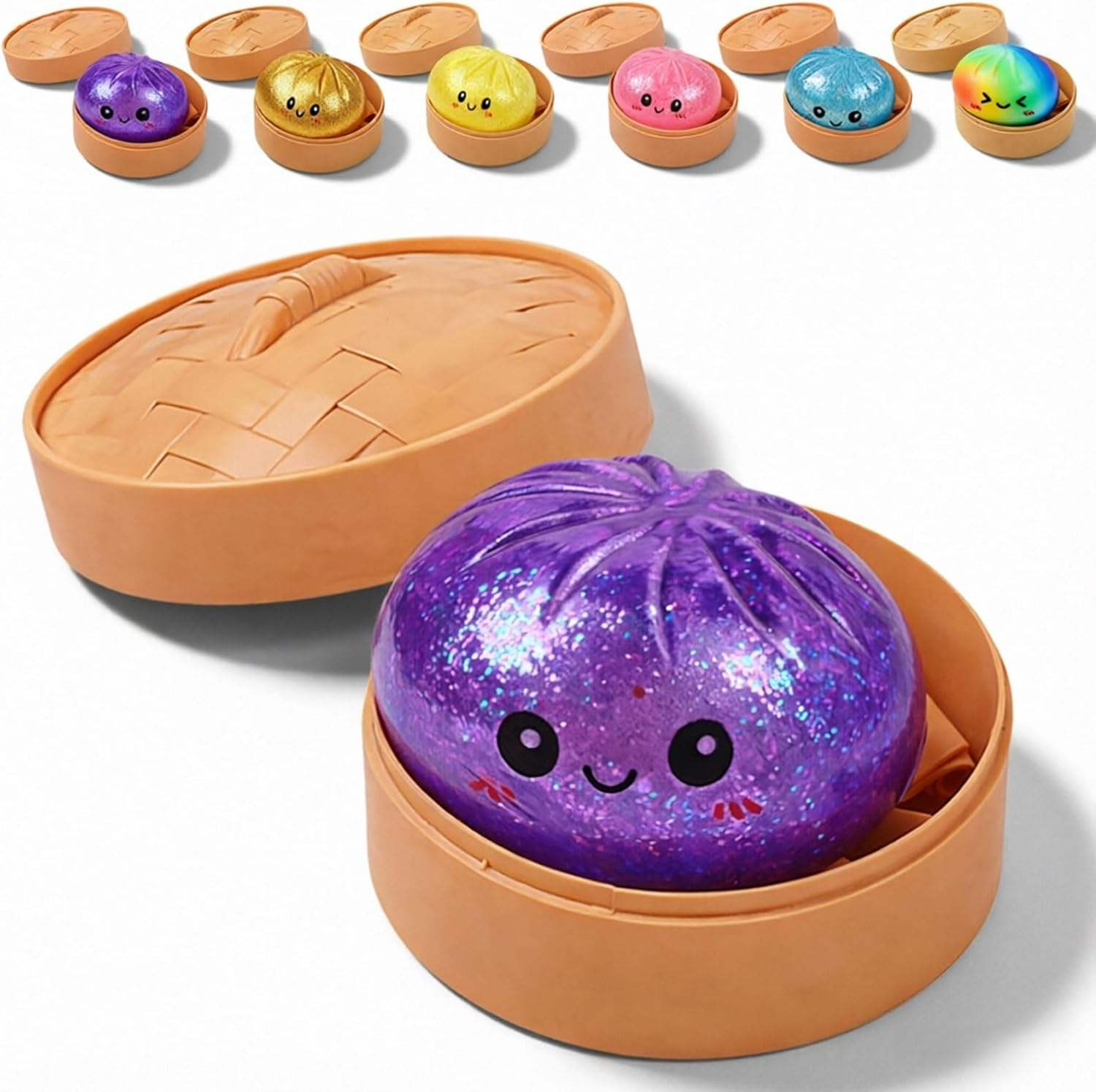
Fashion and accessory brands use squishies as bag charms, keychains and drop add-ons. At SUKEAUTO we see the same pattern: on an accessory, the squishy hangs from a ring, gets knocked around and travels in bags all day — so the choice between a solid TPR body and a filled one matters more than on a desk toy.
Formats
- Solid TPR — the body is TPR all the way through. Firmer, springy, cannot leak.
- Filled TPR — a TPR skin around jelly, maltose, flour or oil fill. Softer, slower, more satisfying — and more visual when the fill is clear.
Solid Bodies
Solid squishies suit charms that hang and swing: no fill to leak if a seam is snagged on a zip, and the attachment point can be moulded into the body. They print well and keep their shape in bags. The trade-off is feel — they squeeze less deeply.
Filled Bodies
Filled squishies deliver the slow, deep squeeze buyers film and share. On an accessory, keep them compact, use a strong seal, and attach the fitting to a reinforced point rather than through the filled area. See why some squishies leak for the failure points to avoid.
Jelly or Maltose Fill
Jelly rebounds fast and wobbles; maltose is thick and slow, and holds glitter in suspension so the effect stays visible. Our 8.5 cm (3.3 in) dumplings run in both, with gold glitter. Compare in squishy fillings and feel.
Glitter Inside, Not on the Surface
For special-edition colourways, put the glitter in the fill under a clear skin — it can’t rub off onto bags or hands. Surface glitter coatings wear and shed.
Branding
Your logo can be pad-printed inside the TPR skin (it won’t rub off) or carried on the packaging — both 5,000 pcs per design on our existing moulds. A new charm shape is a new mould: TPR 10,000 per design with a 3D file. See squishy logo printing methods and plush, PVC or squishy keychains.
What Buyers Ask SUKEAUTO About Materials
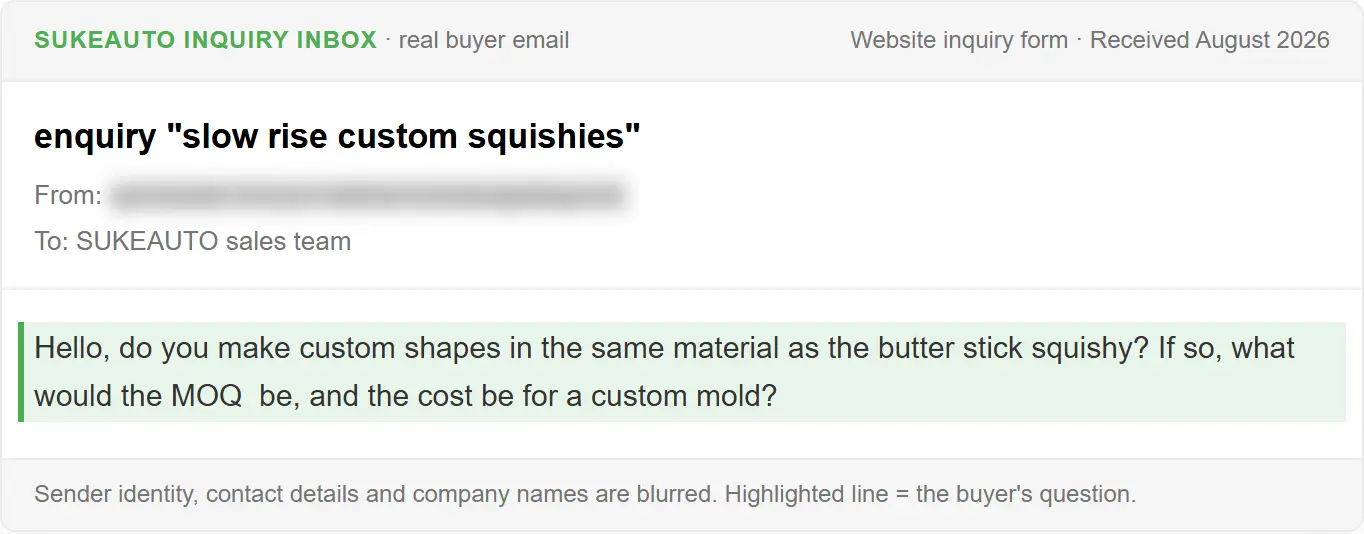
Material is one of the most-asked squishy topics: 67 of the 408 squishy buyers who wrote to SUKEAUTO between July and October 2026 asked about materials — 22 in August, 20 in September and 22 in October. Buyers ask which material gives a particular feel, whether a custom shape can be made in the same material as a stock item, and which material is best for durability.
Solid vs Filled: The Engineering Difference
A solid TPR squishy is one moulded part. There is no seal and no fill, so there is nothing to leak, settle or dry out. It is firmer and springier, and it is the safest choice for anything that hangs, swings or gets knocked around.
A filled TPR squishy is a moulded skin closed around a fill — jelly, maltose, flour paste, oil or glitter. The fill gives weight, slow flow and the feel people film and share. It also adds risks a solid body doesn’t have: the seal, the fill point, and how the fill behaves after weeks in a warm container.
Building a Squishy Bag Charm That Lasts
Treat a charm as a small carry product, not a decorative loop:
- Choose the attachment by the wall around it. A moulded loop, an embedded eyelet, a textile strap or a metal finding each needs enough material around it; very thin projections need a design change before a durable sample is possible.
- Never anchor through a filled cavity. On a filled body, the loop sits on a reinforced solid area.
- Agree a test plan. There is no single pull value for squishy charms; pull load, twist, repeated movement and drop height are set from the market, the age grade and the intended use, and approved samples are checked against it.
- Check the finished assembly. Hardware burrs, metal rubbing through the soft body and paint cracking at flex points are the common failures.
- Test the finished version. The regulated article is the whole charm — body, hardware and coating — not just the squishy body.
Choosing Between Them for Your Product
| Use | Better choice | Why |
|---|---|---|
| Bag charm, keychain | Solid TPR | No seal to fail, attachment can be moulded in |
| Desk toy, shop counter | Filled TPR | Deeper, slower squeeze; visual fills |
| Special-edition colourway | Filled, glitter inside a clear skin | Effect can’t rub off |
| Young children | Choose by your age grade and tested items | Safety tests come first |
Material Questions We Answer Most
Is the same material available for a custom shape? Yes — a new TPR shape uses the same material system at 10,000 pcs per design with tooling of USD 3,500–4,000; a new slow-rise PU shape is 5,000 pcs per design with tooling of USD 2,000–3,000.
What testing covers SUKEAUTO’s material? The TPE / TPR material has an EU REACH report; finished TPR squishies are covered by EN 71-1/2/3 and ASTM F963-23 / CPSIA reports, including lead and phthalates.
What do the US limits look like? Under CPSIA, total lead is limited to 100 ppm in the substrate and 90 ppm in paint or coatings, and eight listed phthalates to 0.1% each in children’s toys.
Is silicone better than TPR? It is a different material with its own tooling and feel; ask SUKEAUTO before planning around it.
Can the material be made softer? Feel is set by the material, the wall and the fill; tell SUKEAUTO the feel you want and we will suggest the route.
Does a charm need its own test report? The finished charm, including its hardware, should be covered for your market and age grade.
TPR, TPE and Slow-Rise PU in Plain Words
TPR (thermoplastic rubber) is the soft, rubbery material used for most moulded squishies: dumplings, cubes, food shapes and squeeze balls. It can be clear or coloured, solid or filled, and it is shaped by injection moulding.
TPE (thermoplastic elastomer) is the wider family TPR belongs to. Our material test report covers the TPE / TPR material used for squishies.
Slow-rise PU foam is a different material: a foam that compresses deeply and rises back slowly. It is cast in moulds rather than injected, prints cleanly on its matte surface, and is what butter-style squishies are made from.
Questions to Ask Any Supplier About Material
- Which exact material is used for this item, and do the test reports name it?
- Is the material the same in the sample and in production?
- How is a filled item sealed, and how is the seal checked?
- What happens to the surface after a few weeks in a warm room?
- Can I see the material squeezed, stretched and pulled hard on video?
SUKEAUTO answers each of these before you order. If a supplier can’t, treat it as a warning sign.
Why Material Grade Matters More Than Price
Two squishies can look identical in a photo and behave completely differently after a month. Second-grade TPR is the most common reason squishies turn sticky, smell or split, and it often shows first on the bottom finish. A slightly higher unit price for a qualified material is cheaper than a returned shipment.
The Short Version
Choose solid TPR when the squishy will hang, swing or be handled roughly, and filled TPR when the feel is the product. For anything attached to a bag or keyring, agree the attachment design and a test plan before sampling, and make sure the finished piece — body, hardware and coating — is covered by test reports for your market. SUKEAUTO reviews the attachment point on your 3D file before tooling, so weak spots are fixed on paper rather than discovered in a customer’s hand.
TPR or TPE: One Family, Two Names
Buyers often see “TPR” on one quote and “TPE” on another and wonder whether they are comparing different materials. In the squishy trade the names are used loosely for the same family: soft thermoplastic elastomers that melt when heated, flow into a mould and set into a rubbery skin when cooled. What matters is not the label but the grade:
- The base polymer. Better soft compounds are built on a base that holds oil tightly and resists ageing. Cheaper ones lose oil to the surface and harden or yellow sooner.
- The oil. Refined oils with larger molecules stay put; cheap light oils migrate.
- The additives. Stabilisers protect light colours from yellowing; poor processing aids leave the surface hazy.
Ask your supplier which base and oil grade a squishy uses, especially for light colours and clear skins.
Properties That Describe a Good Skin
Material suppliers publish data sheets for soft compounds. The figures that matter most for squishies:
| Property | Why it matters for a squishy |
|---|---|
| Hardness (Shore 00 or Shore A) | How soft the first squeeze feels |
| Tensile strength | How much pulling the skin withstands before breaking |
| Elongation at break | How far it stretches before it tears |
| Tear strength | Resistance to tears starting at thin spots, corners and hang holes |
| Compression set | Whether it springs back after being squashed for a long time |
A squishy skin needs high elongation and good tear strength more than raw hardness. Thin areas around ears, tails and hang holes are where tears start, so designs keep those areas thicker.
Solid Versus Filled, Under Stress
The two formats fail in different ways:
- Solid TPR can be pinched, stretched and bitten without anything escaping. Its weak points are thin features and the surface, which can get tacky in heat.
- Filled TPR depends on its seal. The skin is thinner, the filling pushes outward with every squeeze, and a weak seam or seal leaks first.
That difference matters for who the product is for. Solid bodies suit younger users, shared classroom use and giveaways; filled bodies suit older children and adults who want the slow, heavy squeeze.
How to Specify a TPR Squishy
When you order a TPR squishy, put these in writing with the approved sample:
- Solid or filled, and the filling type.
- Size and weight, with the sample as reference.
- Colour and finish, including any glitter or clear skin.
- Any print, its position and method.
- The packaging, one piece per bag or box.
- The test reports required for your market.
Key Terms
- TPE (thermoplastic elastomer) — the family of soft, rubbery plastics that includes TPR.
- Data sheet — the material supplier’s list of tested properties.
- Elongation at break — how far a material stretches before breaking.
- Compression set — permanent flattening after long compression.
Does SUKEAUTO make solid and filled TPR squishies? Yes. SUKEAUTO makes both, with flour and maltose fillings for filled styles.
Which TPR format lasts longest? In SUKEAUTO’s experience, solid TPR, because there is no seal to fail.
Can a filled squishy be used as a bag charm? Yes, if the hang point is designed thick enough; at SUKEAUTO the area around the loop is kept thicker in the design.
Sources: SUKEAUTO inquiry inbox — 408 squishy buyers by email and WhatsApp, July–October 2026 · CPSC: final rule on phthalates in children’s toys · TÜV SÜD: toy safety requirements.
Planning a drop? Tell us the format, colourway and quantity. Back to custom squishy toy manufacturer.
Send Your Inquiry
Tell us the style, quantity, logo or packaging you need and your target date — we reply with the right route and a price range.
Leave A Comment