
Two squishies can look the same in a photo and feel completely different in the hand. Quality shows in a few specific places, and SUKEAUTO checks every one before your goods leave.
Bottom Finish and Gate Marks
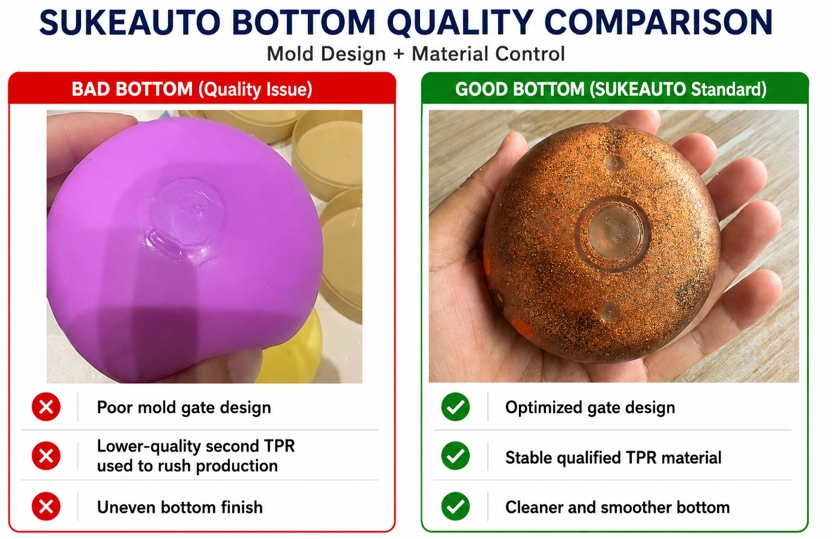
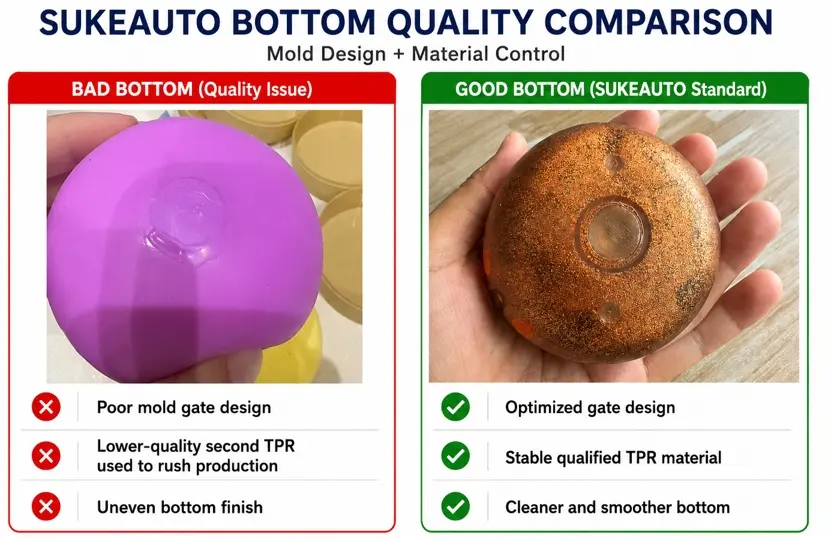
Turn a squishy over. The bottom is where the material enters the mould (the gate), and it tells you how the piece was made. With a poorly placed gate, or second-grade TPR used to rush production, you see injection marks, rough edges and an uneven finish. We design gate positions carefully, use stable, qualified TPR, and inspect bottom appearance before shipment.
Wall Thickness and Leak Checks
We hold a minimum wall of about 2.8 mm and squeeze-test filled items from each batch for leaks before packing. See why some squishies leak, cloud or turn sticky.
Colour and Print Consistency
Colour is checked against the sealed sample and recorded Pantone references; logos are checked for position, sharpness and adhesion.
Counts, Cartons and Packing
Pieces per inner pack, packs per display, displays per carton, carton marks and the packing list — counted and matched before dispatch.
Video Inspection Before the Balance
Every order gets 100% inspection before dispatch. Before you pay the balance, we open cartons and film your actual goods — unpacking, then squeezing and stretching several randomly chosen pieces, not just one — with photos of the product, packaging and outer cartons. You approve from what you see. If you prefer, appoint a third-party inspector; their fee is yours.
Keeping Reorders Consistent
The approved sample and colour standard from your first order stay on file. Reorders run on the same mould, with the same material grade, matched to that standard.
What Buyers Ask SUKEAUTO About Quality
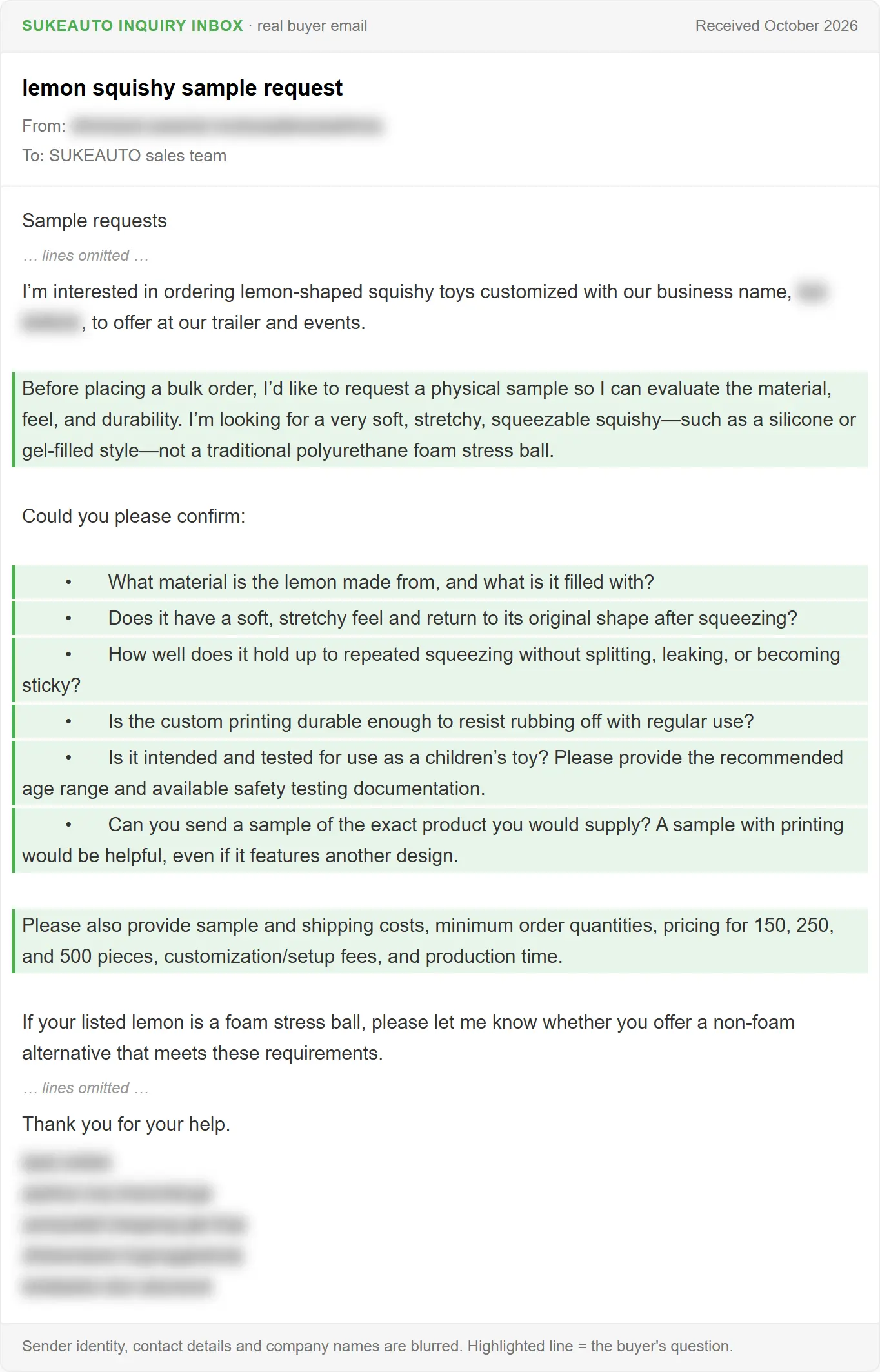
Buyers who have had problems before ask the most detailed quality questions: what the material is, whether it returns to shape, how it holds up to repeated squeezing without splitting, leaking or turning sticky, whether the print will rub off, and whether it is tested for children.
The Four Inspection Stages Used in the Toy Industry
| Stage | When | What it catches |
|---|---|---|
| Pre-production check | Before the run | Wrong material, colour or packaging before anything is made |
| During-production check | Roughly 20–80% complete | Drift in colour, print position, wall thickness |
| Pre-shipment inspection | 100% produced, at least 80% packed | Defects in finished, packed goods |
| Container loading check | At loading | Counts, carton condition, correct marks |
Independent inspectors classify defects as critical (safety or legal risk), major (affects function, durability or saleability) and minor (small cosmetic issues), and commonly sample under ISO 2859-1 with levels such as 0 for critical, 2.5 for major and 4.0 for minor defects. Sampling must be random — not pieces chosen by the factory.
What SUKEAUTO Checks on Every Order
- Material — qualified TPR with stabilisers, checked on arrival.
- Moulding — wall thickness, gate position, flash, bottom finish.
- Filling and sealing — fill amount, seal integrity, squeeze check on filled items.
- Decoration — colour against the approved sample, print position and sharpness.
- Packing — counts, pack condition, carton marks.
Every order is 100% inspected before packing, and you receive a video of your actual goods before paying the balance.
Booking Your Own Inspection
Many buyers appoint an independent inspector. To make it useful, give the inspector the approved sample photos, the product specification, the packaging artwork, the AQL levels you want and the safety points to check. Book it when production is complete and most cartons are packed, and tell SUKEAUTO the date so the goods are ready.
Common Defects and What They Mean
- Rough bottom or visible gate marks — rushed moulding or low-grade material.
- Tacky surface — oil migrating from a low-grade compound, or heat in storage.
- Leak at the seal — weak sealing or overfilling.
- Colour patch — uneven mixing or a material change.
- Print offset — jig or plate movement during the run.
More Quality Questions
Can SUKEAUTO show me the bottom finish before I order? Yes — SUKEAUTO shares close-up photos and video of bottoms from current production.
Can my inspector visit the factory? Yes, at your cost; tell us the date.
What AQL does SUKEAUTO work to? Every order is 100% inspected; if you use an inspector, agree the AQL levels in your order.
What happens if goods fail inspection? Failed pieces are reworked or replaced and re-inspected before shipment.
How do you keep reorders consistent? Each reorder is checked against the approved sample kept from the first order.
Do you test seals on filled squishies? Filled items are squeeze-checked for leaks as part of the 100% inspection.
How AQL Sampling Works
Most pre-shipment inspections use AQL sampling, based on ISO 2859-1 (also published in the US as ANSI/ASQ Z1.4). The inspector picks a random sample from the finished goods, checks every piece in the sample, and accepts or rejects the whole lot based on how many defects are found. Three points are worth knowing:
- Defects are graded. Critical defects are safety or legal problems; major defects affect function, durability, appearance or saleability; minor defects are small workmanship issues.
- Each grade has its own limit. A common toy setting is zero critical, 2.5 major and 4.0 minor, though buyers set their own limits.
- Samples must be random. The inspector chooses the pieces, never the factory.
Sampling decides whether a lot is acceptable; it does not decide what to check. The checklist — dimensions, colour, print, seals, labels, barcodes, safety points — is a separate document the buyer approves.
Safety Points Inspectors Check on Toys
Inspection companies treat a few toy issues as critical every time:
- Small parts — attached eyes, accessories and loops pulled and twisted; anything that comes off is checked against the small-parts cylinder.
- Sharp edges and points — especially at gates and parting lines.
- Age grading and warnings — consistent on the product, the pack and the instructions, in the right language.
- Barcodes — every sampled barcode must scan.
Preparing for an Inspection
An inspection goes smoothly when the inspector has the right references: the purchase order, the approved sample, the colour standard, the packaging artwork, the label files and your checklist. Send these to the inspection company in advance, and agree what happens if a lot fails — rework, re-inspection or a documented deviation.
Quality Records You Should Receive
After each order, a clear record makes the next one easier. Useful items to keep for every production run:
- The approved sample: sealed, labelled and stored as the reference.
- Inspection photos or video: showing the product, the printing, the packing and the cartons.
- Carton marks: including any batch or order reference.
- Test reports: current for the product line and your market.
- Any agreed deviations: written down, so they are not repeated or forgotten.
With these records, a reorder months later starts from facts instead of memory, and any question from a retailer or marketplace can be answered quickly. SUKEAUTO keeps its own records of your approved sample, artwork and inspection results for every reorder.
What happens if a lot fails inspection? The lot is reworked or replaced and re-inspected before shipping; SUKEAUTO does not ship a lot that failed your agreed limits.
Can I use my own inspection checklist? Yes, send it in advance so the inspector and SUKEAUTO work from the same list.
Do you inspect stock orders as well as custom orders? Yes, every order is checked and packed against the order list before it leaves SUKEAUTO, whatever its size.
Defect Classes for Squishies
Inspectors sort defects into three classes, and each class has its own tolerance. For squishies, a practical split looks like this:
| Class | Meaning | Squishy examples | Usual tolerance |
|---|---|---|---|
| Critical | Could cause harm or break the law | Parts that detach and fit the small-parts cylinder, sharp edges or flash, missing age grading or required warnings, wrong or missing tracking label | Zero |
| Major | Affects use or saleability | Leaks, a sticky or oily surface, wrong colour against the approved sample, missing or badly smeared print, crushed or misshapen pieces, wrong count | Low |
| Minor | Cosmetic only | Small marks, slight trim marks, minor pack scuffs | Higher |
Critical defects are never accepted. The tolerances for major and minor defects are set by the AQL levels agreed before inspection.
How a Sampling Inspection Works
Most pre-shipment inspections use an international sampling standard such as ISO 2859-1 or ANSI/ASQ Z1.4:
- Lot size decides sample size. The inspector looks up how many pieces to check for the order quantity, usually at general inspection level II.
- Cartons are chosen at random from across the shipment, not from the top of the stack.
- Each sampled piece is checked against the approved sample and the checklist.
- Defects are counted by class and compared with the accept and reject numbers for the agreed AQL.
- The report records the sample size, inspection level, AQL, defects found and photos.
Before Your Inspector Arrives
If you book a third-party inspection, a little preparation avoids wasted visits:
- Confirm the address matches the factory producing your order, so the inspection is done where your goods are.
- Send the inspector the approved sample photos, the artwork and the packing details.
- Agree the checklist in advance: feel, weight, colour, print, leak check, carton marks and labels.
- Make sure goods are packed to the agreed level, usually most of the order finished and packed, so the sample is representative.
What Happens When an Inspection Fails
A failed inspection is not the end of an order. The usual path:
- The report lists the defects and how many were found.
- The factory proposes a fix, such as sorting, rework or replacement, and you agree it in writing.
- The goods are re-inspected after the fix.
- Once they pass, the balance is paid and the goods ship.
Agree before the inspection how re-inspection will be handled, so a failure does not turn into a dispute.
Key Terms
- AQL (acceptance quality limit) — the defect rate used to decide whether a sampled lot passes.
- Inspection level II — the standard level that sets sample size for most inspections.
- Critical / major / minor defect — classes of defect by seriousness.
- Re-inspection — a second inspection after rework.
Does SUKEAUTO inspect every order? Yes. Every SUKEAUTO order passes a 100% pre-shipment inspection, and you receive photos and video before paying the balance.
Can I send my own inspector as well? Yes. SUKEAUTO welcomes a third-party inspection booked by the buyer before shipment.
What does SUKEAUTO check on a squishy? SUKEAUTO checks feel, colour and print against the approved sample, looks for leaks and stickiness, and confirms counts, labels and carton marks.
Sources: SUKEAUTO inquiry inbox — 408 squishy buyers by email and WhatsApp, July–October 2026 · ISO 2859-1:2026 sampling by attributes (AQL) · ECQA: toy inspection checklist and process · UTS Inspection: toy inspection.
Want a sample to judge our finish yourself? See the sample policy. Related: squishy odour checks. Back to custom squishy toy manufacturer.
Send Your Inquiry
Tell us the style, quantity, logo or packaging you need and your target date — we reply with the right route and a price range.
Leave A Comment