
A leaking squishy in a customer’s hand is the fastest way to lose a retail account. Buyers who have been burned before ask us directly: “Will it split, leak or get sticky?” Here are the real causes and what SUKEAUTO does about each.
1. Thin or Uneven Walls
The skin is thinnest where the mould gate sits and where the shape stretches most. If the wall is too thin there, repeated squeezing opens a split. We keep a minimum wall of about 2.8 mm and review gate position before cutting any new tool.
2. Weak Seals
Filled squishies are closed after filling. A seal that is too narrow, contaminated with fill, or cooled too fast is where most leaks start. Oil-filled styles are permanently sealed, and filled items are squeeze-tested from each batch before packing.
3. Second-Grade Material
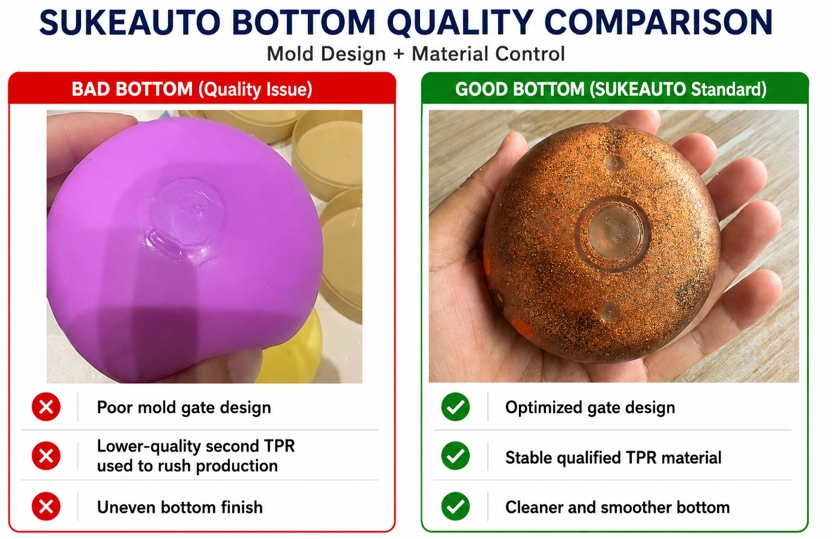
Cheap TPR is the main cause of stickiness, odour and “sweating”. It also shows on the bottom: visible injection marks, rough edges and an uneven finish. We use stable, qualified TPR with UV, oxidation and heat-resistance additives as standard, and inspect the bottom finish before shipment.
4. Heat and Storage
TPR softens with heat. Sealed in its original packaging, out of direct sunlight and at normal room temperature — ideally below 30 °C (86 °F) — a TPR squishy stays unchanged for a year or more; it is a toy, not a food, and has no expiry date. On long summer sea transits, ask your forwarder to avoid the hottest container positions.
Why “Clouding” Happens in Clear Squishies
Clear fills can cloud when moisture or a mismatched fill reacts with the skin, or when the fill is too thin and glitter settles. Matching fill viscosity to the skin, and using fills that keep glitter suspended, keeps cubes and balls clear.
What We Can and Can’t Prove
We can show a video of the material being squeezed, stretched and pulled hard, and film your actual goods before the balance is paid. We do not hold accelerated-aging data for this compound; if you need formal aging data, it is arranged through a third-party lab of your choice.
Further reading: squishy fillings and feel · squishy quality checks · durability and care.
What Buyers Ask SUKEAUTO About Leaks and Durability
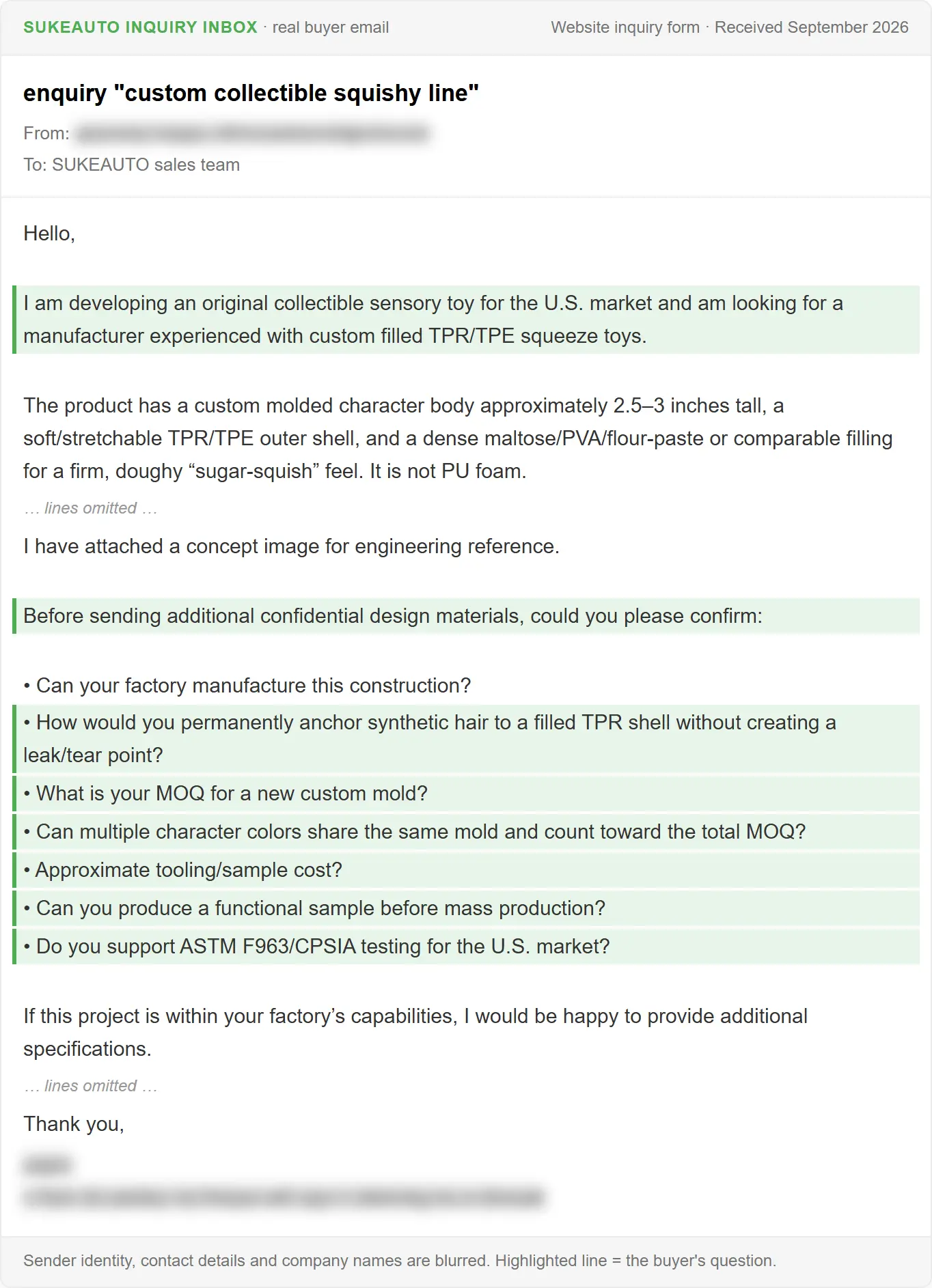
Buyers who have had a bad batch before ask the most precise questions. Between July and October 2026, 16 squishy buyers asked SUKEAUTO about durability and 26 about safety, and many of them were developing their own filled characters. They ask how a seam is closed, how an attachment avoids becoming a weak point, and what the factory checks before shipping.
The Failure Map: Where Squishies Go Wrong
| Symptom | Usual cause | Where it starts |
|---|---|---|
| Leak | Thin wall, weak seal, air trapped at the closure, overfilling | Corners, thin limbs, the fill point |
| Sticky or oily surface | Oil-extended low-grade TPR, heat and humidity in storage | Whole surface, worst after warm transit |
| Strong smell | Material residues, an unstable fill, or inks and glues in the packaging | Opening the sealed pack |
| Cloudy clear skin | UV light, heat, dust, oil bloom on the skin | Clear cubes and balls |
| Cracks after use | Low-grade blends, thin knit lines, squeeze fatigue | Flex zones and seams |
Most of these start long before final inspection, in the material choice and the mould design. That is why SUKEAUTO looks at gate position and wall thickness before cutting a tool and uses stable, qualified TPR with UV, oxidation and heat-resistance additives as standard.
How Factories Commonly Check for Leaks
Common checks in the squishy industry include:
- Squeeze test on absorbent paper after filling — any seepage shows immediately.
- Repeated press testing of samples to see where cracks start and whether rebound drops.
- Temperature cycling — warm and cool cycles to mimic transit and storage.
- Bottom and seam inspection — injection marks, rough edges and uneven bottoms point to rushed moulding or second-grade material.
At SUKEAUTO every order is 100% inspected before packing, and filled items are squeeze-checked for leaks.
Heat, Containers and the Long Way to Your Warehouse
A sea container can be cool at night and very hot by day, with condensation inside — conditions that soften TPR and push oil to the surface. Good transit practice for squishies:
- Each piece sealed in its own bag; gel and oil fills always bagged.
- Rigid export cartons, packed so the pieces are not compressed.
- Keep finished goods away from heat sources in your warehouse.
- In summer, ask your forwarder to avoid the hottest container positions.
Sealed in its original packaging, out of direct sunlight and at normal room temperature — ideally below 30 °C (86 °F) — a TPR squishy stays unchanged for a year or more.
Custom Characters: Designing Out the Leak
When the design is yours, the strongest protection is in the drawing: avoid very thin limbs on filled bodies, keep attachment points away from the filled area, and give seams enough wall. Synthetic hair, loops and accessories need a reinforced anchor that does not pierce the filled cavity. SUKEAUTO reviews these points on your 3D file before tooling.
More Durability Questions
Do SUKEAUTO squishies have an expiry date? No. A squishy is a toy, not a food; stored as above it keeps its look and feel.
Can you guarantee a number of squeezes? We don’t publish a squeeze count; ask for a sample and test it in your own conditions.
Is a sticky squishy dangerous? Stickiness is a material-quality problem — test reports for the exact material are what show the toy is compliant.
Will a leak spoil a whole carton? No — SUKEAUTO packs filled items in individual sealed bags, which keep one damaged piece from affecting the rest.
Do clear squishies always cloud eventually? Storage is the main factor: cool, dark and dry keeps clear skins clear far longer.
Can I see how your material behaves before ordering? Yes — SUKEAUTO can share a video of the material being squeezed, stretched and pulled hard, and you can order samples.
A Receiving Checklist for Squishy Shipments
When a squishy shipment arrives, a quick check in the first days tells you whether storage and transit treated it well:
- Open one carton per item and look at the inner bags: they should be dry, with no oily film.
- Squeeze a handful of pieces from each item over a sheet of paper; any seepage shows immediately.
- Check bottoms and seams for rough edges, splits or injection marks.
- Smell an opened bag — a strong smell points to material or packaging issues and should be photographed.
- Check clear items for clouding and note whether the cartons were stored warm.
- Photograph anything unusual with the carton label visible and send it to SUKEAUTO straight away.
How to Store Squishy Stock
- Keep cartons off the floor and away from heaters, skylights and sunny windows.
- Don’t stack cartons so high that the bottom ones are crushed — slow-rise foam takes the shape it is pressed into.
- Keep pieces in their sealed bags until they go on display.
- Rotate stock: first in, first out.
Good storage keeps a squishy looking new on the shelf, and it is the easiest quality step a buyer controls.
The Short Version
Leaks, stickiness, smells and clouding almost always trace back to three things: the material grade, the wall and seal design, and heat during transit and storage. Choose a supplier that controls the first two, and protect your stock from the third.
Why Squishies Turn Sticky: The Chemistry
A soft squishy is soft because its polymer is blended with oils or softeners. Those small molecules are not locked in place. Over time, and much faster in heat, some of them move to the surface. That is the tacky, slightly oily feel that collects dust and makes a squishy stick to its bag.
How quickly it happens depends on:
- The size of the oil molecules. Smaller, lighter oils move faster than heavier ones. Cheap industrial oils tend to migrate faster than refined grades.
- The base polymer. Well-made soft compounds use a base that holds oil tightly; poorer ones let it seep.
- Temperature. Migration speeds up sharply in heat. A container crossing the equator or a delivery van in summer can do months’ worth of ageing in weeks.
- Pressure. Tightly packed or heavily stacked squishies push oil to the surface where they touch.
The Powder Trick
Some suppliers dust squishies with powder or starch before packing. It makes a sticky surface feel dry for a while, and the buyer sees a white film when the goods arrive. Powder hides the symptom; it does not stop the oil. If samples arrive powdered, ask why.
What US Regulators Tell Consumers to Look For
In August 2026 the US Consumer Product Safety Commission warned about fake and non-compliant squishy toys. It reported 55 shipments of violative squishies stopped at US ports, totalling 355,683 units, and told consumers to stop using any squishy that:
- has an unknown manufacturer or lacks required safety information;
- has a strong chemical smell;
- feels oily or unusually sticky;
- is leaking;
- can be torn apart easily.
Those are exactly the signs a buyer should check on samples and on arrival, because they are the signs your customers will notice.
A Simple Heat Check for Samples
You can get an early warning without a laboratory:
- Put one sample in a sealed bag on a sheet of plain paper.
- Leave it somewhere warm, such as a sunny windowsill or near a heater, for a few days.
- Compare it with a sample kept at room temperature.
- Look for oil marks on the paper, a tacky surface, cloudiness in clear skins and any seepage at seams.
A piece that stays clean and dry through this is a good sign. A piece that marks the paper in days will not survive a hot summer shipment.
Packing and Transport Habits That Reduce Sticking
- Individual bags stop pieces touching each other.
- Moderate carton weight and stacking avoids crushing the bottom layers.
- Cool, shaded storage at both ends of the journey.
- First in, first out, so no carton sits through two summers.
Key Terms
- Oil migration — oils moving from inside a soft material to its surface.
- Tackiness — a sticky surface feel caused by migrated oil.
- Clouding — haze in a clear skin, often from moisture or migrating oil.
- Seepage — liquid or oil escaping at a seam or seal.
How are SUKEAUTO squishies packed? Most SUKEAUTO stock items are packed one piece per bag or box, which keeps pieces from touching in transit.
What should I do if a delivery feels sticky? Send SUKEAUTO photos with the item number and batch, and store the remaining stock cool and out of the sun.
Can heat damage squishies in transit? Yes. SUKEAUTO recommends planning summer shipments with cool storage at arrival.
Sources: SUKEAUTO inquiry inbox — 408 squishy buyers by email and WhatsApp, July–October 2026 · China Shipowners’ Association on container heat and condensation (Chinese) · CPSC: warning about fake and counterfeit squishy toys (August 2026).
Had leaks with a previous supplier? Send us the item and we’ll tell you what we’d change. Back to custom squishy toy manufacturer.
Send Your Inquiry
Tell us the style, quantity, logo or packaging you need and your target date — we reply with the right route and a price range.
Leave A Comment