“Will the logo rub off?” is one of the first questions brand and promotional buyers ask SUKEAUTO, and logos and private label are among the most-asked topics in our squishy inbox. A squishy gets squeezed thousands of times, so the method matters more than on a pen or a mug. Here are the options we run, with their honest trade-offs.
Pad Printing and Silk Screen on Soft Surfaces
Pad printing transfers ink from an etched plate to the squishy through a soft silicone pad, so it follows curves — ideal for small logos on round shapes. Silk screen pushes ink through a mesh and suits flat areas and larger artwork. On our existing TPR moulds, logos are pad-printed; no logo mould is needed. For full-colour designs on dumplings we can also spray-paint, with no fixed limit on the number of colours.
Printing Inside vs Outside the Skin
This is the decision that decides durability:
- Printed inside the TPR (recommended). The logo sits under the transparent skin, protected from hands and friction. It does not rub off.
- Printed on the outer skin. It costs a little less, but a logo on the surface of a squeeze toy wears and fades with squeezing and handling. We always say so before you choose it.
Both are 5,000 pcs per design on our existing moulds, with no logo-mould fee; each adds a per-piece print cost on top of the item price. “No logo mould” does not mean the logo is free — and it is the inside print, not the lack of tooling, that makes it last.
Debossed and Moulded Logos
A raised or recessed logo is formed in the TPR itself and needs its own logo mould. That route is 10,000 pcs per design plus a separate logo-mould fee. It gives a premium, tactile result and never wears off, so we suggest it only when a buyer specifically wants a 3D logo and the volume supports it.
Why Logos Peel — and How to Avoid It
Logos fail for three reasons: the print sits on the surface, the ink doesn’t suit the material, or the logo is placed on the area that gets squeezed hardest. The fixes are the same three in reverse — print inside the skin, use ink matched to TPR, and place the logo on a low-stretch area. For PU foam squishies, faces and graphics are applied as printed transfers bonded with a tested adhesive layer so they do not peel or wrinkle over time.
Minimum and Cost by Method
| Method | Minimum | Tooling | Durability |
|---|---|---|---|
| Logo on packaging only | 5,000 per design | None | n/a (product stays plain) |
| Pad print inside TPR | 5,000 per design | None | Does not rub off |
| Pad print on outer skin | 5,000 per design | None | Fades with squeezing |
| Moulded / debossed logo | 10,000 per design | Logo-mould fee | Permanent |
Relative cost, lowest to highest: outer-skin print, inside print, moulded logo.
Two-Sided Prints, Names and Slogans
Each side counts as its own print position, so two sides means two print set-ups. Names and slogans work best short and bold — very thin strokes blur on soft material. Send your file as vector artwork; see logo files for printing on squishies.
What Buyers Ask SUKEAUTO About Logos
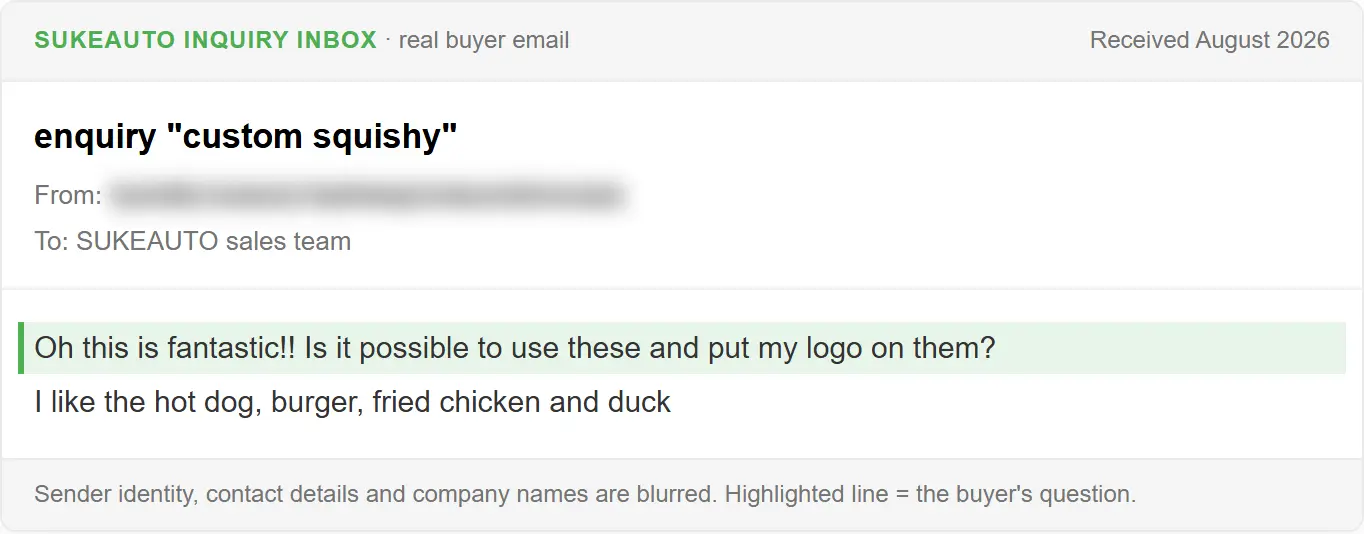
73 of the 408 squishy buyers who wrote to SUKEAUTO between July and October 2026 asked about logos or private label, with a peak of 31 in September as promotional and brand buyers prepared for the holiday season. Most of them ask in one line — can you put my logo on these? — and the real questions follow once they see the options:
- Will the logo rub off when the squishy is squeezed?
- Can it go on the squishy, on the packaging, or both?
- Can it be raised or moulded into the shape?
- What file do you need?
Why Logos Fail on Soft Toys
Printing on a squishy is harder than printing on a mug because the surface stretches every time it is squeezed. Logos fail for four reasons:
- Incomplete curing — the ink looks fine on day one and softens weeks later.
- Untreated surface — soft TPR and PU have low surface energy; ink needs a matched system or surface preparation to grip.
- Ink that cannot stretch — an ink film less flexible than the toy cracks when the toy is compressed.
- Migration and blocking — residues in soft materials can soften the ink or make printed faces stick to bags and to each other.
That is why SUKEAUTO recommends printing inside the transparent TPR skin: the ink is protected under the skin and the squeezed surface never touches it.
Each Method in More Detail
Pad printing lifts ink from an etched plate with a soft silicone pad, so it follows curves and fits small logos and fine lines on round shapes. Multi-colour logos need one plate per colour and careful registration.
Screen printing pushes ink through a mesh and lays a thicker film, good for flat areas and solid colour blocks, but less suited to tight curves.
Spray painting covers larger areas, gradients and full-body colour, and on our dumplings has no fixed limit on colours — ideal for a mascot face or a rainbow finish.
Moulded or debossed logos are formed in the material itself. Nothing can rub off, but the logo needs its own mould: 10,000 pcs per design plus a logo-mould fee.
How Logo Durability Is Tested
Simple, repeatable tests tell you more than a photo:
- Cross-cut and tape test (methods such as ASTM D3359 or ISO 2409) for ink adhesion.
- Rub test (for example ISO 105-X12) for dry and wet rubbing.
- Repeated squeeze test — compress the printed area many times and check edges for cracking or lifting.
- Warm storage test — keep printed pieces packed together in a warm room and check for sticking.
Test standards give methods, not pass marks, so agree the pass level with SUKEAUTO and write it into the approved sample.
Preparing Your Logo File
- Vector artwork: AI, EPS or PDF; no JPG or PNG for plates.
- All fonts converted to outlines.
- Pantone references for each colour, plus a note that colours on soft TPR are matched as closely as the material allows.
- One layer per colour.
- A placement drawing showing where and how big the logo sits.
Details are on our page about logo files for printing on squishies.
More Logo Questions
Does SUKEAUTO charge a logo mould for printing? No. Printed logos on our existing moulds need no logo mould; only moulded logos do.
Can I put a different logo on each colour? Each artwork counts as its own design with its own 5,000-piece minimum.
Can my logo go on both the squishy and the box? Yes; at SUKEAUTO each is its own set-up, and each follows the 5,000 per design rule.
Will the logo colour match my brand exactly? SUKEAUTO matches to your Pantone reference and confirms it on the sample.
How small can a printed logo be? Very fine lines blur on soft material; keep strokes bold and text short.
Can you print a different name on each piece? Not on a production run — every piece in a run carries the same artwork.
A Quick Decision Guide
- You want the logo to last as long as the toy → print inside the transparent TPR skin.
- You want the lowest cost for a short promotion → outer-skin print, accepting it will fade with heavy use.
- You want a premium, tactile logo and have the volume → moulded or debossed logo at 10,000 per design.
- You want the toy itself to stay plain → put the logo on the packaging, from 5,000 per design.
Printing Defects on Soft Toys and What Causes Them
Soft TPR and PU surfaces are harder to print than rigid plastic. These are the defects buyers see most, and their usual causes:
| Defect | What it looks like | Usual causes |
|---|---|---|
| Peeling or rubbing off | Print lifts with a fingernail or wears off after a few squeezes | Release agent or oil left on the surface; ink made for rigid plastic; ink not fully cured |
| Ghosting | A faint double image beside the print | Worn pad or loose screen; too much gap between screen and surface |
| Misregistration | Colours in a multi-colour logo do not line up | The jig locates on the soft outline instead of a firm reference point |
| Fuzzy edges | Lines look jagged or blurred | Wrong screen mesh, ink too thin, too little squeegee pressure |
| Cracking | Print splits when the squishy is stretched | Ink not flexible enough for a stretchy material |
The fix is rarely more ink. It is the right ink for soft material, a clean surface, the right curing time and a jig that holds the squishy firmly in the same place every time.
The First-Piece Check Before a Print Run
Before a run starts, the first printed pieces are checked step by step:
- Warm up with a few test prints so the ink flows evenly, then print the first pieces for checking.
- Registration — overlay each colour; misalignment should be within a fraction of a millimetre.
- Ink film — even coverage, no thin patches, no ink build-up at the edges.
- Adhesion — a fingernail scratch and a pressed-on tape strip pulled off sharply; the print should stay on.
- Dry and clean — no tackiness, smudging, pinholes, bubbles or stringing.
The approved first piece is dated and kept at the line, and each shift compares its output against it.
Why Curing Time Matters
Many inks used on soft toys reach full adhesion only after curing, sometimes a full day at room temperature or a shorter time with heat. A print that passes a scratch test straight off the line can still be soft underneath. Durability tests should be done after curing, and goods should not be packed tightly while the ink is still fresh.
Two Tests Worth Asking For
- Cross-cut and tape test. A small grid is cut through the print and tape is pulled off; very little ink should come away.
- Alcohol rub test. A cloth with alcohol is rubbed back and forth over the print many times. This matters because customers and shop staff clean toys with wipes. A print that passes the tape test but fails the alcohol rub will fade on the shelf.
Why Printing Inside the Skin Lasts Longer
On SUKEAUTO’s TPR squishies, a logo can be printed on the outer skin or inside the TPR. On the outside, every squeeze rubs the print against hands and pockets; inside, the clear skin protects it. That is why SUKEAUTO recommends the inside print for anything that will be handled a lot, and says plainly that an outer-skin print fades with heavy handling.
Key Terms
- Pad printing — transferring ink from an etched plate to the product with a soft silicone pad; good for curved surfaces.
- Screen printing — pushing ink through a mesh screen; good for flatter areas and strong colour.
- Jig — the holder that keeps each piece in the same position for printing.
- Registration — how accurately the colours of a print line up.
- Curing — the period in which ink reaches full hardness and adhesion.
Can SUKEAUTO print a logo in several colours? Yes, multi-colour logos are printed one colour at a time; SUKEAUTO recommends simple artwork for soft surfaces.
How is logo durability checked before shipping? SUKEAUTO checks adhesion on first pieces and during inspection; tell us if your market expects a specific rub test.
Which logo method lasts longest? On SUKEAUTO TPR squishies, the print inside the skin, or a moulded logo for very large runs.
Sources: SUKEAUTO inquiry inbox — 408 squishy buyers by email and WhatsApp, July–October 2026 · ASTM D3359 tape adhesion test · ISO 2409:2020 cross-cut test.
Want the logo on the packaging instead? Compare the options on branded packaging for squishies. Back to custom squishy toy manufacturer.
Send Your Inquiry
Tell us the style, quantity, logo or packaging you need and your target date — we reply with the right route and a price range.
Leave A Comment