
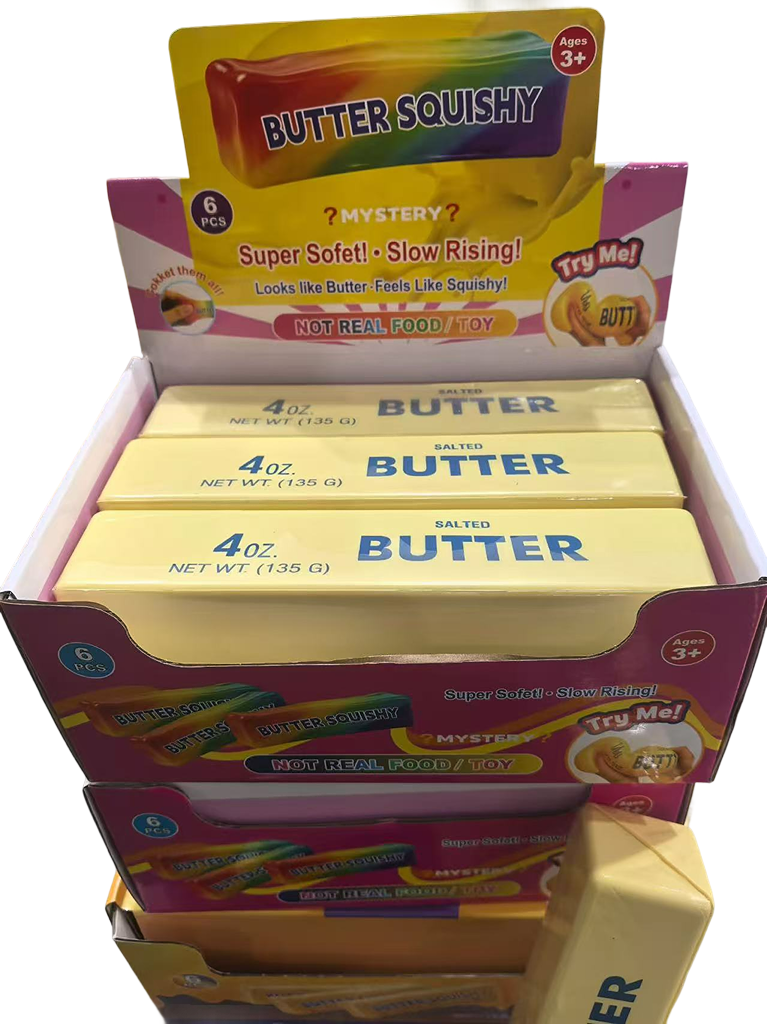
Branding the packaging keeps the squishy itself plain and puts your name where shoppers read first. At SUKEAUTO it’s the most flexible way to make stock squishies yours — and a different design per season or event is easy.
Branding on the Packaging vs on the Squishy
Both start at 5,000 pcs per design on our existing moulds, with no tooling fee.
- On the packaging: the squishy stays plain; you change bags, cards, boxes and belly bands. Easy to switch themes or campaigns.
- On the squishy: pad-printed inside the TPR so it doesn’t rub off. The brand stays with the product after the pack is thrown away. See squishy logo printing methods.
Printed Header Cards and OPP Bags
A header card across the top of an OPP bag carries your brand, product name, warnings and barcode and gives the pack a hang hole for peg displays. A fully printed bag is cleaner still for retail.
Belly Bands, Colour Boxes and Display Boxes
A paper belly band around a steamer box or a gift box is a quick way to brand food shapes. Colour boxes suit gifting; 12-piece display boxes put your brand at the till. For clear ice cubes, we draw single colour boxes (58 × 58 × 58 mm) and a 12-box display to your project. A four-pack retail box in your design on our dumpling mould starts at 5,000 pcs with a one-time packaging set-up fee.
Minimum: 5,000 pcs per Design, No Tooling Fee
One design = one artwork. A second artwork is a second design with its own 5,000. Below 5,000, logo work doesn’t run — the alternative is plain stock items at their own carton minimums. See squishy minimum order quantity.
Artwork and Proof Approval
We send dielines with cut lines, bleed and folds marked. Your designer lays the artwork on them in vector or high resolution; we print a proof for your approval, matching Pantone colours across the box print. Required warning text and barcodes come from you for your market. See logo files for printing on squishies.
What Buyers Ask SUKEAUTO About Branded Packaging
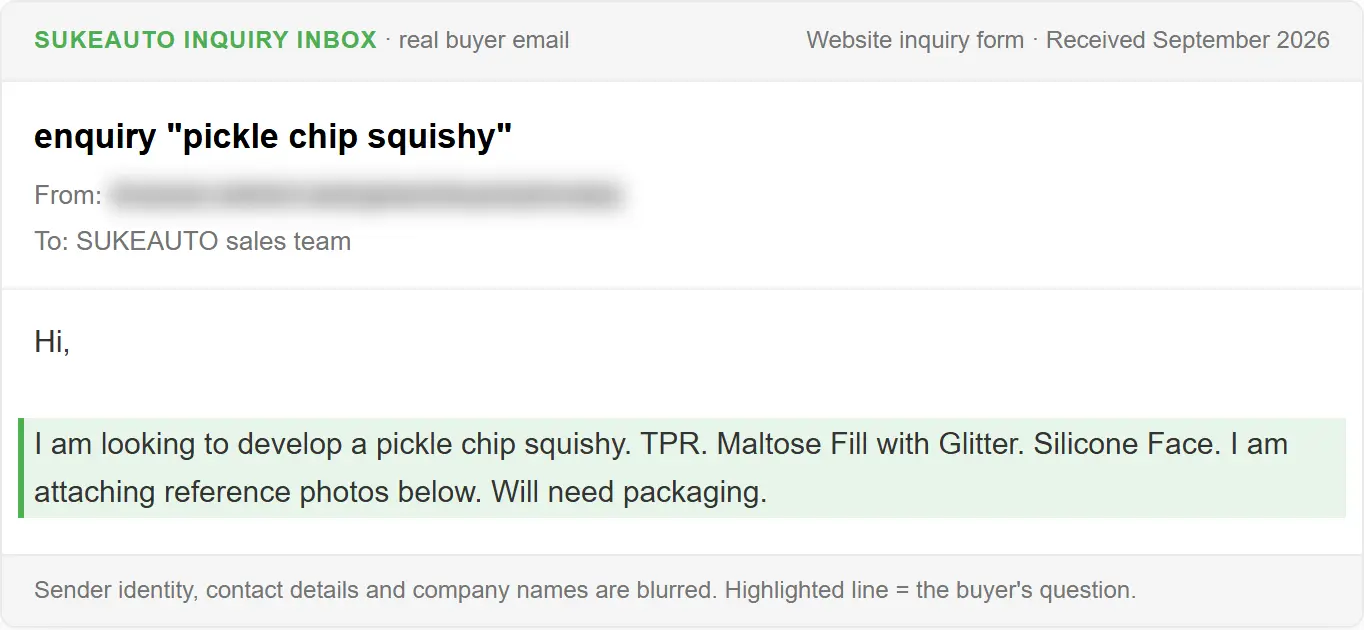
Branded packaging is often the first step from a stock product to a brand. 92 of the 408 squishy buyers who wrote to SUKEAUTO between July and October 2026 asked about packaging, and many of them combined it with a product request: a squishy they had designed, a fill they wanted, and “will need packaging”.
Packaging That Works as Hard as the Product
Good squishy packaging does four jobs at once:
- Sells — shows the product or its character, and says what it is in one glance.
- Protects — keeps the shape, keeps dust off, and keeps filled items sealed.
- Informs — age grade, warnings, importer details, barcode and country of origin.
- Ships — fits the carton and the shelf without wasted space.
Formats Compared
| Format | Best for | Notes |
|---|---|---|
| Printed OPP bag | Giveaways, online orders | Lowest cost; print one or two colours |
| Header card + bag | Peg hooks in shops | Carries barcode and warnings on the card |
| Belly band | Steamers, food shapes | Uses little material; easy to change per design |
| Window box | Gift and toy shelves | Shows the product; needs an insert for soft TPR |
| Colour box | Premium gifts | Full branding on all sides |
| Display box | Shop counters | 12 pieces ready to sell; branded front panel |
Designing for the Shelf
- Front panel first — product name, brand and one visual cue.
- Back panel for the facts — warnings, age grade, importer, barcode, origin.
- Leave space for marks — CE or UKCA, and room for a future data carrier such as a QR code for EU digital product passports.
- One common box, many products — a single box design with a changeable sticker or insert keeps minimums manageable across a range.
Greener Choices
Retailers increasingly ask for less plastic. Paper belly bands, card boxes without plastic windows, single-material packs and FSC-certified board are the usual steps. Tell SUKEAUTO your retailer’s packaging manual and we match it on the dieline.
From Artwork to Printed Pack
SUKEAUTO sends the dieline, you place your artwork with bleed and named spot colours, SUKEAUTO checks it and sends a proof on the dieline, then a printed sample for approval. The approved pack becomes the standard for production and reorders.
More Branded Packaging Questions
What is the minimum for branded packaging at SUKEAUTO? 5,000 pcs per design, with no tooling fee; fully custom boxes carry a one-time packaging set-up fee.
Can SUKEAUTO print barcodes on my packaging? Yes — send the barcode number or file and SUKEAUTO places it to scanner-friendly size.
Can one design cover several squishy styles? Yes, with a changeable sticker or insert — the most economical route for a range.
How long does printed packaging take? It runs alongside product sampling and production.
Can I see my box before production? Yes — SUKEAUTO sends a proof on the dieline, then a printed sample.
Do you offer eco packaging? Paper bands and plastic-free boxes are available; ask about your retailer’s requirements.
Europe’s New Packaging Rules
Packaging sold in the EU is moving to a single, stricter regulation: the Packaging and Packaging Waste Regulation, (EU) 2025/40. It applies from August 2026, with further obligations phased in over the following years. Its direction is clear for anyone printing toy packaging:
- Less empty space — packaging is expected to be sized to the product, with limits on empty space phased in.
- Recyclable by design — packaging is expected to be recyclable, with stricter criteria phased in over time.
- Fewer problem substances — limits on certain substances in packaging, including PFAS in food-contact packaging.
- Clearer labelling — harmonised sorting labels are being introduced.
For squishy buyers selling in Europe, the practical steps are simple: choose packs sized to the product, prefer paper-based or single-material packs, and avoid mixed materials that cannot be separated.
Packaging and Traceability
Packaging also carries the information that keeps a product traceable. In the US, children’s products need tracking information on the product and its packaging where practicable; in the EU, the manufacturer, importer and product identification must appear on the product or its packaging. A good pack design leaves room for:
- Your brand and the importer’s name and address.
- Age grading and warnings in the languages of the market.
- A batch or order reference.
- A barcode that scans first time.
Planning these fields into the artwork from the start avoids last-minute stickers.
Testing Packaging Before Production
Printed packaging gets the same approval steps as the product: a digital proof for content and position, then a physical sample for colour, folding and fit. Check that the squishy slides in and out without catching, that windows do not crush the product, and that cartons protect the packs in transit.
Packaging for Online Sales
Packaging for online orders has different priorities from shelf packaging. The squishy must survive a parcel journey, the pack should not add empty space that raises postage, and the label information must still be complete. A sealed printed bag in a small mailer box often works better online than a large retail window box.
Can SUKEAUTO help adapt my existing pack design? Yes, send the current artwork and SUKEAUTO will check it against the pack size and printing method before the proof.
Barcodes: Getting Them Right the First Time
Retailers and marketplaces scan every unit, so a barcode problem stops goods at the receiving door. The basics:
- Get codes from GS1. Product barcodes (UPC for North America, EAN-13 elsewhere) are issued through GS1 member organisations. Each code is tied to the company that licensed it.
- One code per variant. Every shape, colour, size and pack quantity that is sold separately needs its own code.
- Avoid resold codes. Cheap codes sold online are often registered to another company. When a retailer or marketplace checks the code, the owner does not match your brand and listings can be removed. Chinese market regulators have penalised sellers whose toy barcodes turned out to belong to unrelated food and farming companies.
- Supply the code as a vector file or the number, so the printer generates it at the correct size.
- Place it where it scans: on a flat back or base panel, away from folds, seams and the edge of the lamination, dark bars on a light background, with clear space on both sides.
- Test before the run. A printed sample should be scanned with a real scanner before mass printing.
The Finishing Sequence and Its Traps
Branded boxes are usually printed and then finished in this order: printing, lamination, foil stamping, embossing, spot UV, die-cutting and gluing. Each step has a classic mistake:
| Step | Common mistake | How to avoid it |
|---|---|---|
| Printing | Brand colour built from four-colour process drifts from batch to batch | Print the brand colour as a Pantone spot colour |
| Lamination | Colours look darker after lamination than on the proof | Approve colour on a laminated sample |
| Foil stamping | Foil placed across a fold cracks and flakes when the box is opened | Keep foil a few millimetres away from folds and cut lines |
| Spot UV | Applied before foil, so the foil edge cracks | Apply spot UV after foil |
| Gluing | Glue flap laminated, so boxes open in transit | Leave the glue flap free of lamination |
Why One Supplier for the Whole Pack Helps
Boxes, cards, stickers and bags printed by different suppliers often show three slightly different versions of the same brand colour. When SUKEAUTO produces your squishy and its packaging as one order, the pack components are planned together, checked together at inspection and packed together, so the colours, sizes and labels match on arrival.
Information Your Pack Has to Carry
Which details are required depends on your market, but most branded squishy packs carry:
- Brand and product name.
- Age grading and any choking or small-parts warning.
- The name and address of the manufacturer or brand owner, and the importer or EU or UK responsible person where required.
- A batch or production reference, for traceability.
- Conformity marks for your market, such as CE or UKCA.
- Country of origin.
- The barcode.
Send SUKEAUTO the exact wording for your market, and we place it on the dieline before the proof.
Key Terms
- GS1 — the organisation that issues product barcodes worldwide.
- UPC / EAN-13 — the 12-digit and 13-digit retail barcode formats.
- Quiet zone — the blank space either side of a barcode that scanners need.
- Spot UV — a gloss highlight applied to part of a printed surface.
- Batch reference — a code that links a product to its production run.
Can I use one barcode for all colours? No. Each colour sold separately needs its own code, and SUKEAUTO prints the right code on each variant.
Can SUKEAUTO buy barcodes for me? No. Barcodes must be licensed to your company through GS1, and SUKEAUTO prints the codes you provide.
Will SUKEAUTO scan-test my barcode? Ask SUKEAUTO to scan the printed sample before the run; it is the simplest way to catch a sizing or contrast problem.
Sources: SUKEAUTO inquiry inbox — 408 squishy buyers by email and WhatsApp, July–October 2026 · CPSC: tracking labels for children’s products · EU General Product Safety Regulation (EU) 2023/988 · EUR-Lex: Packaging and Packaging Waste Regulation (EU) 2025/40 · GS1: barcodes and identification keys.
Send your logo, pack type and quantity. Related: squishy packaging options · back to custom squishy toy manufacturer.
Send Your Inquiry
Tell us the style, quantity, logo or packaging you need and your target date — we reply with the right route and a price range.
Leave A Comment