
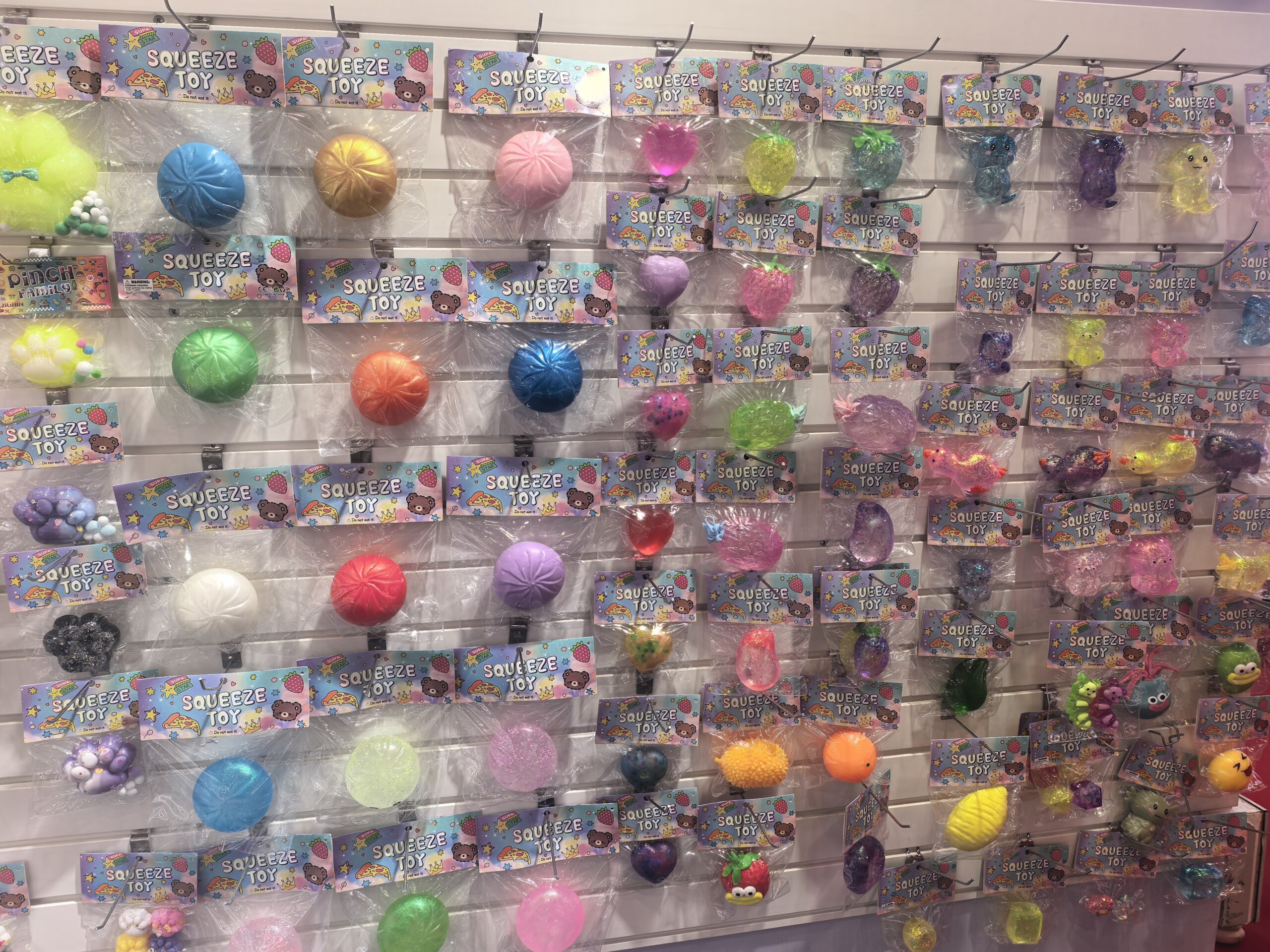
A finished squishy at SUKEAUTO goes through five main stages. Each one decides part of what the buyer feels in the hand — and each is where a cheap squishy cuts a corner.
1. Moulding the Skin
TPR squishies start as TPR compound injected into a steel mould. The mould’s design decides wall thickness (we hold a minimum of about 2.8 mm) and where the gate sits — the point where material enters. A well-placed gate and qualified TPR give a clean, flat bottom; a rushed job with second-grade material leaves injection marks and rough edges. Slow-rise PU squishies are made differently: liquid PU foam expands inside the mould and cures into a soft, airy body.
2. Filling and Sealing
Filled TPR squishies are filled after moulding — with flour dough, jelly, maltose, oil, glitter or flakes — then sealed. The seal is the most common failure point in cheap squishies, so filled items are squeeze-tested from each batch before packing. Oil-filled styles are permanently sealed and come out non-sticky.
3. Spray Painting and Printing
- Spray painting adds colour gradients, cheeks, eyes and full-colour designs — on dumplings there’s no fixed limit to the number of colours.
- Pad printing applies logos and faces, inside or outside the TPR skin.
- Water-transfer printing wraps an all-over pattern around a shape.
- Printed transfers on PU foam, bonded with a tested adhesive layer, carry faces that don’t peel.
4. Embedding Inserts and Confetti
Glitter, snowflake flakes and confetti are mixed into clear fills. A shaped insert — a logo, a character head, a fruit — suspended inside a clear body is custom work that needs its own insert and mould.
5. Checks Between Steps
After moulding: bottom finish and wall. After filling: seal and leaks. After painting: colour against the sealed sample. Before dispatch: 100% inspection, counts, carton marks — and a video of your actual goods before you pay the balance.
What Buyers Ask SUKEAUTO About Production
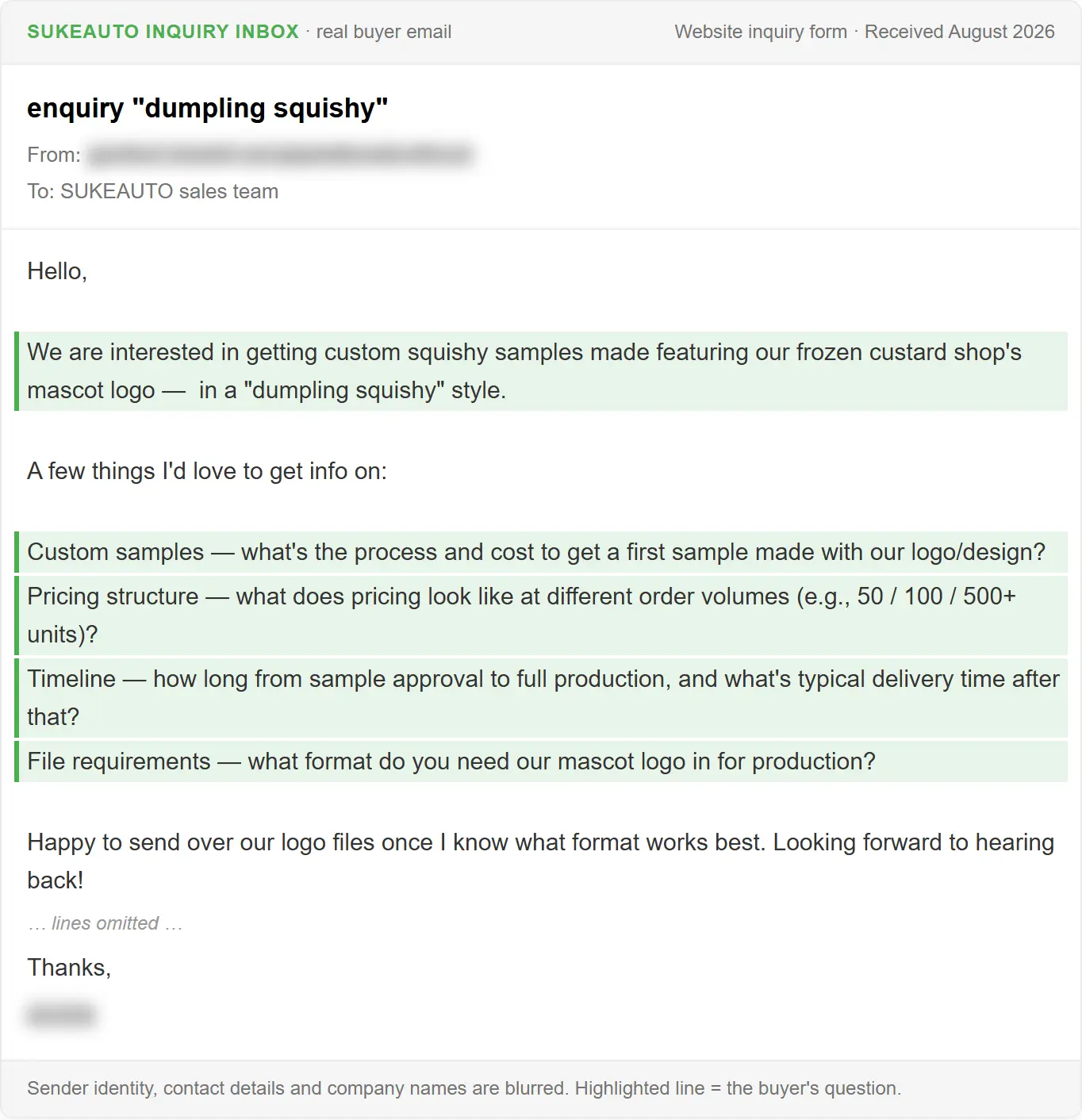
Buyers developing their own squishy often want to understand the process before committing: how a first sample is made with their logo or design, what affects the price at different volumes, how long each step takes and what files we need. Between July and October 2026, 82 squishy buyers asked SUKEAUTO about samples and 110 about custom shapes, and many asked how the work actually happens on the factory floor.
TPR Squishies: From Pellets to Packed Toy
- Drying and colouring. TPR pellets are dried — moisture causes bubbles and silver streaks — and coloured, usually with a colour masterbatch matched to the approved standard.
- Injection moulding. The melted compound is injected into the mould and cooled; the operator watches temperature, pressure and speed, because each affects wall thickness, surface and bottom finish.
- Trimming. Flash at the parting line and the gate is removed so the bottom sits smooth.
- Filling. Filled squishies are weighed to a target fill; too much fill stresses the skin and changes the feel, too little looks flat.
- Sealing. The fill point is closed and the seal checked; filled items are squeeze-tested.
- Decoration. Faces and logos are pad-printed or spray-painted, then cured.
- Inspection and packing. Every piece is checked, bagged and packed.
Slow-Rise PU: From Liquids to Foam
- Mixing. Two liquid components are metered and mixed; water in the mix releases carbon dioxide, which forms the open-cell foam.
- Moulding. The mix is poured into a closed mould, where it rises and cures.
- Resting. Freshly moulded foam rests at room temperature for a day or more so its feel and rebound stabilise; rushing this step leaves a stronger smell and an inconsistent feel.
- Coating and painting. The surface is sealed and painted; details are sprayed or printed.
- Inspection and packing. Slow rise, softness, surface and smell are checked before packing.
Where Quality Is Won or Lost
- Material choice — qualified compound versus cheap blends.
- Mould design — wall thickness, gate position and venting.
- Process control — drying, temperature and cycle time.
- Fill and seal — weight control and seal checks.
- Curing time — for PU foam, patience before painting and packing.
What the Buyer Controls
You decide the material, the target feel, the colours, the print positions and the packaging, and you approve the sample that becomes the production standard. The more precisely these are set at the start, the fewer surprises in production.
More Production Questions
Can I watch my order being made? Yes — SUKEAUTO can arrange a live video tour of the production floor.
How long does a production run take? Logo or custom-colour work runs 20–25 days after the deposit; a new mould 30–45 days after sample approval.
Why does PU need resting time? Freshly moulded foam is still stabilising; resting gives a consistent feel and less odour.
Can you show me filling and sealing? SUKEAUTO can share process videos for stock items.
Do you use recycled material? SUKEAUTO uses qualified TPR with stabilisers as standard.
Where are the moulds made? Moulds are made for your design and used only for your orders.
Common Production Defects and Their Causes
Most squishy defects trace back to a small number of causes, which is why good factories control the process rather than sorting out bad pieces at the end:
| Defect | Usual cause |
|---|---|
| Bubbles or silver streaks on TPR | Moisture in the pellets, or material overheated |
| Sink marks and dents | Uneven wall thickness or not enough holding pressure |
| Flash at the parting line | Too much pressure or worn mould |
| Short shots (missing areas) | Material too cold or injection too slow |
| Sticky or oily surface | Low-grade compound releasing oil |
| Strong smell | Low-grade or recycled material, or overheating |
| Pinholes in PU foam | Moisture in raw materials or mould too hot |
| Foam that collapses | Wrong mixing ratio or not enough catalyst |
| Foam that feels hard and springs back too fast | Wrong formulation for slow rise |
Seeing these on a sample is a useful sign of how well a supplier controls its process.
Incoming Material Checks
Quality starts before production. Toy factories check incoming compounds, colour concentrates, paints, printing inks, adhesives and cartons: batch reports, production dates, and samples tested for colour and adhesion. Any change of material is flagged, because a new foam or compound can mean new testing for chemicals such as phthalates. Keeping a record of which material batches went into which order lets a problem be traced to the right production run.
Why Some Steps Are Still Done by Hand
Moulding and filling are mechanised, but faces, fine details and the final check are often still done by hand. Hand-painted details give a softer, friendlier look than print alone, and a person squeezing every finished piece catches problems — a weak seal, a misprint, a dented body — that machines miss. That is one reason squishy lead times depend on detail: a simple shape with a single print moves faster than a character with hand-finished features.
Visiting or Auditing the Factory
Some buyers want to see production in person or send an auditor. A factory visit is most useful during production rather than before it: you see the real line, real materials and real checks. If travel is not practical, a live video tour of the moulding, filling, painting and packing areas shows the same steps.
How a Filled TPR Squishy Is Closed
Many squishies are a hollow TPR skin with something inside: flour dough, maltose syrup, beads, glitter gel or a mix. The skin is moulded with a small fill opening, and the order of work matters:
- Mould the skin with the fill opening in a hidden place, usually the base.
- Fill by weight or volume, so every piece has the same squeeze and the same weight on the scale.
- Add layers if the design has them, such as beads in one layer and gel in another, before closing.
- Seal the opening and finish it so the seam is smooth and hard to find.
- Leak-check the sealed piece, by pressing it and checking the seal and seams for weeping.
A poorly sealed opening is the most common cause of leaks months later, which is why the seal deserves the closest check of any step.
Tests a Filled Squishy Should Pass
Filled squishies face two risks that solid foam does not: the skin can split, and the filling can be unsafe if it escapes. Production and laboratory checks therefore look at:
- Squeeze and abuse resistance. Safety standards include tests that pull, twist, drop and squeeze toys the way a child might; the skin should not split and the filling should stay inside.
- The filling itself. Liquid and gel fillings can grow bacteria, yeast and mould if they are not made and preserved correctly. In 2026, UK officials rejected and destroyed liquid- and glitter-filled squishy cubes whose filling exceeded microbiological limits.
- What the filling is made of. Water beads, the super-absorbent polymer balls that swell in water, are restricted in toys under US toy safety rules, and dumpling-style squishies containing them have been recalled in the US and rejected at the UK border.
Painting With Masks and Jigs
Colour on a squishy is applied in layers:
- Base coat sprayed over the whole body, or the colour moulded into the material.
- Masked colours, where shaped shields cover parts of the body so a second colour lands only where it should, such as the crust on a bun or the cheeks on a face.
- Printed details such as eyes, mouths and logos, applied by pad printing with the piece held in a jig.
- Effects such as glitter or pearl, sprayed or mixed into the material.
Each additional colour adds a mask, a spraying step and a drying time, which is why simpler colour schemes are faster and more consistent.
Why Hand Work Remains
Even in a modern squishy factory, several steps stay manual: placing parts in jigs, masking, trimming, filling by hand for small or complex designs, sealing, checking and packing. Hand work is the reason squishies can be produced in so many shapes and colours at sensible quantities, and it is also why checks between steps matter. Most defects are caught at the step where they happen, not at the end.
Key Terms
- Fill opening — the small hole through which a hollow squishy is filled before sealing.
- Mask — a shaped shield that limits spray paint to part of the squishy.
- Water beads — super-absorbent polymer balls that swell in water; restricted in toys and a frequent recall reason.
- Abuse testing — safety tests that simulate rough handling by children.
How are leaks caught before shipping? At SUKEAUTO every order passes a 100% pre-shipment inspection, where leaking or sticky pieces are removed.
What fillings does SUKEAUTO use? SUKEAUTO’s TPR squishies are made in two main variants, flour filling and maltose filling, with glitter in some clear-skin styles.
Can SUKEAUTO add a small card inside a clear squishy? Ask SUKEAUTO; a printed insert inside the skin is developed and sampled with the design.
Sources: SUKEAUTO inquiry inbox — 408 squishy buyers by email and WhatsApp, July–October 2026 · ECQA: toy inspection checklist and process · WE Inspection: appearance defects in squeeze-toy production (Chinese) · GOV.UK: liquid-filled squishy rejected for microbiological risk.
Related: squishy fillings and feel · squishy quality checks · toy manufacturing · back to custom squishy toy manufacturer.
Send Your Inquiry
Tell us the style, quantity, logo or packaging you need and your target date — we reply with the right route and a price range.
Leave A Comment