
Online sellers often ask whether SUKEAUTO can send single orders straight to their customers. The short answer is no — and here is what works instead.
Do We Dropship to Your Customers?
No. We are a factory: we produce against confirmed orders at our minimums and ship in bulk. We don’t hold stock to pick and pack single parcels.
Shipping to Your Warehouse or 3PL
The model that works for online sellers: we ship your order in bulk to your warehouse or third-party logistics (3PL) partner, and they fulfil individual orders. On a DDP basis — fast sea, slow sea or air — freight, customs clearance and duty are included. Fast sea DDP to Europe takes about 25–28 days door to door.
Moving from Dropshipping to Your Own Stock
Holding stock changes your economics: a lower unit cost, control over quality and faster delivery to your customers. Start small with plain stock items by the carton; see starting a squishy business.
Carton Labels and Packing Lists for Your Warehouse
Send us your warehouse’s carton label files and requirements; we apply them before dispatch, with a packing list per shipment.
Marketplace Prep: Polybags, Barcodes, Warning Labels
Marketplaces and 3PLs have their own prep rules — individual polybags with suffocation warnings, barcode labels, age and safety warnings. Tell us the rules and send the label files, and we prepare the units accordingly.
Kitting at the Factory vs at Your 3PL
If you sell sets — a bundle of three squishies, or a squishy with a card — packing the set at the factory saves 3PL handling fees. We need the kit list and labels before production.
Tracking Every Leg
You receive photos and video of your goods before the balance is paid, and shipping documents and tracking once the shipment leaves.
What Online Sellers Ask SUKEAUTO About Dropshipping
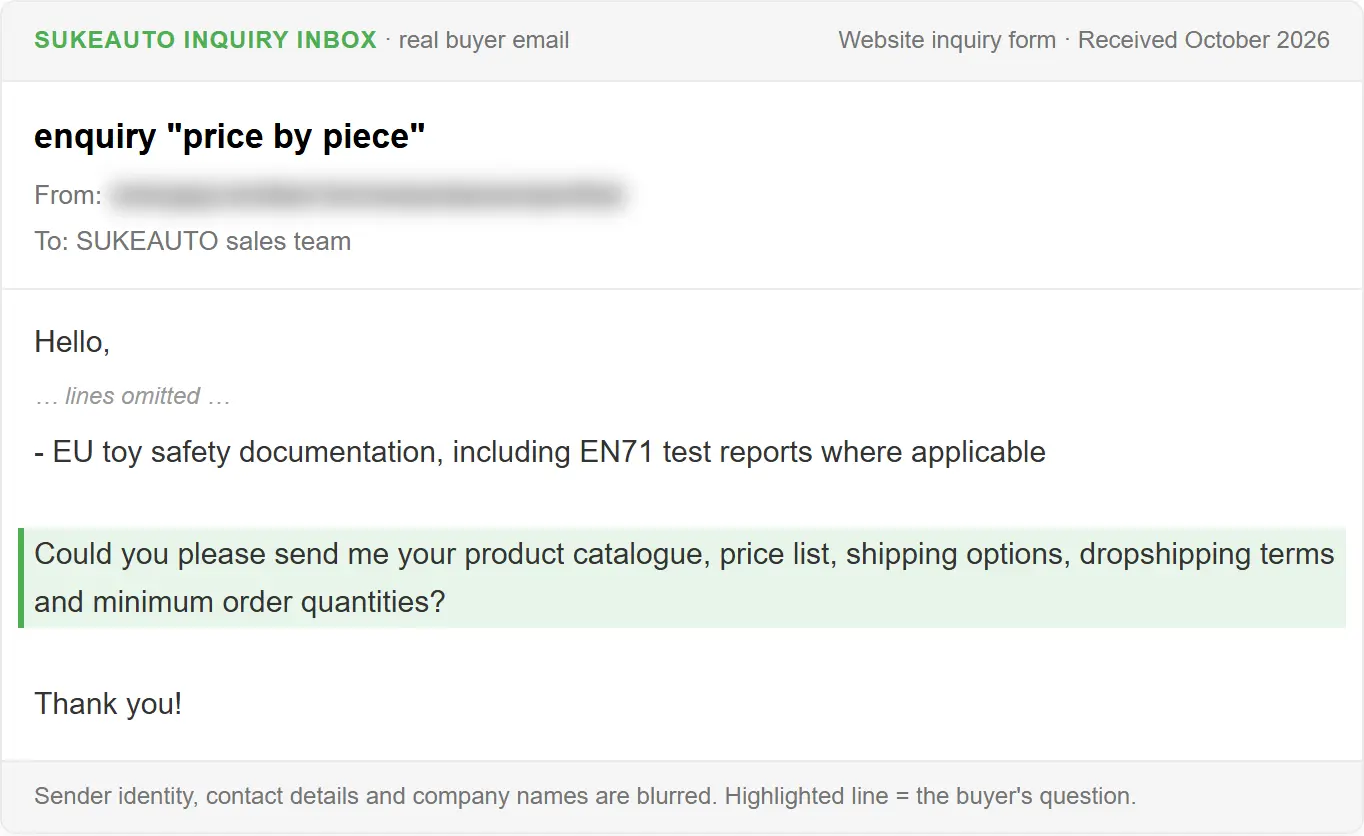
Dropshipping questions come mostly from new online sellers. Between July and October 2026, 62 of the 408 squishy buyers who wrote to SUKEAUTO sold online, 71 asked about shipping, and a smaller group asked directly about dropshipping terms or marketplace warehouse preparation.
How Dropshipping and Wholesale Inventory Differ
| Dropshipping single parcels | Holding your own stock | |
|---|---|---|
| Upfront cash | Low | Higher |
| Unit cost | Higher | Lower |
| Delivery speed to customers | Slow from overseas | Fast from a local warehouse |
| Quality control | Hard to check | You check before selling |
| Packaging and branding | Limited | Your own |
| Platform acceptance | Restricted on some platforms | Widely accepted |
Several major marketplaces now restrict classic dropshipping — buying from another retailer and shipping straight to the customer — and require fast delivery and local return addresses. Holding stock in your market avoids those problems.
Compare the Full Fulfilment Cost
Dropshipping looks cheaper only until the full cost is counted. Compare per order:
- International shipping for every single parcel.
- Duty and taxes on each parcel.
- Picking and packing fees.
- Last-mile delivery in your market.
- Returns — far harder from overseas.
- Lost or delayed parcels and customer service time.
Against this, bulk shipping to a local warehouse or 3PL spreads freight and duty across hundreds of units, and local delivery is fast and cheap.
Working With a Manufacturer Without Dropshipping
A factory works best for online sellers as the supplier behind your stock:
- Order in bulk to your warehouse or 3PL.
- Prepare units at the factory — polybags, barcodes, warnings and kits.
- Receive on DDP terms so duty and clearance are handled.
- Fulfil locally — your 3PL ships single orders quickly.
- Reorder before you run out.
Documents for Your Platform
Platforms ask for test reports and certificates for children’s products, and in the US certificate data for children’s products is now filed electronically at import. Keep each item’s documents ready before you list.
More Dropshipping Questions
Does SUKEAUTO dropship single orders? No, SUKEAUTO ships in bulk to you or your warehouse.
Can you ship to my 3PL? Yes, SUKEAUTO ships with your carton labels and packing list.
Can you prepare units for a marketplace warehouse? Yes, send the prep rules and label files.
What is the smallest stock order? Stock items go by the carton; start small and reorder what sells.
Can I get delivered pricing? Yes, DDP quotes include freight, clearance and duty.
Do you supply EU toy documents? Our TPR squishies are covered by CE and EN 71-1/2/3 reports.
Choosing a Warehouse or 3PL
When you move from dropshipping to holding stock, the warehouse becomes your most important partner. Compare:
- Cut-off times — how late an order can be placed for same-day dispatch.
- Platform integrations — which marketplaces and shop systems connect directly.
- Accuracy — how often orders are picked wrong.
- Fees — receiving, storage, picking, packing and returns.
- Location — close to most of your customers.
A marketplace’s own fulfilment service suits sellers on one platform; an independent 3PL suits sellers on several channels from one stock.
Starting Small With Your Own Stock
Moving to your own stock does not need a huge order. Choose one or two proven styles, order a few cartons each, ship by air for the first test if speed matters, and reorder by sea once demand is clear. The goal is to learn your real sell-through before committing to larger quantities.
Managing Cash Flow
Holding stock ties up money until it sells. Keep stock levels matched to sales: reorder when about half is sold, use sea freight for steady sellers and air for urgent top-ups, and avoid overbuying trend items. A simple weekly stock report prevents both empty shelves and dead stock.
Returns When You Hold Stock
Holding stock locally makes returns manageable. Returned squishies can be inspected, and sealed, undamaged pieces can often be resold under your marketplace’s rules. Damaged ones are written off. Tracking return reasons — wrong size, different colour, damaged in transit — shows where listings or packaging need improving, and gives SUKEAUTO useful feedback for your next order.
From Dropshipping to Stock: A Checklist
- Best sellers identified — from your dropshipping sales data.
- Warehouse chosen — cut-off times, integrations, fees.
- Landed cost calculated — bulk freight and duty per unit.
- Documents ready — test reports and certificates per item.
- Prep rules shared — labels, polybags, barcodes, kits.
- First stock order placed — small, proven styles.
- Reorder point set — based on full delivery time.
Common Mistakes When Moving to Stock
- Ordering every style you dropshipped — start with the proven few.
- Choosing a warehouse on price alone — slow dispatch costs reviews.
- Forgetting marketplace prep rules — units refused at the warehouse.
- Underestimating delivery time — reorder before you run out.
Questions to Ask Before Leaving Dropshipping
Before you switch, ask yourself a few questions. Which items sold consistently, not just once? How many units do you sell per month, and how long would a carton last? What would a local warehouse charge for your volume? How much cash can you commit without strain? The answers show whether holding stock makes sense now or after a few more months of sales. SUKEAUTO can help with carton sizes, delivery times and landed-cost quotes to fill in the numbers.
Next Step
Send SUKEAUTO your best-selling items, your monthly sales and your warehouse location. We will suggest a first stock order, carton quantities and a delivered quote, so you can compare holding stock with your current costs.
The Per-Order Cost, Line by Line
To compare dropshipping with holding stock honestly, put every cost on a per-order basis:
| Cost line | Dropshipping from a third party | Holding stock in your own or a 3PL warehouse |
|---|---|---|
| Product | Higher unit price, because the dropshipper buys, stores and ships single units | Factory price per piece |
| Inbound freight and duty | Hidden inside the product price | Paid per shipment, spread over the pieces |
| Storage | None for you | Per cubic metre or per pallet per month |
| Pick and pack | Inside the price | Per order |
| Last-mile delivery | Per parcel, usually without volume discount | Per parcel, often discounted at volume |
| Cash tied up | Very little | The value of your stock until it sells |
Add each column for your expected monthly orders. Holding stock usually wins once the saving per order, multiplied by your monthly orders, is larger than the cost of the cash sitting in inventory.
The Hybrid Model Many Sellers Use
Few sellers go all-in at once. A common pattern:
- Hold stock of your proven items, the few shapes that sell every week.
- Test new items in small quantities before committing to a full stock order.
- Raise stock ahead of peak season, when delivery speed matters most and carriers slow down.
Because SUKEAUTO stock ships 3–5 days after payment, the main lead time is freight, which makes it practical to keep proven items topped up and test new ones alongside.
Three Numbers That Keep Stock Healthy
- Weeks of cover — stock on hand divided by average weekly sales. It tells you how long you can sell before you run out.
- Reorder point — weekly sales multiplied by the total lead time in weeks (production plus freight plus receiving), plus a safety buffer. When stock falls to this number, reorder.
- Sell-through — the share of a delivery sold within a set period. Items with low sell-through are candidates to drop, not to reorder.
Check these numbers every week for your top items and every month for the rest.
Getting Factory Cartons Into a Fulfilment Warehouse
Most fulfilment warehouses have strict receiving rules. Agree these with SUKEAUTO before production, not after:
- The warehouse’s carton label format, with your item code and quantity, applied at the factory.
- Carton size and weight limits, if your warehouse sets them.
- Unit labels or barcodes, if each piece must be scannable.
- The advance shipment notice, which you create from our packing list so the warehouse expects the delivery.
- Delivery appointments for larger shipments, which your forwarder or our DDP partner books with the warehouse.
Key Terms
- 3PL — a third-party logistics company that stores and ships for you.
- Pick and pack — collecting the items for one order and packing them for dispatch.
- Weeks of cover — how many weeks current stock will last at the current sales rate.
- Reorder point — the stock level that triggers a new order.
- Advance shipment notice (ASN) — the warehouse’s notice of what is arriving and when.
Will SUKEAUTO apply my warehouse’s carton labels? Yes, SUKEAUTO applies your carton labels before the goods leave the factory.
Can SUKEAUTO deliver to two warehouses from one order? Tell SUKEAUTO the split before shipping; each delivery address is quoted and labelled separately.
Can I order stock in smaller, more frequent shipments? Yes. Each SUKEAUTO stock order meets the 5-carton minimum per item and ships 3–5 days after payment.
Sources: SUKEAUTO inquiry inbox — 408 squishy buyers by email and WhatsApp, July–October 2026 · Federal Register: CPSC certificates of compliance and eFiling · ICC: Incoterms 2020 rules.
Related: squishies for online sellers · EXW, FOB or DDP? · back to custom squishy toy manufacturer.
Send Your Inquiry
Tell us the style, quantity, logo or packaging you need and your target date — we reply with the right route and a price range.
Leave A Comment