
A unit price means little until you know what it includes. SUKEAUTO quotes EXW by default, can quote FOB Shenzhen or Yantian, and offers DDP to your door by fast sea, slow sea or air. The three terms describe the same goods at three different points on the journey, and each one moves a different set of jobs, costs and risks onto your side. This page explains each term step by step: what we do, what you or your forwarder do, where the risk passes, which costs are hidden in the number and which questions to ask before you choose.
The Short Answer
| Your situation | Term that usually fits | Why |
|---|---|---|
| First order, no forwarder, want one number | DDP | Freight, customs clearance and duty are in the price; nothing to arrange on arrival |
| You have a forwarder you trust | EXW or FOB | You control freight cost, schedule and the choice of carrier |
| You buy from several suppliers in China | EXW or FOB | Your forwarder can consolidate everything into one shipment |
| You need to account for import VAT under your own number | DAP, or DDP with VAT excluded | You clear the VAT yourself and keep the right to reclaim it |
What Buyers Ask SUKEAUTO About Shipping
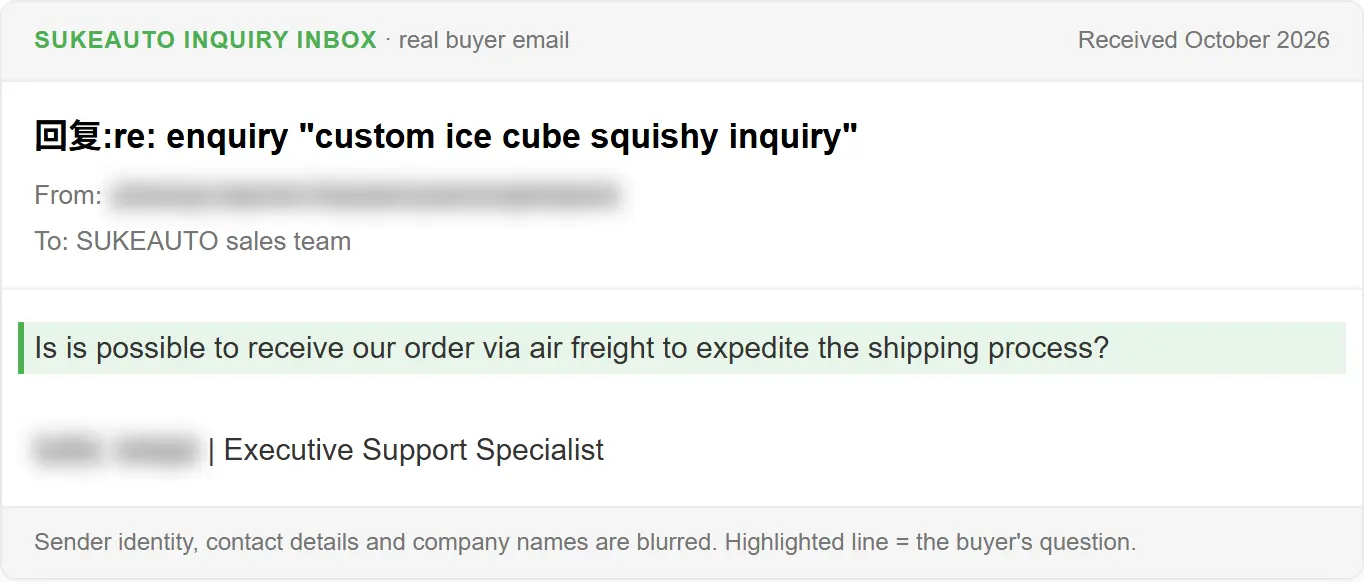
Shipping is one of the most-asked topics in our squishy inbox: 71 of the 408 squishy buyers who wrote to SUKEAUTO between July and October 2026 asked about shipping, and the number rose from 8 in July to 26 in October as holiday orders moved closer. Another 7 asked specifically about duties. The questions show where buyers get stuck with trade terms:
- A delivered price to an address in Europe, including freight, customs, duty and VAT.
- EXW or FOB and DDP side by side, at several quantities, to compare.
- Written confirmation that the DDP total is final, with nothing more to pay on arrival.
- A full timeline from production to the day the cartons reach the delivery address.
- Whether customs has released the container yet.
- Which safety documents customs will want to see.
Incoterms 2020 in One Minute
EXW, FOB and DDP are three of the eleven Incoterms 2020 rules published by the International Chamber of Commerce. The rules fall into two groups:
- Any mode of transport (seven rules): EXW, FCA, CPT, CIP, DAP, DPU and DDP.
- Sea and inland waterway only (four rules): FAS, FOB, CFR and CIF.
Each rule answers three questions: where the seller delivers, who pays for each step, and at which point the risk of loss or damage passes from seller to buyer. Incoterms do not decide the price, the payment terms, the quality standard or who owns the goods; those belong in the contract. Where the contract says something different from the Incoterms rule, the contract wins, so write the term in full, for example “FOB Shenzhen, Incoterms 2020”.
EXW (Ex Works) Step by Step
Under EXW, SUKEAUTO delivers when the finished, packed and labelled cartons are ready for collection at our premises. Everything after that is yours:
- Collection — your forwarder’s truck picks up the cartons. Strictly, loading the truck is also the buyer’s job under EXW, so agree with us in advance who loads.
- Export clearance in China — the export declaration, done by your forwarder or its customs broker.
- Inland transport to the port, airport or consolidation warehouse.
- Origin port charges — terminal handling, documentation, seal and filing fees.
- Main freight by sea or air, and insurance if you want it.
- Import clearance, duty and import taxes in your country.
- Destination charges and delivery to your warehouse.
Where the risk passes: at our premises, as soon as the goods are placed at your disposal. If a carton is damaged on the way to the port, that is a matter between you and your forwarder.
The export-clearance problem. A foreign buyer usually cannot file an export declaration in China. EXW still works because your forwarder files it for you, but the forwarder needs our invoice, packing list and carton data, and the cost of that service is not in our EXW price. The ICC itself notes that EXW suits buyers who can handle export formalities directly or through an agent.
What an EXW Quote Does Not Show
An EXW price is a factory-gate price. The forwarder’s invoice later adds lines such as:
| Stage | Typical charges |
|---|---|
| Factory to port | Trucking (drayage), loading labour, warehouse fees if the cargo waits |
| Export | Customs declaration fee, document fee |
| Origin terminal | Terminal handling (THC), port security, seal fee, bill of lading fee |
| Advance filings | US AMS and EU ENS cargo manifest filing fees |
| Occasional | Customs inspection, fumigation, certificate-of-origin fees |
None of these is unusual. The point is to ask your forwarder for a quote that starts at our door and lists every line, so you compare EXW with DDP on the same basis.
When EXW makes sense: you already have a forwarder in China, you consolidate goods from several factories, or you want full control of the shipment.
FOB (Free On Board) Step by Step
Under FOB, SUKEAUTO does more of the work on the China side:
- We truck the cartons to the named port of loading, usually Shenzhen or Yantian.
- We handle export clearance.
- We pay the origin charges up to the point where the goods are loaded on board the vessel your forwarder has booked.
From there, you pay the ocean freight, insurance, destination charges, import clearance, duty and delivery.
Where the risk passes: when the goods are on board the vessel at the port of loading. Damage on the quay before loading is the seller’s risk; damage at sea is the buyer’s, which is why buyers on FOB usually buy cargo insurance.
Your forwarder books the ship. Under FOB the buyer chooses the carrier. That gives you control of cost and schedule, but it also means your forwarder holds the shipping documents. Choose a forwarder you know, confirm whether it issues its own (house) bill of lading or the shipping line’s (master) bill, and agree how the documents are released.
Why FOB is a sea-only term. FOB is defined by loading on board a vessel. Container cargo is normally handed to the carrier at a container yard or a consolidation warehouse, days before it is loaded, so the moment the seller loses control and the moment risk passes no longer match. For containers, consolidated (LCL) cargo and air shipments, the ICC recommends FCA, which passes risk when the goods are handed to the buyer’s carrier. In practice many factories and forwarders in China still quote FOB for container cargo; what matters is that both sides understand exactly where the goods change hands.
Charges at the destination port. On FOB, CFR or CIF shipments, these are the buyer’s:
- DTHC — destination terminal handling.
- Delivery order (D/O) fee — to release the cargo against the bill of lading.
- Devanning — unloading a shared container in a consolidation (LCL) shipment.
- Demurrage — charged daily when a container stays in the port terminal beyond the free days.
- Detention — charged daily when you keep the carrier’s container outside the terminal beyond the free days.
Demurrage and detention are two separate bills. Arrange collection as soon as the cargo is released, because both grow every day.
DDP (Delivered Duty Paid) Step by Step
DDP is the opposite end of the scale. SUKEAUTO, through our freight partner, handles every step to the named address:
- Export clearance and main freight, by fast sea, slow sea or air.
- Import clearance in your country, including the security and customs filings.
- Duty and the import charges agreed in the quote.
- Delivery to your door. For US business addresses the last leg is usually a trucking company; we pass on the PRO (freight bill) number and the delivery window so your team can receive the cartons.
Where the risk passes: at your address, when the goods are ready for unloading. You pay nothing more on arrival for the items the DDP quote covers.
What we need to quote DDP: your full delivery address, a contact name and phone number, your company name and the final quantity. On orders of tens of thousands of pieces, sea DDP is by far the cheapest route; air DDP costs several times as much per kilo but arrives about three weeks sooner.
Who Is the Importer Under DDP?
Every import has an importer of record: the party customs holds responsible for the declaration, the value and the duty. Under DDP the seller arranges import clearance, usually through a customs broker or clearance partner in your country. In the United States the importer of record also needs a customs bond, and for sea freight an Importer Security Filing (“10+2”) must reach US Customs no later than 24 hours before the cargo is loaded at the foreign port. In the EU and UK, whoever imports needs an EORI number.
Five Questions to Ask Any DDP Supplier
- Who is the importer of record, and under whose EORI or customs bond does the shipment clear?
- What value will be declared? It should be the real invoice value, backed by your purchase contract and proof of payment. In a case published by the Guangzhou Maritime Court, a 2016 shipment of LED lights to Germany was cleared by the forwarder at a value below the export declaration. In a 2019 import VAT audit, German customs could not establish the transaction value without the purchase documents, so it reassessed the tax on online selling prices; the court, and the Guangdong High Court on appeal, held the forwarder responsible. Under-declaration can also hold goods at the border.
- Are inspection, storage and extra port charges included if customs selects the shipment for inspection?
- What happens if the duty rate changes between the quote and arrival? Get the answer in writing.
- Who pays the import VAT, and can you reclaim it? If the VAT is paid under the supplier’s or agent’s number, a VAT-registered business usually cannot reclaim it.
DDP and Import VAT in Europe and the UK
In the EU, customs value is based mainly on the transaction value, with freight and insurance to the EU border added. Duty is calculated on that value, and import VAT on the value plus duty. Many VAT-registered B2B buyers in Europe would rather clear the VAT themselves so they can reclaim it; this is often written as “DDP, VAT unpaid”, or the shipment is sent DAP and the buyer clears it. When you ask SUKEAUTO for a DDP quote to a European address, say whether the figure should include import VAT or whether you will account for it under your own number.
The Other Terms Buyers Mention
- FCA (Free Carrier) — the seller hands export-cleared goods to the buyer’s carrier at a named place, such as the forwarder’s warehouse or the airport cargo terminal. Risk passes at that handover. Since Incoterms 2020, the parties can agree that the buyer’s carrier issues an on-board bill of lading to the seller, which helps when payment is by letter of credit.
- CFR (Cost and Freight) — FOB plus ocean freight paid by the seller. Risk still passes on loading in China.
- CIF (Cost, Insurance and Freight) — CFR plus insurance bought by the seller, at minimum the basic ICC (C) cover for 110% of the contract value. Risk still passes on loading.
- CIP (Carriage and Insurance Paid To) — the any-mode version of CIF; under Incoterms 2020 the minimum insurance rose to the broader ICC (A) cover.
- DAP (Delivered at Place) — the seller delivers to your address; you handle import clearance and pay duty and taxes. DDP minus the import side.
- DPU (Delivered at Place Unloaded) — the seller also unloads at destination. It replaced DAT in Incoterms 2020.
- DDU (Delivered Duty Unpaid) — removed from Incoterms in 2010; DAP replaced it. If a quote still says DDU, ask which term is meant.
Air vs Sea vs Courier by Order Size
- Samples: courier; the buyer pays the courier fee, typically USD 40–50 for a stock sample.
- Small first orders: air is often the practical route.
- Larger orders: sea. On real shipments we see around 25–28 days door-to-door to the US West Coast after sailing; DDP sea 28–33 days; fast sea DDP to Europe 25–28 days door-to-door; air roughly 5–12 days depending on destination.
- Consolidated (LCL) sea: your cartons share a container with other shippers’ goods. If customs selects any one shipment in a shared container for inspection, the whole container can be held while it is unpacked, which can add a few days. Allow a buffer for seasonal orders.
Reading Carton Specs for Freight
Freight is charged on the greater of actual weight and volume weight. Squishies are light for their size, so volume usually decides the cost. Example: our coconut-oil squeeze balls ship 144 pcs per carton, carton 55 × 42 × 22 cm, about 21 kg. Your forwarder needs the carton size, weight and count to quote, and SUKEAUTO lists them for every item on our price sheets.
Duties and Customs
Squishy and stress-relief toys usually classify under HS 9503.00 (US HTS 9503.00.00.90). The US base duty for this heading is free, but additional duties on China-origin goods change often; we confirm the current rate for your product before shipment rather than promise a fixed figure. Labelling for children under 12 can change the statistical suffix. Under DDP, duty is included in our price.
The value that duty is charged on differs by market. US customs generally uses the transaction value of the goods, without international freight and insurance. The EU and UK add freight and insurance to the border, and import VAT is then charged on the value plus duty. The same order can therefore produce quite different landed costs in different countries.
What Goes Into Landed Cost
Landed cost is everything you pay to get one sellable piece into your warehouse:
- Goods — the unit price on the proforma invoice.
- Main freight — sea or air, charged on actual or volume weight, whichever is greater.
- Insurance — optional but common on sea freight.
- Duty — set by your country’s tariff for the product’s HS code.
- Import taxes — VAT or GST in many countries, often calculated on value plus duty.
- Clearance and destination charges — broker fees, port and terminal charges, delivery to your door.
- Your own costs — warehousing, labelling, marketplace prep.
DDP from SUKEAUTO rolls items 1–6 into one delivered price. Under EXW you collect each line from your forwarder and broker.
A Worked Landed-Cost Example (Method, Not Prices)
Take a carton-based stock order going by sea to a US warehouse. To work out landed cost per piece:
- Start with the goods total on the proforma invoice.
- Add the forwarder’s door-to-door freight quote for the total cartons, calculated on the greater of actual and volume weight.
- Add insurance if you buy it.
- Add duty at the rate your broker confirms for the HS code, applied on the value your customs authority uses.
- Add broker, port and delivery charges from the forwarder’s invoice.
- Divide the total by the number of sellable pieces.
Repeat the same calculation for an air shipment and for our DDP figure, and compare. The cost per piece is often higher by air, but the stock sells three weeks earlier. For a seasonal product, those weeks can be worth more than the freight difference.
Choosing a Term by Situation
- First order, no forwarder yet: DDP. One number, nothing to arrange on arrival.
- Experienced importer with a forwarder contract: EXW or FOB. You control freight cost and schedule.
- Order mixing several suppliers in China: EXW or FOB, so your forwarder can consolidate.
- Small consolidated or air shipment through your own forwarder: FCA at your forwarder’s warehouse describes the handover most accurately.
- VAT-registered business in Europe: DAP, or DDP with VAT excluded, so you can reclaim the import VAT.
- Marketplace warehouse delivery: DDP, with the warehouse’s label and appointment rules sent before production.
Using Your Own Forwarder
That is fine with us. SUKEAUTO provides the commercial invoice, packing list and carton specifications, applies your carton labels before collection and sends ready dates so your forwarder can book space early. Tell us the forwarder’s contact details when you confirm the order.
Paperwork That Travels With the Goods
- Commercial invoice and packing list, matching the cartons exactly.
- Carton marks with the item, quantity and country of origin. For the US, goods must be marked with their country of origin in English, “Made in China”, in a conspicuous, legible and permanent way.
- Test reports for the product line where your market requires them.
More Shipping Questions
Does SUKEAUTO quote DDP to every country? DDP is available to most markets by sea or air; send the full delivery address and SUKEAUTO confirms the route.
Is DDP more expensive than EXW? The delivered total is usually similar; DDP simply includes freight, clearance and duty that you would otherwise pay separately.
Can I get EXW and DDP prices side by side? Yes, SUKEAUTO can show both for the same quantity, so you can compare our DDP figure with your forwarder’s quote.
Can I switch from sea to air after ordering? Yes, before dispatch; air costs more per kilo but saves about three weeks.
Who pays if customs holds the shipment? Under DDP, clearance is SUKEAUTO’s responsibility; under EXW and FOB, it is the importer’s.
Do you insure sea shipments? Ask for insurance in the quote; it is listed as its own line.
Can my forwarder collect from your factory? Yes. SUKEAUTO prepares the packing list, carton specifications and invoice, and applies your carton labels before collection.
Which port does SUKEAUTO ship FOB from? Usually Shenzhen or Yantian, depending on the final shipment plan.
Does SUKEAUTO help my forwarder book the shipment? Yes. SUKEAUTO sends carton data and ready dates so your forwarder can book space early.
Can SUKEAUTO split one order into air and sea? Yes. A small air shipment to launch and the rest by sea is a common pattern.
Will I know when my DDP delivery arrives? For US addresses, SUKEAUTO passes on the trucking company’s PRO number and delivery window as soon as the forwarder confirms them.
Key Terms
- Incoterms® 2020 — the International Chamber of Commerce rules that define who arranges and pays for each step of delivery and where risk passes.
- Importer of record — the party legally responsible for the goods at import; under DDP the seller arranges it for the shipment.
- EORI number — the registration number every business needs for customs operations in the EU, with a separate GB number for Great Britain.
- ISF (“10+2”) — the security filing for sea cargo entering the United States, due 24 hours before loading at the foreign port.
- THC / DTHC — terminal handling charges at the origin and destination ports.
- Demurrage / detention — daily charges for keeping a container in the terminal, or outside it, beyond the free days.
- Volume weight — a carton’s size converted into a chargeable weight; freight is charged on whichever is greater, volume or actual weight.
- HS code — the international tariff classification that decides duty; squishies usually fall under heading 9503.
- Door-to-door — transit time from the factory to your address, not just port to port.
- Consolidation (LCL) — combining goods from several shippers in one container, usually arranged by a forwarder.
Sources: SUKEAUTO inquiry inbox — 408 squishy buyers by email and WhatsApp, July–October 2026 · ICC: Incoterms® 2020 · CBP: Importer Security Filing “10+2” · European Commission: Calculation of customs duties · European Commission: EORI number · GOV.UK: Get an EORI number · Southcn, from the Guangzhou Maritime Court: import VAT back-tax case (Chinese) · CPSC: Toy Safety business guidance.
Send us your address and quantity for a DDP figure, or your forwarder’s details for EXW or FOB. Related: payment terms · importing toys by country · back to custom squishy toy manufacturer.
Send Your Inquiry
Tell us the style, quantity, logo or packaging you need and your target date — we reply with the right route and a price range.
Leave A Comment