
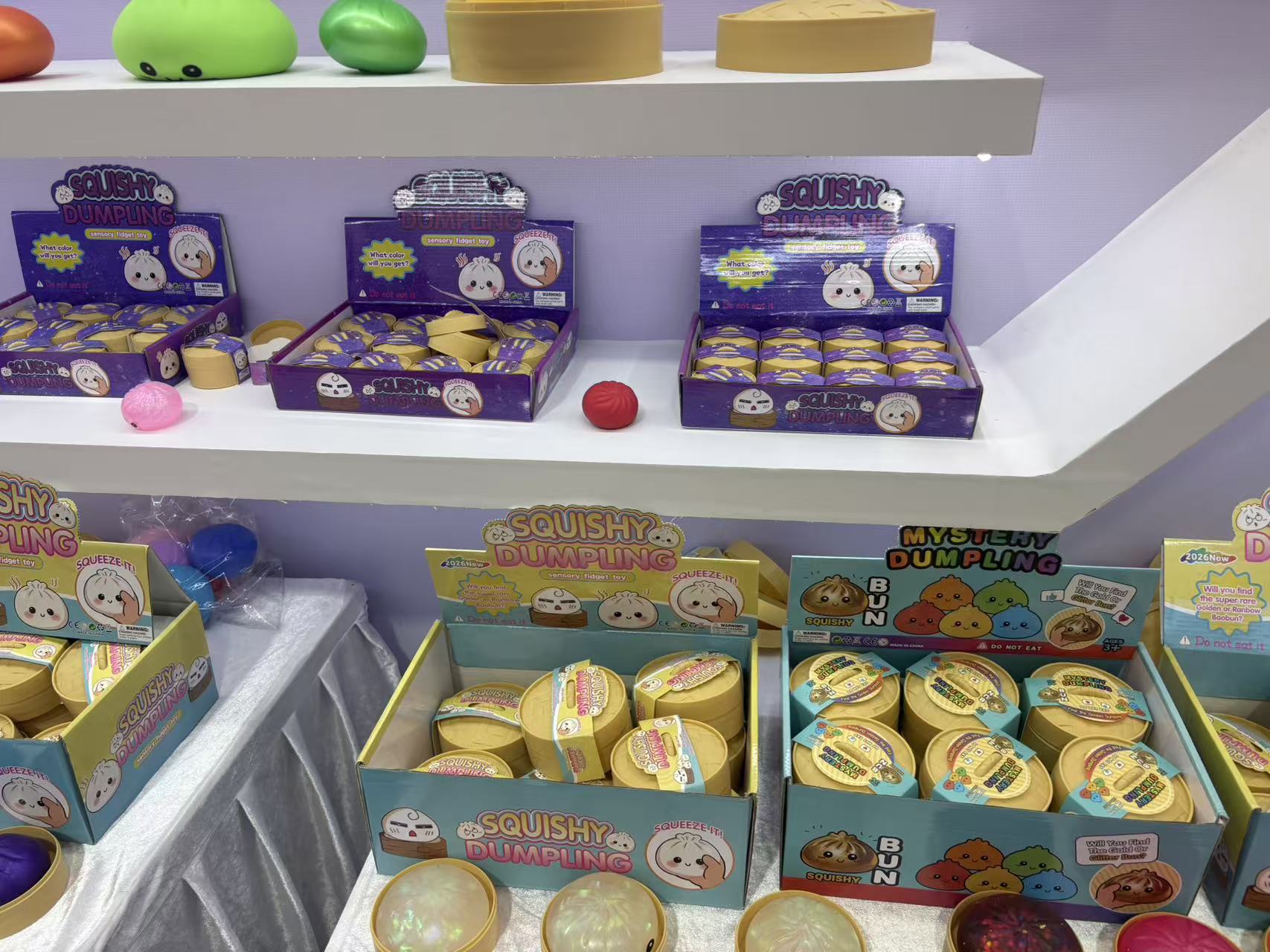
Every month new businesses write to SUKEAUTO wanting to start selling squishies — a market stall, a web shop, a party business, a second line for an existing store. A good first order is small enough to sell through and broad enough to learn from.
Step 1: Choose Styles That Already Sell
Start with the styles buyers ask us about most: dumpling or bao, cube, butter, jelly or maltose fills, and coconut-oil balls. Three of these cover soft, clear and slow-rise feels at different price points. Add one trending item — the crunchy series is this season’s push.
Step 2: Build a Mixed Order from Stock
Stock items go by the carton and ship 3–5 days after payment. Useful entry points:
- 8.5 cm (3.3 in) dumplings — 1,440 pcs per order, mixed evenly across 4 stock colours (360 each).
- 14 oz (397 g) butter squishy — from 480 pcs; 4 oz (113 g) from 1,680.
- Catalogue items — 5 cartons per item.
- 15 cm (6 in) jumbo dumplings — from 500 pcs as display pieces.
Rules for mixing: mixing styles and colours in one order.
Step 3: Samples First
1–2 samples of each stock item are free; you pay the courier fee, typically USD 40–50. Compare feel, bottom finish and smell before committing. See the sample policy.
Step 4: Work Out Landed Cost
Our default price is EXW. Add freight, duty and delivery — or ask for a DDP quote that includes everything to your door. Then set your retail price; see which squishies sell best.
Step 5: Pay and Inspect
Proforma invoice → 50% deposit by bank transfer → production or picking → photos and video of your goods → balance → dispatch.
Step 6: Add Your Brand When It Pays
Once a style sells steadily and you can commit to 5,000 per design, add your brand on the packaging or the squishy. Until then, selling well-made stock items is the low-risk way to learn your market. See private label squishies.
Reorders
Reorder at about half sold through, and earlier before the holiday season, when capacity is fully booked.
What First-Time Buyers Ask SUKEAUTO
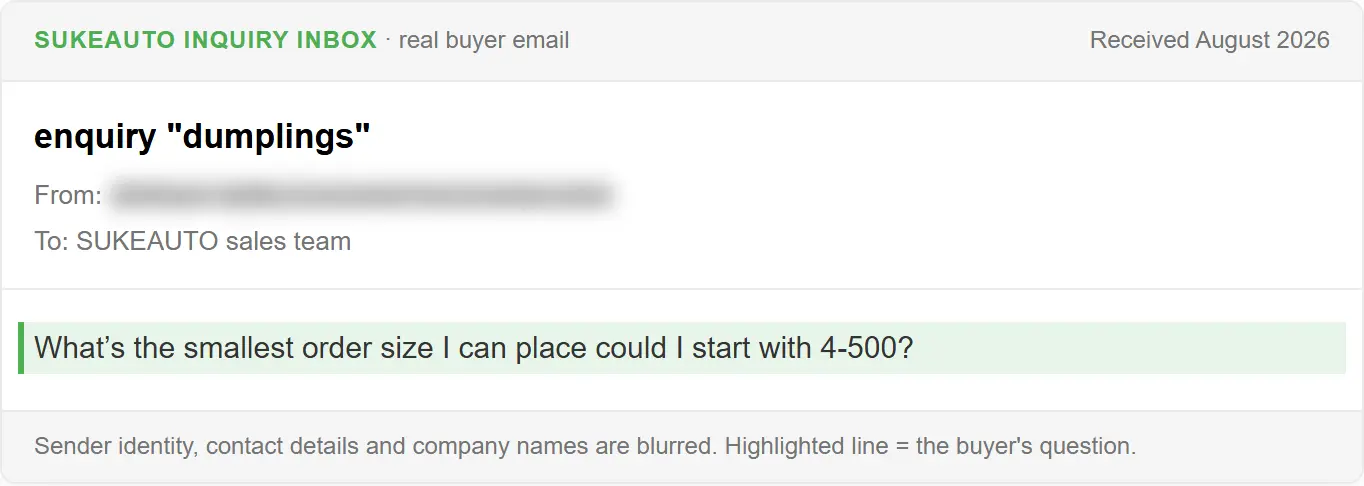
New businesses write to us every week, and their first question is almost always the same: how small can the first order be? Between July and October 2026, 102 of the 408 squishy buyers who contacted SUKEAUTO asked about minimum order quantities, 82 asked about samples and 210 asked about price — and first-time buyers ask all three in their first message.
What a Minimum Order Means for You
Minimum order quantities exist because every order has fixed set-up work: picking and packing stock by the carton, or printing plates, colour checks and moulds for custom work. For a first-time buyer, the practical point is simpler: the minimum sets how much cash you tie up in stock before you have sold anything. Choose stock items sold by the carton for the first order; leave branded and custom work until you know what sells.
Product Cost Is Not Your Whole Budget
The money you pay the factory is only part of the money a first order needs. Plan for:
- Product cost — the goods themselves.
- Samples and courier fees — before the order.
- Freight and duty — or a DDP price that includes them.
- Storage — at home, in a unit or with a warehouse.
- Packaging and labels — bags, tags and any marketplace prep.
- Marketing — photos, videos, listings and promotion.
- Time to sell — money stays in stock until it is sold, often for weeks.
A first order that uses all your budget on product leaves nothing to sell it with.
When to Invest in a Custom Design
Custom work is worth it when three things are true: you know which style sells, you can sell the minimum quantity within a reasonable time, and the custom version gives you something competitors cannot copy easily — your brand, your colour, your character. Until then, well-chosen stock items are the low-risk way to learn the market.
Common First-Order Mistakes
- Too many styles — a little of everything means no clear bestseller to reorder.
- Too few of the hero item — the style that sells runs out first.
- No samples — surprises in feel, size or smell arrive with the whole order.
- Ignoring freight — bulky items cost more to ship than expected.
- No reorder plan — a sold-out bestseller can take weeks to replace.
Your First 90 Days
- Weeks 1–2 — order samples, compare feel and quality, set your budget.
- Weeks 3–4 — place a first stock order and prepare listings or shelf space.
- Weeks 5–8 — receive goods, launch, photograph and promote.
- Weeks 9–12 — review what sold and reorder the winners.
More First-Order Questions
Can I order a few hundred pieces? Stock items go by the carton, so a first order can be small; SUKEAUTO will suggest a mix within your budget.
Can I see the goods before paying the balance? Yes, SUKEAUTO sends photos and video of your actual goods before the balance is due.
Should I start with my own logo? Usually not; SUKEAUTO recommends selling stock first, then adding your brand from 5,000 pcs per design.
How do I pay? A 50% deposit by bank transfer, then the balance after you see photos and video of your goods.
Can SUKEAUTO quote delivered to my door? Yes, a DDP quote includes freight, clearance and duty.
What should I reorder first? The style that sold fastest, in the colours that sold first.
Where to Sell Your First Squishies
Each channel has its own start-up demands:
- Market stalls and pop-ups — low cost, instant feedback, testers on the table.
- Your own web shop — full control, but you must bring the traffic.
- Marketplaces — built-in shoppers, with fees, documents and warehouse rules.
- Social shops and live selling — video-first, fast-moving trends.
- Local shops on consignment — a way into retail without a store of your own.
Many new sellers start with one channel, learn what sells, then add a second. Your first order should suit the channel: testers and variety for stalls, depth in a few hero styles for online listings.
Pricing Your First Range
Set prices from landed cost upwards, not from competitors downwards. Add up product, freight, duty, packaging and selling fees per piece, then add a margin that leaves room for discounts and damaged units. Check that your price still makes sense next to similar squishies in your market. If it does not, choose a different style or a different pack size rather than cutting your margin to nothing.
Keep Records From Day One
Write down every cost, every order and every sale. After the first order, those records tell you which styles to reorder, which channel works, and what your real margin is. They also make your next conversation with SUKEAUTO faster, because you can ask for exactly what sold.
First Order Checklist
- Budget split — product, freight, storage, marketing and a reserve.
- Channel chosen — where the first squishies will be sold.
- Samples compared — feel, size, smell and finish.
- Styles chosen — a few core styles plus one trend item.
- Landed cost calculated — with a DDP quote if you prefer.
- Selling price checked against similar squishies in your market.
- Reorder plan written — when and how much.
Ticking every line before you pay the deposit makes a first order a planned test rather than a gamble.
Ask Before You Order
Write down every question before your first order and send them together: sizes, materials, carton quantities, delivery options and payment steps. One clear list gets one clear answer, and it helps SUKEAUTO suggest a first order that fits your budget and your sales channel.
Hold Stock, Dropship or Use a Warehouse?
A new squishy business has three ways to get goods to customers, and each one moves cost and risk to a different place:
| Model | How it works | Upfront cash | Cost per order | Main risk |
|---|---|---|---|---|
| Dropshipping from a third party | Someone else stores and ships single orders | Low | Highest | Slow delivery, little control over quality and packaging |
| Your own small stock | You import cartons and ship from home or a small unit | Medium | Lower | Your time, storage space, unsold stock |
| Stock in a third-party warehouse (3PL) | You import cartons into a fulfilment warehouse that ships for you | Medium to high | Lower at volume | Storage fees, receiving rules, minimum monthly charges |
A simple test helps choose: if the saving per order from holding stock, multiplied by the orders you expect each month, is larger than the cost of tying up cash in inventory, holding stock wins. Early on, when sales are uncertain, many sellers test with a small stock order and move to a warehouse as volume grows. SUKEAUTO is a factory that ships cartons to you or your warehouse; see dropshipping vs holding stock.
The Hidden Costs of Fulfilment Warehouses
If you plan to use a 3PL, ask about these before you send the first carton:
- Storage after the free period. Some warehouses offer free storage for the first weeks, then charge much more per cubic metre.
- Receiving rules. Most need an advance shipment notice; cartons that arrive without one may be refused or charged.
- Labels. Cartons and units without the right labels are relabelled at the warehouse’s rate.
- Duty and taxes on the inbound leg. A freight quote that does not include duty can leave a large bill at the port.
- Peak-season capacity. Busy warehouses slow down in the weeks before major holidays, exactly when you need them.
- Who runs the warehouse. A warehouse that subleases space from someone else adds a party that can hold your goods in a dispute.
Setting Up to Import for the First Time
Your first order may also be your first import. Check these before goods leave the factory:
- An importer registration. Many countries require one: an EORI number in the EU and UK, and in the United States an importer number, usually your company’s tax number, with a customs bond arranged by your broker. Under DDP, SUKEAUTO arranges import clearance for the shipment.
- A customs broker or forwarder, unless you choose DDP.
- Product rules for your market, such as test reports, age labelling and warnings. See importing toys by country.
- Your business records: invoices, packing lists and test reports for each order, kept together.
Set Your Reorder Rule Before You Order
Decide in advance what result will trigger a reorder, so the decision is based on numbers:
- Pick a sell-through target, such as the share of your first order sold within a set number of weeks.
- Watch which items reach it first. Those are your reorder items.
- Count lead time backwards. Stock ships 3–5 days after payment, plus freight; reorder before you run out, not after.
- Drop the slow items rather than discounting them into the next order.
Key Terms
- Dropshipping — a seller lists goods that a third party ships directly to the customer.
- 3PL (third-party logistics) — a warehouse company that stores, picks and ships goods for you.
- Sell-through — the share of stock sold in a given period.
- Importer of record — the party customs holds responsible for an import.
- Advance shipment notice — the notice a warehouse needs before your cartons arrive.
Can SUKEAUTO ship my first order straight to my 3PL? Yes. SUKEAUTO ships to any warehouse address, with your carton labels applied before collection.
Do I need a company to import? Requirements differ by country; SUKEAUTO can quote DDP so import clearance is arranged for you.
How small can a first stock order be? At SUKEAUTO each catalogue item starts at 5 cartons, and some best-sellers have their own minimums.
Sources: SUKEAUTO inquiry inbox — 408 squishy buyers by email and WhatsApp, July–October 2026 · ICC: Incoterms 2020 rules · CPSC: Toy Safety business guidance.
Tell us where you’ll sell and your budget — we’ll suggest a first order. Back to custom squishy toy manufacturer.
Send Your Inquiry
Tell us the style, quantity, logo or packaging you need and your target date — we reply with the right route and a price range.
Leave A Comment