
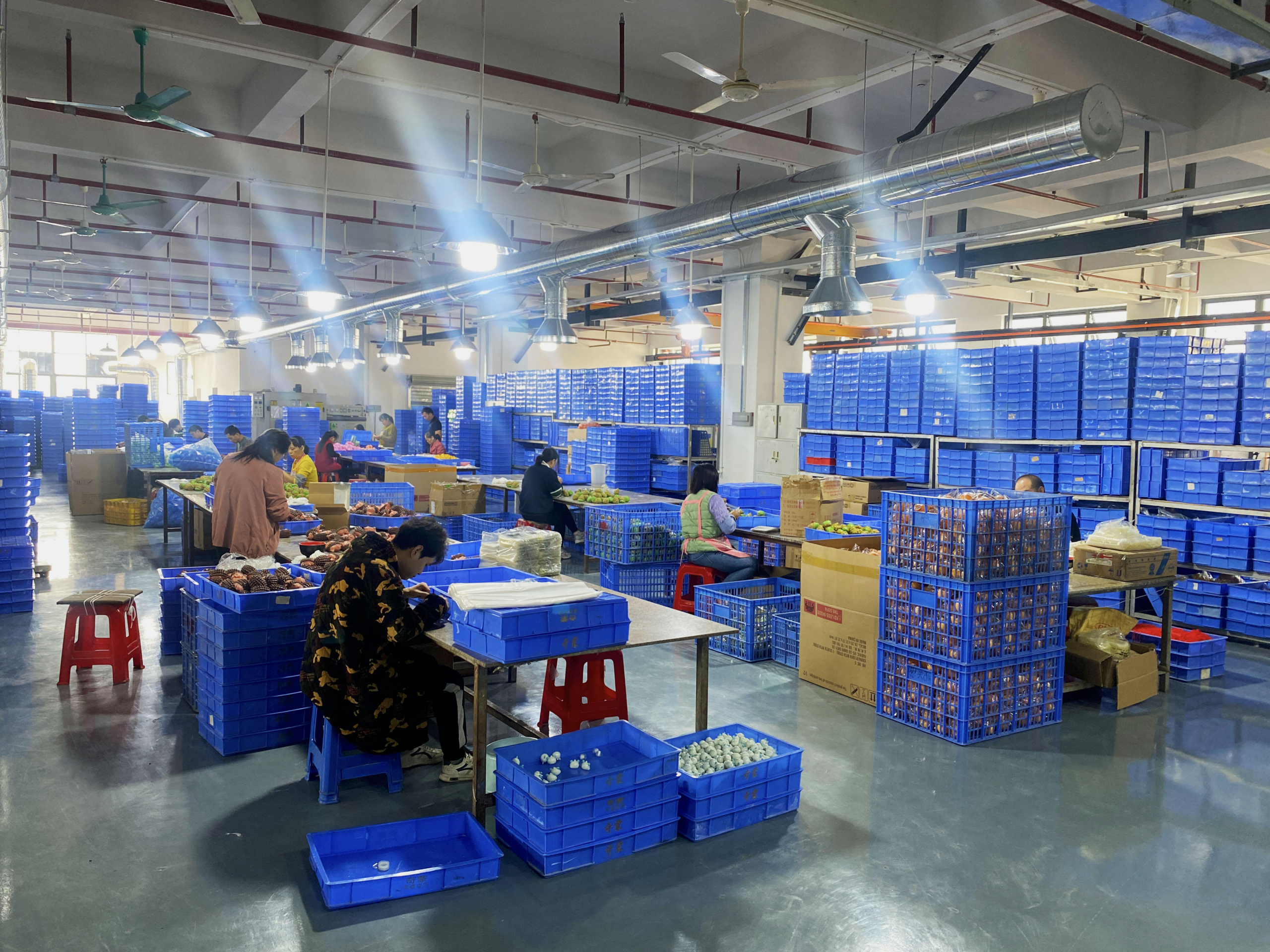
Of the 130 buyers who told SUKEAUTO a target quantity in 2026, 13 asked for fewer than 1,000 pieces and 51 asked for 1,000–4,999. Small orders are a normal starting point — but custom squishy production has set-up steps that do not shrink with the order. This article explains where our minimums come from, so the numbers on our squishy minimum order quantity page make sense.
Every Custom Order Starts with Fixed Set-Up Work
A squishy run is not one machine making one piece at a time. Before the first saleable piece comes off the line, the factory has to:
- Mount and test the mould. TPR squishies are injection-moulded; the mould has to be fitted, heated and run until the skin comes out with an even wall (our technical floor is about 2.8 mm) and a clean bottom.
- Mix the colour. A custom colour is matched to your Pantone reference and checked against the approved swatch. The first kilograms of material are used just to reach a stable colour.
- Set up printing. Pad printing needs a printing plate and positioning jig for each logo and each print position.
- Set up packing. Printed bags, header cards and boxes have their own plates, die-cuts and assembly instructions.
These costs are almost the same whether the run is 500 or 5,000 pieces. Spread over 500 pieces, they make the unit price unworkable; spread over 5,000, they disappear into a normal price.
Why Each Route Has a Different Number
- Plain stock items have no set-up at all — they are already made and packed — so the only limit is that we do not split cartons. That is why stock goes by the carton.
- Logo on stock moulds (5,000 per design) covers the print plate, jig, colour checks and packaging plates.
- Custom colour (2,000 per colour) covers a colour batch on an existing mould.
- New mould (TPR 10,000 / PU 5,000 per design) covers tool making, sampling rounds and line set-up for a shape nobody has made before. Slow-rise PU tools cost less than TPR tools (USD 2,000–3,000 against USD 3,500–4,000), which is why its minimum is lower.
Why We Don’t Offer “Small Branded” Workarounds
We are often asked whether a logo sticker on a bag, or a printed card, could brand a few hundred stock pieces. We do not run those: any branding on the packaging or the product starts at 5,000 per design, for the same set-up reasons above. A route that looks cheap on paper but that our production line cannot run consistently helps nobody.
The One Route If You Need Fewer
If your quantity is below the custom minimums, the route that works is a plain stock item at its own minimum:
- 14 oz (397 g) butter squishy: from 480 pcs.
- 15 cm (6 in) and 25 cm (10 in) jumbo dumplings: from 500 pcs, plain.
- Catalogue items: 5 cartons per item — see the stock squishy catalogue.
- 8.5 cm (3.3 in) dumpling: 1,440 pcs per order, mixed across 4 stock colours.
Sell through that first order, learn which shapes and colours move, then come back for a branded run when your quantity reaches the custom minimum. Many of our long-term buyers started exactly this way — read starting a squishy business.
Questions Buyers Ask About Minimums
Can two designs share one minimum? No — each design carries its own minimum, because each has its own set-up. Designs can share a mould, though, which cuts tooling cost.
Does a sample count? No. Samples are separate; see the sample policy.
Will the minimum drop on a reorder? At SUKEAUTO the minimum stays the same; what drops is cost, because tooling is not charged again.
What Small-Quantity Buyers Tell Us
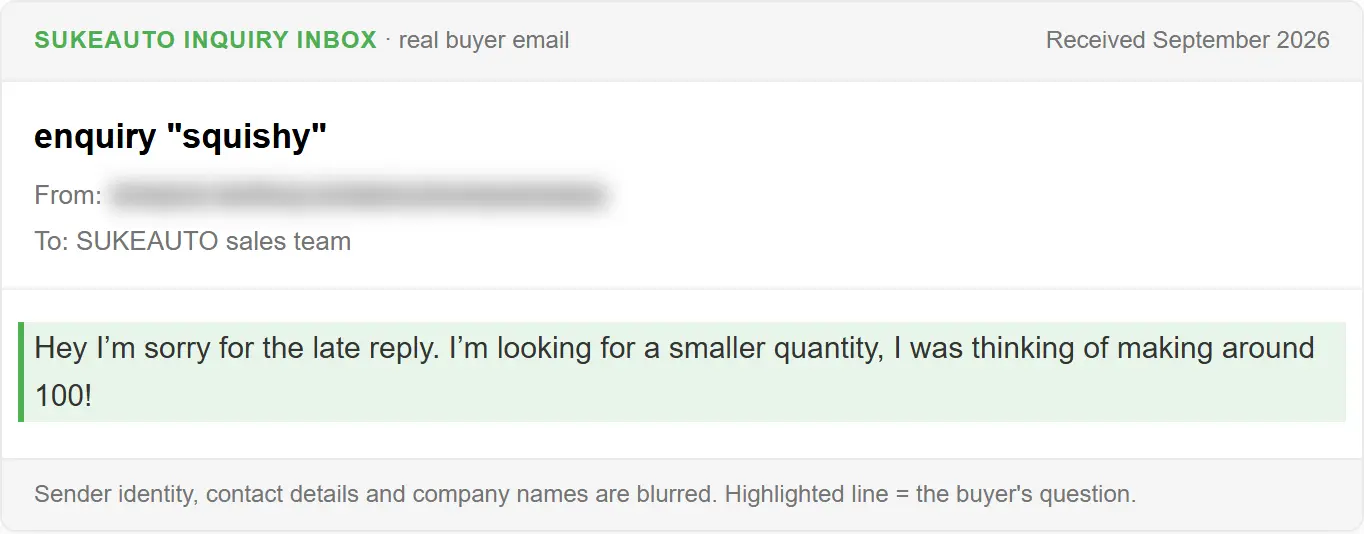
Of the 408 squishy buyers who wrote to SUKEAUTO between July and October 2026, 102 asked about minimums — and a large share of them were asking for less. Some want around a hundred pieces for a launch, some a few hundred for a pop-up or an event, and some ask whether the minimum is “negotiable” for a first order. These are honest, normal requests, so this page explains the factory side in plain terms instead of just saying no.
What Happens on the Factory Floor Before Piece One
Every custom run starts with work that produces nothing you can sell:
Mould change-over. The injection machine is stopped, the previous mould comes out, your mould goes in, and the machine is heated and adjusted. While that happens the machine earns nothing but still carries its labour, power and floor cost.
Trial shots. The first pieces from a freshly mounted mould are used to set temperature, pressure and timing. They are scrapped until the wall thickness and the bottom finish are stable.
Ramp-up. Even after the settings are right, the first part of a run has a lower pass rate than the middle of it. On a short run, that early, less efficient stretch is most of the run.
Colour batches. A custom colour is mixed, sprayed or compounded and checked against the approved swatch. Material is used up reaching a stable colour, and the line is cleaned before and after.
Print plates and jigs. Pad and screen printing need a plate or screen and a positioning jig for each artwork and each print position. Preparing them typically takes a few days.
Packaging plates and dies. Printed bags, cards and boxes need their own plates and cutting dies, and printers apply their own minimums.
Inspection set-up. Quality checks are not free on small lots either. Toy inspection commonly samples by AQL (for example 2.5 for major and 4.0 for minor defects under ISO 2859-1), while safety-critical points such as small parts and sharp edges are checked separately. Per-colour or per-material testing does not shrink with a smaller order.
None of these steps gets cheaper when the order gets smaller — which is the whole reason minimums exist.
Why a Factory That Accepts Tiny Custom Runs Is a Risk
When a supplier accepts a custom run far below its real set-up cost, the money has to come from somewhere. The usual places are the material grade, the inspection, or the schedule — your run gets squeezed in between larger orders. Second-grade TPR is the most common cause of sticky, smelly or leaking squishies, and it shows first on the bottom finish. SUKEAUTO would rather tell you the minimum up front than accept an order we cannot make properly.
The Honest Alternatives If You Need Fewer
- Plain stock items at their own minimum. The lowest entry points are the 14 oz (397 g) butter squishy from 480 pcs, the 15 cm (6 in) and 25 cm (10 in) jumbo dumplings from 500 pcs, and catalogue items from 5 cartons each.
- Mix several stock items in one shipment. Each item meets its own minimum, but they travel together on one invoice, so a first order can still be varied.
- Plan your brand for the second order. Use the first order to learn what sells; put your logo on the proven item when it reaches 5,000 pieces.
- Share one mould across a series. If you are designing several characters, building them on one body keeps the tooling to a single set.
Questions About Why Minimums Exist
Is the minimum just a way to make me order more? No. It is the point at which SUKEAUTO’s set-up costs per piece stop dominating the price. Below it, the unit price would be several times higher.
Why can stock items go lower than custom ones? Stock items are already made and packed, so there is no set-up left to cover — the only rule is that cartons are not split.
Why is the PU minimum lower than TPR? Slow-rise PU tools cost less (USD 2,000–3,000 per design against USD 3,500–4,000 for TPR), so 5,000 pieces covers them.
Why does a logo need 5,000 pieces when the squishy itself is in stock? The print plate, jig, colour checks and packaging plates are new work for every artwork, even on a stock body.
Will SUKEAUTO hold stock of my custom item to sell to me in smaller lots? No. Custom goods are produced for your order and shipped to you.
Can I see the factory’s quality before committing to a minimum? Yes — order samples first, and SUKEAUTO films your actual goods before the balance is paid.
Inside a TPR Run: Why Short Runs Waste a Larger Share
Most squishy shapes at SUKEAUTO are made in TPR (thermoplastic rubber). TPR arrives as pellets, is melted and shaped in a mould, and cools into a soft skin that can be filled and sealed. In a typical TPR process:
- The material is melted at roughly 180–210 °C (356–410 °F) and the mould is kept far cooler, around 30–50 °C (86–122 °F).
- Cooling time depends on wall thickness, so a thick-walled squishy holds the mould longer than a thin one.
- The first pieces after start-up are adjusted for weight, wall thickness and surface until they match the sample, and those pieces are scrapped.
- When the colour changes, the barrel and nozzle are purged with new material until no trace of the old colour remains. That purged material is waste.
Start-up scrap and purge waste are almost the same for a short run as for a long one. On a long run they are a rounding error; on a short run they are a real share of the material bill.
Inside a PU Run: The Chemistry Behind the Minimum
Slow-rise PU foam is made by a chemical reaction rather than melting:
- Two liquid components, a polyol blend and an isocyanate, are measured in a fixed ratio. The ratio decides how soft the foam is and how slowly it rises.
- Water in the mix reacts with the isocyanate and releases carbon dioxide, which blows the open-cell foam.
- The mixture is poured and the mould closed within seconds, before the reaction takes off.
- The foam cures in a warm mould for several minutes, then rests at room temperature for one to three days. Freshly made foam rises too fast and feels too firm; the slow, heavy rise buyers want appears only after the rest.
- The surface is painted and printed after the foam has settled.
Because the reaction is sensitive to temperature and humidity, a factory keeps the room within a narrow range and checks the rise time on every batch. A run that is too small spends most of its life in the start-up phase, where those settings are still being dialled in.
How Set-Up Cost Shrinks as Quantity Grows
The fixed work of a run is spread over every piece. Without quoting prices, the pattern looks like this:
| Pieces in the run | Share of the unit price taken by set-up |
|---|---|
| A few hundred | Dominant: set-up can cost more than the toy itself |
| About 2,000 | Large: still a visible part of every piece |
| About 5,000 | Small: the material and labour now decide the price |
| 10,000 and more | Minor: tooling and set-up are almost invisible |
That curve is why SUKEAUTO sets custom minimums where it does. Below those quantities, the unit price would be several times higher and would still not cover the run properly.
Why Packaging Printers Have Minimums Too
Printed boxes and cards are made on offset presses. Each design needs its own printing plates and a cutting die, and the press runs a stack of make-ready sheets before the colour is right. The printer charges that set-up whether you print 500 boxes or 5,000, so packaging carries its own minimum even when the toy inside is a stock item. A plain bag or a common box with a printed label is the way to keep packaging costs low on a small order.
How to Tell a Real Minimum From a Sales Number
A minimum should be explainable. When a supplier quotes one, ask:
- What set-up does the minimum cover? Mould, colour batch, print plates, packaging plates.
- Is it per design, per colour or per order? A clear answer means the supplier knows where its costs come from.
- What changes above the minimum? A real minimum is usually followed by price breaks.
- Who makes the goods? A trading company may quote a low minimum and then place the work with another factory.
SUKEAUTO answers all four in every quote: the route, the minimum, the price breaks and the factory that produces your goods.
Key Terms
- Purge — running new material through the machine to flush out the previous colour.
- Start-up scrap — pieces made while the process is adjusted at the start of a run.
- Rise time — how long slow-rise foam takes to return to shape after a squeeze.
- Make-ready — the sheets a printing press runs before colour and registration are correct.
- Cutting die — the steel-rule tool that cuts and creases a printed box.
Can a minimum be shared between two buyers? No. SUKEAUTO runs each design for one buyer, so the minimum belongs to that design.
Why does a reorder not lower the minimum? At SUKEAUTO the set-up work happens again on every run; only the tooling cost disappears.
Is it cheaper to order one larger run than two smaller ones? Usually yes, because SUKEAUTO pays the set-up once instead of twice.
Sources: SUKEAUTO inquiry inbox — 408 squishy buyers by email and WhatsApp, July–October 2026 · ISO 2859-1:2026 sampling by attributes (AQL).
Not sure which route fits your quantity? Send us the item and number you have in mind and we will tell you straight away which route is open. Back to custom squishy toy manufacturer.
Send Your Inquiry
Tell us the style, quantity, logo or packaging you need and your target date — we reply with the right route and a price range.
Leave A Comment