
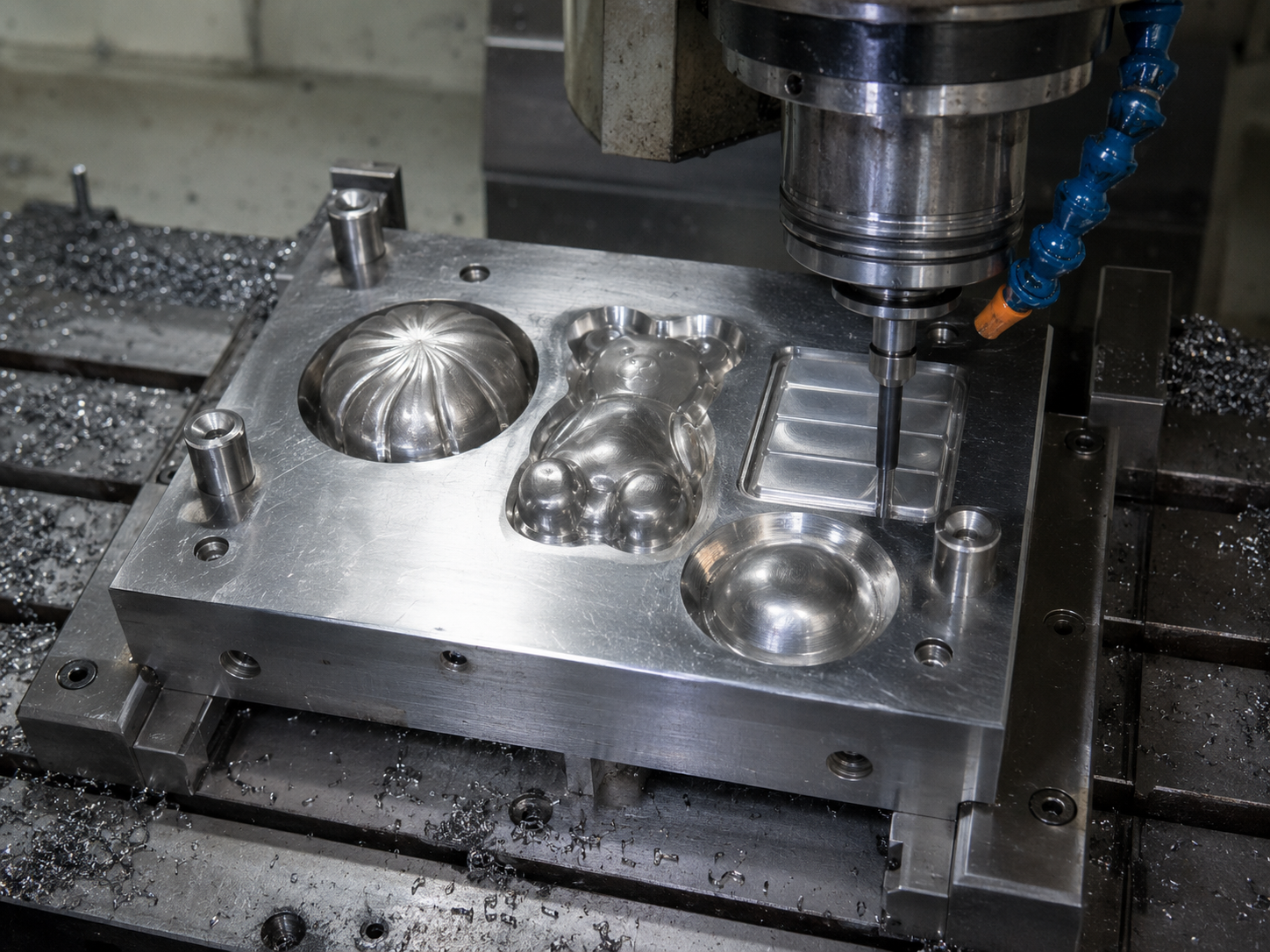
“Custom” means three different things in squishy manufacturing, and the cost gap between them is large. Of the squishy buyers who wrote to SUKEAUTO since July 2026, 148 asked about a custom colour or shape. Before you spend on tooling, check which of these three routes your idea actually needs.
Route 1: Stock Squishies with Your Logo or Colour
You pick an item we already make and we change what’s on it:
- Your logo on the packaging or pad-printed on the squishy — 5,000 pcs per design, no tooling fee.
- A custom colour on the same mould — 2,000 pcs per colour, about 10 days.
Sampling takes 25–35 days (sample fee USD 150–250) and production 20–25 days after the deposit. This is the fastest and cheapest custom route.
Route 2: Adapting a Stock Mould to Your Shape
The outline stays; almost everything else can change — colour, filling, printed face or pattern. Our dumpling mould runs in 6 colours with no tooling; our coconut-oil ball mould takes a pearlescent finish with no tooling. Many character ideas fit an existing body better than buyers expect. Read matching your idea to a stock squishy mould.
Route 3: A New Mould for Your Own Shape
When the shape itself is your product, it needs its own tool:
- TPR (dumplings, food shapes, cat paws, liquid-filled): 10,000 pcs per design, tooling USD 3,500–4,000 per design depending on size, structure and finish.
- Slow-rise PU foam: 5,000 pcs per design, tooling USD 2,000–3,000 per design.
- Custom inserts — a logo or character suspended inside a clear cube — are new-mould work too.
To quote a new shape we need a 3D file (STL or STEP); a 2D drawing alone cannot define wall thickness or filling volume. We do not create 3D models, so if you don’t have one yet, start with your designer — see our custom character squishy process.
Tooling Costs and Shared Moulds
Tooling is paid by the buyer as a separate line, once — reorders don’t pay again. Several designs can share one mould, in which case the tooling is charged once for the set: one recent project ran five cube designs on a single tool.
Timelines for Each Route
| Route | Sample | Production |
|---|---|---|
| Stock + logo / custom colour | 25–35 days (colour only: ~10 days) | 20–25 days after deposit |
| New mould | 25–35 days (PU 25–30) | 30–45 days after sample approval |
Add transit; see squishy lead times.
When a New Mould Is Worth It
Three signals: your volume reaches 10,000 per design (5,000 for PU), the shape is your brand and must not exist elsewhere, and you plan to reorder. If what you really want is your colour or your logo, Route 1 does it for a fraction of the cost.
What Buyers Ask SUKEAUTO About Moulds and Custom Shapes
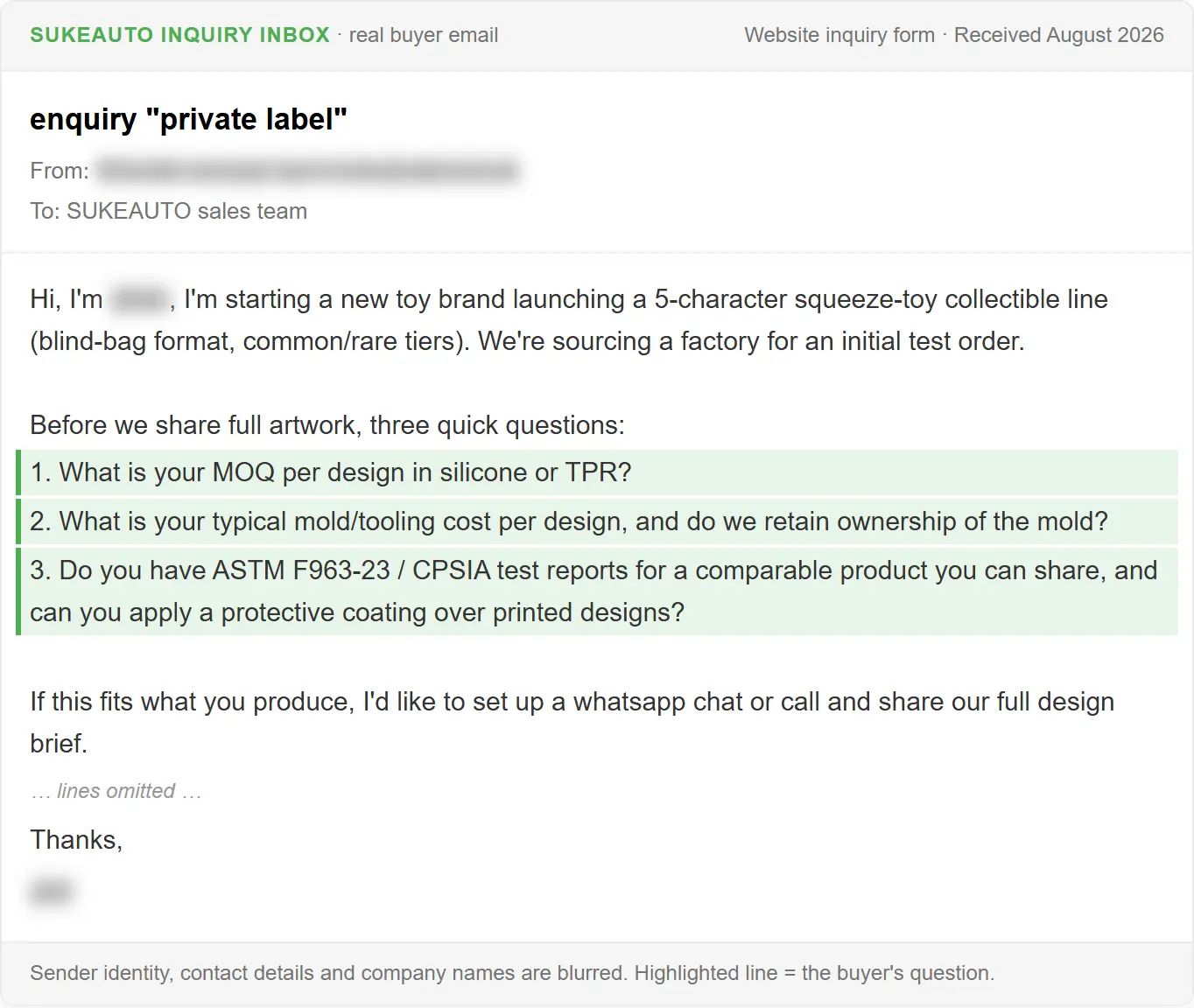
Custom shapes are the most-asked topic after price. 110 of the 408 squishy buyers who wrote to SUKEAUTO between July and October 2026 asked about a custom shape, and 30 asked specifically about mould or tooling cost. The tooling questions became more frequent each month — 7 in August, 11 in September, 12 in October — as more start-ups planned their own characters. Typical questions:
- What does a mould cost per design, and what is the minimum on a new shape?
- Can several characters share one mould?
- Does the price drop if we order more?
- Do we keep the mould?
The Four Routes, Side by Side
Before comparing any quote, check which route it describes — a quote for “custom” can mean any of these:
- A stock item with new packaging — shape and material unchanged.
- A stock mould with a new colour or print — 2,000 pcs per colour; logo 5,000 per design.
- An adapted stock shape — possible only where the existing mould allows it.
- A brand-new mould — TPR 10,000 pcs per design with tooling of USD 3,500–4,000; slow-rise PU 5,000 per design with tooling of USD 2,000–3,000.
Mixing these up is the most common reason two quotes look impossible to compare.
How a New Squishy Mould Is Developed
- Brief. Front, side, back and top views; target size; material direction (TPR or slow-rise PU); target feel and rebound; colours; finish; logo position; target market and age grade.
- 3D file review. SUKEAUTO quotes from a 3D file (STL or STEP). The review checks parting lines, thin walls, protruding parts like ears and tails, stability and how it fits the pack. We do not create 3D models, so start with your designer.
- Tool making and first trial shots. The first pieces from the tool are checked for flash, short shots, sink marks, colour and size.
- Corrections. If needed, the tool is adjusted and shot again.
- Approved sample. Product, decoration and packaging are approved together. From here, production runs 30–45 days.
A 3D render never replaces the physical sample — softness, rebound, feel and print adhesion can only be judged in hand.
What to Prepare Before Asking for a Mould Quote
- 3D file (STL or STEP) and a 2D drawing with key dimensions.
- Proof that you own or license the design.
- Your target hardness or feel, and the filling if it is a filled squishy.
- Pantone references and logo artwork in vector format.
- Packaging dieline and barcode, if you already have them.
- Destination market, age grade and the test reports you will need.
The more of this list you send with the first message, the faster SUKEAUTO can return a firm tooling quote.
When Shared Moulds Make Sense
Several designs can share one tool. If your characters share a body and differ in colour, face and print, the tooling is charged once for the set. One recent SUKEAUTO project ran five cube designs on a single tool. Shared bodies are also the easiest way to build a blind-box series.
More Mould Questions
Is tooling paid separately? Yes. SUKEAUTO lists tooling as its own line, paid once; reorders of the same design do not pay it again.
Can I get a lower tooling price for a bigger order? Tooling reflects the size, structure and finish of the tool, not the order size; volume lowers the unit price instead.
Who keeps the mould? Ask for the tooling terms — ownership, storage and use — to be written into your order before you pay for tooling.
Can a mould be changed after the first sample? At SUKEAUTO, small corrections are part of sampling; a new outline is a new mould.
Does a new mould need new safety testing? Each new design is tested for its market; testing is arranged per order and third-party fees are separate from the unit price.
What if my volume is below the new-mould minimum? Use a stock shape with your colour and logo first, and move to your own mould when the design has proven its volume.
Two Real Patterns From Our Inbox
The start-up with a series. A new brand plans five or seven characters and asks for the mould cost of each. Often the characters share a body and differ only in face and colour, so one shared mould and printed decoration cover the whole series — and the tooling is paid once.
The company with a product shape. A business wants a squishy shaped like its truck or flagship product. Here the outline is the brand, so a new mould is the right route; the question is whether the volume reaches 10,000 pieces (TPR) or 5,000 (slow-rise PU). If it doesn’t yet, a stock shape in the brand’s colours with its logo bridges the gap until it does.
In both cases the first reply from SUKEAUTO names the route, the minimum and the tooling range, so the buyer can decide before spending anything.
Design Rules That Decide Whether a Mould Works
Before a new mould is cut, an engineer reviews the 3D file for manufacturability. These are the points that most often cause rework on soft toys:
| Design point | Why it matters | What usually fixes it |
|---|---|---|
| Draft angle | Soft parts need a slight taper to leave the mould without stretching | A taper of a few degrees on vertical walls, more on deep shapes |
| Wall thickness | Thick and thin areas cool and cure differently, causing sink marks, trapped air or thin spots | Even walls, with gradual transitions |
| Corner radius | Sharp inside corners are where soft material tears | Rounded corners |
| Parting line | The seam where mould halves meet shows on the toy | Placed along an edge or a natural line in the design |
| Undercuts | Shapes that lock into the mould need moving parts | Redesign the shape, or accept extra mould sections and cost |
| Small raised details | Fine points fill poorly and break off | Thicker, rounder details, or print instead of moulding |
A design that respects these rules is cheaper to tool, faster to sample and more consistent in production.
What a Mould Is Made Of
Production moulds for soft toys are usually machined from tool steel. Harder, heat-treated steels cost more but last longer and keep fine detail through long runs. A production steel mould is expected to last for a very large number of cycles, far beyond the typical life of a squishy design. Faster, cheaper tooling methods exist for samples and short runs, but they lose accuracy and wear out sooner, so they are used for testing a design rather than for bulk production.
What Drives Tooling Cost
At SUKEAUTO a new TPR squishy mould costs USD 3,500–4,000 per design and a slow-rise PU mould USD 2,000–3,000. Where a design sits in that range depends on:
- Size — larger cavities need more steel and machining time.
- Complexity — undercuts, separate sections and inserts add work.
- Surface finish — textures, matt or high-gloss areas each need their own treatment of the mould surface.
- Number of parts — a body with separate accessories needs more than one cavity.
Who Owns the Mould?
Mould ownership is one of the most common sources of disputes between brands and factories, and lawyers advise that it is decided by what the contract says, not by who paid an invoice or where the mould is stored. A clear agreement covers:
- The tooling fee as a separate line, paid by the buyer.
- Ownership of the mould by the buyer once the fee is paid.
- Exclusive use: the factory uses the mould only for the buyer’s orders and never for anyone else, in the same design or a modified one.
- Storage: the factory keeps the mould in working condition, marked with the buyer’s reference.
- What happens on request to move, return or destroy the mould.
At SUKEAUTO, a mould made for your design is used only for your orders.
Key Terms
- DFM (design for manufacturing) — a review of a design to make it practical to mould and produce.
- Draft angle — the slight taper that lets a part release from the mould.
- Undercut — a shape that locks the part into the mould and needs extra mould sections.
- Parting line — the seam where the mould halves meet.
- Cavity — the hollow inside the mould that forms the part.
Does SUKEAUTO review my design before quoting tooling? Yes. SUKEAUTO’s engineering team reviews the 3D file and confirms the tooling price and any changes needed.
Can a mould be changed after it is made? Small changes are possible on a steel mould; SUKEAUTO quotes any modification before the work starts.
Is the mould fee charged again on reorders? No. SUKEAUTO charges tooling once; reorders use the same mould.
Sources: SUKEAUTO inquiry inbox — 408 squishy buyers by email and WhatsApp, July–October 2026.
Send us a reference and target quantity and we will tell you which route fits. Back to custom squishy toy manufacturer.
Send Your Inquiry
Tell us the style, quantity, logo or packaging you need and your target date — we reply with the right route and a price range.
Leave A Comment