

Colour is the cheapest way to make a stock squishy your own — no new mould, just a new colour batch. Here is what’s possible at SUKEAUTO and what it takes.
Matching Your Brand Colour by Pantone
Send the Pantone reference (or a physical colour sample) and we match the material to it. Screen colours aren’t reliable. Colour matching is a paid service, and a custom single colour on an existing mould starts at 2,000 pcs per colour, ready in about 10 days.
Glitter, Pearl, Marbled and Galaxy Effects
- Glitter and snowflake in clear fills — our 5 cm (2 in) cube runs in glitter, snowflake and marbled versions.
- Pearlescent — the coconut-oil ball takes a pearl finish on its existing mould with no tooling.
- Gold glitter — our 8.5 cm (3.3 in) dumpling runs with gold glitter in jelly or maltose.
- Marbled / two-tone — a controlled two-tone works in production; a fully flowing marble does not stay stable from piece to piece.
Translucent Skins and Keeping Glitter Suspended
Clear skins show off the fill. Glitter stays suspended in thicker fills like maltose; in thin fills it settles. We match fill viscosity to the effect you want.
Colour Consistency Between Batches
We seal a colour sample on the first order and match every reorder to it, with the Pantone codes recorded on the production sheet.
Custom Colour Minimums and Lead Time
| Minimum | Time | |
|---|---|---|
| Stock colours (mixed or chosen) | Item’s own minimum | Ships 3–5 days |
| Custom single colour | 2,000 per colour | About 10 days |
| Multi-colour / rainbow spray | 4,000 | Quoted per design |
Full-colour spray painting has no fixed limit on the number of colours.
Colours That Photograph and Sell Well
Bright translucent colours, pearl and gold glitter look best on camera — useful if you sell on social media. Pastels and soft tones suit wellness and gift buyers.
What Buyers Ask SUKEAUTO About Colour
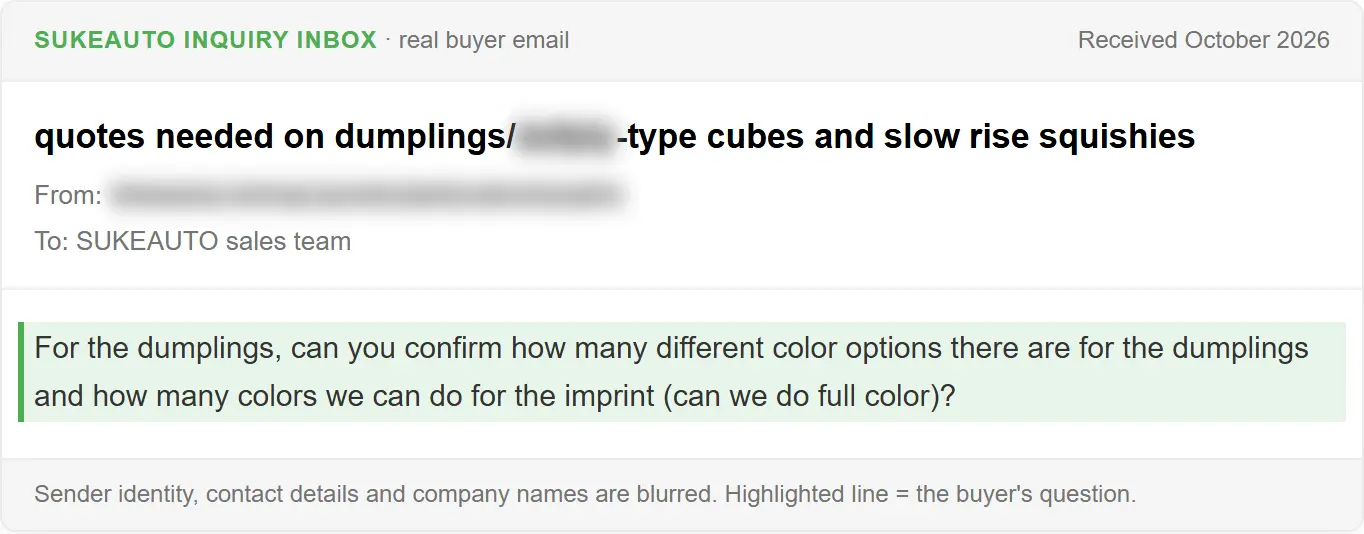
Colour is one of the most visual decisions a buyer makes. 42 of the 408 squishy buyers who wrote to SUKEAUTO between July and October 2026 asked about colours — rising to 18 in October — usually about how many stock colours an item has, whether a full-colour imprint is possible, and whether a brand colour can be matched exactly.
How Colour Matching Is Judged
Matching a colour on a squishy is a physical process, so it needs a physical standard and agreed viewing conditions:
- One reference. A specific Pantone number from a named library, ideally a physical plastics chip for coloured resin; printed Coated or Uncoated chips are references for paper, not plastic.
- One viewing condition. Samples are compared in a light booth under a daylight-simulating source (D65) and at least one other light, against a neutral grey background — the method described in ISO 3668.
- One tolerance. If a numeric tolerance is used, it must name the formula (for example ΔE76 or CIEDE2000), the light source and the observer; “ΔE under 2” alone is not a complete specification, because different formulas give different numbers for the same pair of colours.
- One approved sample that both sides keep.
Why Colours Shift on Soft Material
- The base material. TPR and PU have their own base tones; translucent TPR lets light through, which changes how deep a colour looks.
- Thickness. A thicker wall looks darker and more saturated than a thin one in the same colour.
- Surface finish. Gloss makes colours look richer; matte surfaces look lighter and greyer.
- Light. A colour can match under shop lighting and differ in daylight (metamerism) — which is why two light sources are used.
How Pearl, Glitter and Glow Effects Work
Pearlescent colours use tiny, transparent mica flakes coated with titanium dioxide or iron oxide. Light reflects from layer after layer and interferes, producing a soft shimmer that changes with the viewing angle; the effect is strongest on a dark base and softest on white.
Glitter is precision-cut film, usually metallised PET, mixed into clear fills or skins. Particle size and shape decide whether it reads as sparkle or shine; in thin gels it can settle, while thicker fills such as maltose keep it suspended.
Glow-in-the-dark pigments store light and release it slowly; they lose performance if exposed to moisture unless coated, so they suit sealed or skin-coloured uses better than wet fills.
A Colour Specification You Can Send
Item · Pantone number and library · Physical chip available: yes/no · Effect: none, pearl, glitter, glow · Translucent or opaque · Approve under: D65 and shop light · Quantity per colour
More Colour Questions
Can SUKEAUTO match my brand colour exactly? SUKEAUTO matches to your Pantone reference as closely as the material allows and confirms it on a physical sample before production.
Is a custom colour available on any stock item? On most existing moulds, yes — 2,000 pcs per colour, about 10 days.
Can one squishy have several colours? Yes — multi-colour or rainbow spray painting on the existing mould, from 4,000 pcs.
Will reorders match the first order? SUKEAUTO keeps the approved colour sample and checks each reorder against it.
Can glitter be added to any squishy? To clear skins and fills, yes; opaque fills hide it.
Do neon colours work on squishies? Bright colours work well on TPR; very fluorescent shades can look duller in print on packaging.
Why Your Colour Needs a Written Tolerance
“Match Pantone 123” is a starting point, not a complete specification. Colour measurement uses a number called ΔE (delta E) to describe the difference between a sample and the standard, but different formulas give different numbers for the same pair of colours: the same difference can read about 4.0 in the older ΔE76 formula and about 2.0 in the newer CIEDE2000. A tolerance such as “ΔE under 2” therefore only means something when it also names the formula, the light source and the reference.
For most squishy programmes, a simpler approach works: agree a physical colour standard, compare under daylight in a light booth, and keep the approved sample as the reference for every reorder.
What Changes a Colour in Production
Colour in soft plastics depends on more than the pigment:
- The base material. Each compound has its own natural tint, which shifts the final shade.
- The colour concentrate. Too little looks pale or streaky; too much can change the material’s feel.
- Process heat and speed. Melt temperature, shear and mould temperature all affect how the colour looks.
- Surface finish. A glossy mould surface makes colours look brighter and richer; a matte or textured one makes them look darker and greyer.
- Wall thickness. Thin areas look lighter on translucent materials.
That is why colour is approved on a first-production piece, not only on a flat colour plate: gate position and wall thickness can shift the colour locally. Any change of material, colour concentrate or process is treated as a new colour approval.
Matching Usually Takes a Few Rounds
Colour matching on plastic often takes three or four rounds: a first formula, a small test batch, adjustment, then a final chip for approval and archive. Planning for this in the sample stage avoids pressure later.
Colour Notes for Reorders
Every reorder should start from the same three things: the approved colour sample, the Pantone reference and the written tolerance. Keep one approved piece sealed in a bag away from light, because colours fade over time in daylight. SUKEAUTO keeps its own reference for your colour, so reorders are matched to the original approval, not to memory.
Why Light Colours Need Extra Care
Pale and pastel squishies are popular, but they show the material underneath more than strong colours do:
- Yellowing. Light-coloured TPR and PU can yellow with heat and ultraviolet light. Material grade and stabilisers matter, and so does storage. A pale squishy that sits in a sunny window for weeks will not look like the approved sample.
- Material base. Different grades of TPR age differently; some hold their colour and resist oil migration better than others. Ask your supplier which base is used for light colours.
- Clear and translucent skins. These show any haze, bubbles or uneven filling, so they need tighter control than opaque colours.
Matching the Squishy and the Pack
Brand colours often appear twice: on the squishy and on its box. They will never look identical, because one is a soft, often slightly translucent polymer and the other is ink on board, usually under lamination that deepens the colour. Approve them side by side, in the same light, and aim for a match that reads as the same brand from arm’s length rather than an exact numerical match between two different materials.
Keeping the Approved Colour on Record
The approved colour sample is the reference for every reorder, so it needs to be protected:
- Keep three signed samples: one at the factory, one with you and one spare.
- Store them sealed and in the dark, because light changes the reference itself over time.
- Label each sample with the item, colour name or Pantone number, date and order number.
- For effects, keep a sample of each batch, because glitter and pearl pigments vary slightly from lot to lot and can only be judged by eye.
Photographing Colour for Remote Approval
When you cannot see the sample in person, a photo can still help if it is taken the right way:
- Daylight or a daylight-balanced lamp, not a warm room light.
- A white or neutral grey background, with the Pantone chip or previous sample in the same shot.
- No filters, and white balance set to daylight.
A photo is a guide, not a final approval. For brand-critical colours, approve the physical sample.
Key Terms
- Yellowing — a gradual yellow shift in light colours caused by heat and ultraviolet light.
- Reference sample — the approved sample that later production is checked against.
- Lot — one batch of a raw material such as glitter or pigment.
- Daylight-balanced — lighting that simulates daylight, used for judging colour.
Can SUKEAUTO match my box colour to the squishy? SUKEAUTO approves both together under the same light, so they read as one brand colour.
Will my reorder match the first order? SUKEAUTO checks reorders against the signed reference sample kept from your first order.
Do pastel squishies fade? Light colours can yellow with heat and sunlight; SUKEAUTO advises storing and displaying them away from direct sun.
Sources: SUKEAUTO inquiry inbox — 408 squishy buyers by email and WhatsApp, July–October 2026 · Pantone: plastics standards explained · Sun Chemical: pearlescent pigments primer · Colourwise: why ΔE formulas give different numbers.
Send the Pantone code and item. Related: squishy fillings and feel · back to custom squishy toy manufacturer.
Send Your Inquiry
Tell us the style, quantity, logo or packaging you need and your target date — we reply with the right route and a price range.
Leave A Comment