
Blind-box packaging turns a single squishy into a collectible: the buyer doesn’t know which design or colour they will get, so they buy again. It works especially well for food shapes and colour series on a single mould. This page covers how SUKEAUTO handles the packaging side; for choosing designs and rare variants, see planning a squishy collectible series.
The Three Layers of a Blind Box
- Inner pack — the squishy in a sealed bag so it cannot be identified by touch or sight. Foil-style bags or opaque printed bags are the common choice.
- Mystery box or blind bag — the printed outer that shows the whole series, never the piece inside.
- Checklist card — inside each box, listing every design in the series, with rare pieces shown as silhouettes.
A Working Example: Our Stock Blind Display
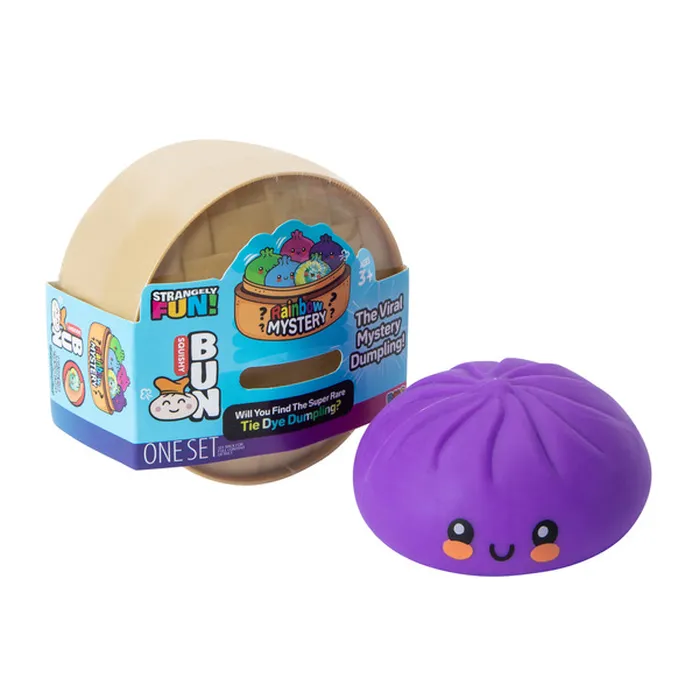
Our stock blind display is a ready-made blind format: each mini steamer cup hides a bun in a random colour, 12 to a display, with a rare golden-glitter piece to find, printed as the hook on the box. It shows the whole mechanic — a series, a rare piece, a counter display — without any new tooling.
Rare Pieces and Carton Ratios
The rare or “chase” piece is usually the same shape in a special finish — gold glitter, pearl or clear. Ratios are fixed per carton: for example one rare piece in every display of 12. The ratio is written on the packing list so every carton ships the same mix.
Counter Display Boxes
Blind boxes sell at the counter. A 12-piece display box is the standard; the outer carton holds a fixed number of displays. Tell us your shelf space and we will suggest the display size.
Minimums for Printed Blind-Box Packaging
Printed mystery boxes, foil bags and checklist cards are branded packaging, so they follow the same rule: 5,000 pcs per design on our existing moulds, no tooling fee. Packaging artwork is laid onto dielines we supply, and we print a proof for your approval before production. See branded packaging for squishies and the full squishy packaging options.
FAQ
Can the rare piece be a different shape? Yes, but a new shape is a new mould (TPR 10,000 per design). Most series use a special colour on the same mould instead.
Can buyers see the series before buying? Yes — on the blind boxes SUKEAUTO packs, the outer box and checklist card show every design.
What Buyers Ask SUKEAUTO About Blind Boxes
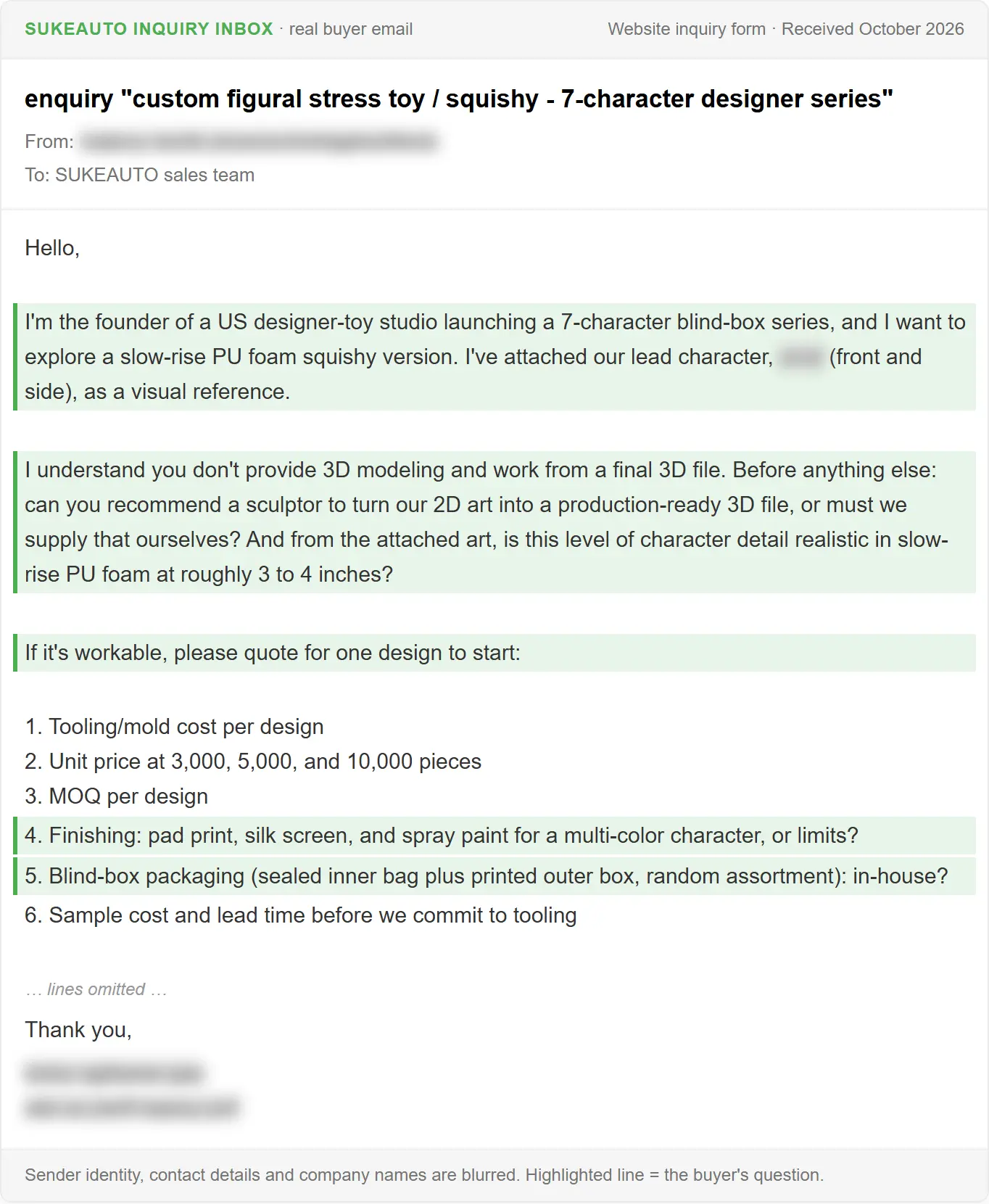
Blind-box squishies come up whenever a buyer is planning a series rather than a single item. Of the 92 squishy buyers who asked SUKEAUTO about packaging between July and October 2026, a growing group — collectible start-ups, designer-toy studios and shop chains — asked specifically about sealed inner bags, random assortments and rare pieces. Their questions are almost always the same four:
- Can you pack a series so each piece is a surprise?
- How do rare pieces work, and can the ratio be controlled?
- Can the outer box show the whole series?
- Is blind-box packing done in-house?
How a Squishy Blind Box Is Put Together
The inner bag hides the piece completely. Opaque foil-style or printed bags stop buyers from identifying a design by light or shape; for squishies they also keep dust off and stop soft surfaces sticking.
The outer box or blind bag shows the whole series — never the piece inside — with the series name, the number of designs and the age grade and warnings.
The checklist card sits inside, showing every design, with rare pieces as silhouettes. It is what turns one purchase into a collection.
The display box holds a fixed number of blind units for the counter.
Ratios: Why Every Carton Must Be the Same
The rule that matters most is that every master carton ships the same mix. If one carton contains a rare piece and the next does not, retailers who open different cartons get different results — and complaints follow. So the ratio is fixed per display and per carton, written on the packing list, and checked when packing. Rare pieces are counted separately so the ratio cannot drift.
The outer carton should not reveal which designs are inside, only the series name, the number of designs and the carton count.
Being Clear With Buyers About Odds
Most toy markets have no single rule for physical blind boxes, but retailers and marketplaces increasingly expect brands to be transparent about how rare a rare piece is. Many brands print a simple line such as “one chase piece per display of 12” on the box or checklist card. It costs nothing and avoids disputes.
Designing a Series That Can Be Produced
- Build the series on one body. Several characters on one mould keep tooling to a single set; colour and print do the rest.
- Make rare pieces a finish, not a shape. Gold glitter, pearl or clear versions of a common design need no extra mould.
- Keep the number of designs realistic. Each printed design carries its own 5,000-piece minimum on branded work.
- Plan the display first. A 12-piece display with one rare piece is easy to explain on the box and easy to pack.
More Blind-Box Questions
Does SUKEAUTO do blind-box packing in-house? Yes. At SUKEAUTO, inner bagging, random assortment by ratio and display packing are done at packing; printed boxes and bags are made to your artwork.
Can I use a stock blind-box display before launching my own series? Yes — SUKEAUTO’s stock blind display is a ready-made blind format with no tooling.
Can each display contain every design? If the number of designs divides into the display count, yes; otherwise the ratio is set across a carton.
What packaging minimum applies to blind boxes? Printed boxes, bags and checklist cards follow SUKEAUTO’s 5,000 pcs per design rule.
Do blind-box squishies need extra testing? The toy is tested like any squishy; the packaging must carry the right warnings for your market.
Mistakes We See in Blind-Box Plans
Most blind-box projects that reach SUKEAUTO are well thought out on the character side and thin on the production side. The same gaps come up again and again:
- Too many designs for the volume. A series of seven or eight characters looks generous on a mood board, but every printed design carries its own 5,000-piece minimum. Start with the core designs and add the rest in a second wave.
- A rare piece that needs its own mould. A chase piece with a different outline doubles the tooling. A gold, pearl or clear version of a common design gives the same excitement with no extra mould.
- Ratios that don’t fit the display. If the display holds 12 units, a ratio that only works across 36 makes some displays rare-free. Choose a ratio that each display or each carton can carry.
- No space for warnings on the box. Age grade, warnings, importer details and a barcode all need room on the outer box; plan them before the illustration fills it.
- Inner bags that show the piece. Thin clear bags under bright shop lights reveal the design. Use opaque bags.
What to Send SUKEAUTO for a Blind-Box Quote
- The number of designs and which of them are rare.
- The body you plan to use — a stock shape or a new mould (3D file).
- Colour and print for each design, as Pantone references and vector files.
- The display size and the ratio you want per display or per carton.
- Outer box, inner bag and checklist-card artwork or dielines, if ready.
- Destination market and age grade.
With this list, the quote can cover the toy, the packaging and the packing method in one go.
How Regulators Look at Blind-Box Odds
Blind boxes sell on surprise, and that makes the odds a consumer-protection question. Rules differ by country, but the direction is the same: if a pack advertises rare or hidden designs, the buyer should be able to find out how rare they are. In China, where blind boxes are a large market, market regulators have published guidance on blind-box sales, and a 2026 enforcement case fined a seller whose outer box showed five regular designs and one hidden design without stating the chance of getting the hidden one anywhere on the pack or at the point of sale.
For buyers selling in other markets, a sensible practice is:
- State the number of designs in the series on the outer box or display.
- If there is a rare or hidden design, state its ratio, such as one per display box, rather than leaving it vague.
- Make sure the packing matches the claim. If the pack says one rare piece per display, every display must contain one.
- Check local consumer and gambling-style rules if you plan paid draws or prize mechanics around the series.
How a Factory Builds a Fixed Ratio
A random-looking assortment is actually packed to a plan. In a typical blind-box packing line:
- Each design is finished and sealed in an identical inner bag that hides which design is inside.
- The bags are kept separate by design until the final pack-out.
- Each display box is filled to a recipe, for example a set number of each regular design and one rare design.
- The filled displays are counted and recorded, so the ratio can be checked at inspection.
- Displays are packed into export cartons with the same number of displays per carton.
Because the recipe is applied display by display, every shop that buys a full display gets the same odds. When orders are split below a full display, that certainty disappears, which is why blind-box series are sold by the display.
Tamper Evidence and Collector Trust
Collectors buy blind boxes partly for the certainty that the box has not been opened and searched. Practical ways to protect that:
- Sealed inner bags that cannot be reclosed invisibly.
- Opaque outer boxes with a seal, sticker or perforated tab.
- Consistent weight between designs where possible, so boxes cannot be sorted by weighing.
- Collector cards or numbered cards inside the pack, which add value and make the series feel complete.
Testing a Series
Each design in a series is a different product for safety purposes: different shape, colours and sometimes filling. Plan for each design to be covered by testing for your market, and make sure accessories, such as cards and stickers inside the box, meet the same age grading as the toy.
Key Terms
- Series — the set of designs sold under one blind-box line.
- Rare or hidden design — a design packed less often than the others.
- Ratio — how many of each design go into one display box.
- Display box — the counter box holding a fixed number of blind packs.
- Tamper evidence — packaging features that show whether a pack has been opened.
Can SUKEAUTO pack one rare design per display? Yes. SUKEAUTO packs blind-box series to the ratio agreed for each display.
Can shops buy less than a full display? Splitting a display breaks the planned ratio, so SUKEAUTO recommends selling blind-box series by the full display.
Can each pack include a card? Ask SUKEAUTO; a printed card is branded packaging and follows the 5,000-per-design packaging minimum.
Sources: SUKEAUTO inquiry inbox — 408 squishy buyers by email and WhatsApp, July–October 2026.
Planning a blind-box line? Send us the series idea and target quantity. Back to custom squishy toy manufacturer · see also our blind box page.
Send Your Inquiry
Tell us the style, quantity, logo or packaging you need and your target date — we reply with the right route and a price range.
Leave A Comment