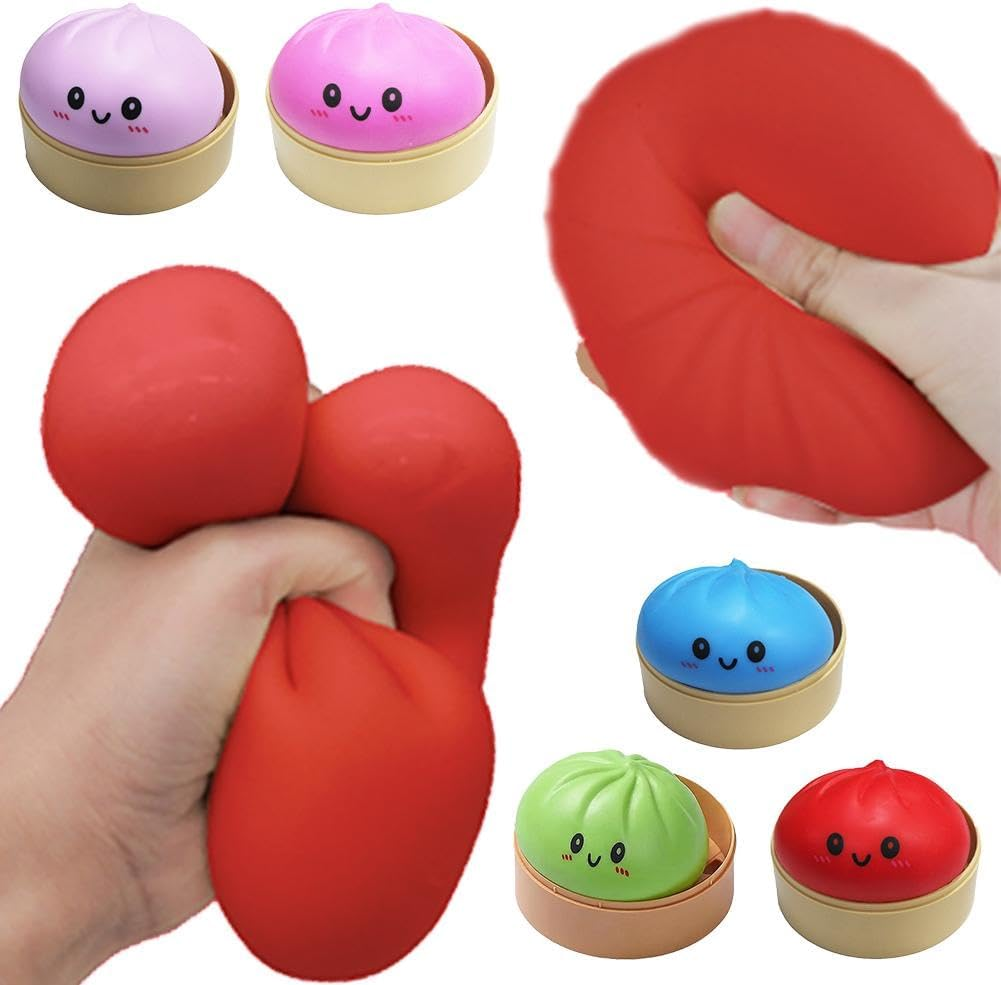
Own-brand and private-label buyers were 50 of the squishy buyers who contacted SUKEAUTO since July 2026. A new toy brand’s first line has two jobs: prove the brand sells, and pass the retailer’s checks. Here is how to plan it.
Your First Line: How Many Designs
Each design carries its own minimum, so fewer designs means a smaller first commitment. Three to six designs is a typical first line; characters that share one body save tooling.
Existing Body (5,000) or Your Own Mould (10,000)
| Existing body | Your own mould | |
|---|---|---|
| What changes | Colour, fill, printed face, your branding | The whole shape |
| Minimum | 5,000 per design (with your branding) | TPR 10,000 / PU 5,000 per design |
| Tooling | None | TPR USD 3,500–4,000 / PU USD 2,000–3,000 |
| Time | Sample 25–35 days, production 20–25 days | Sample 25–35 days, production 30–45 days after approval |
Many brands launch on existing bodies, then tool their hero character once it sells.
Files We Need: 3D for a New Shape
A new squishy shape needs a 3D file (STL or STEP); we review and sample from it but don’t create it. See our custom character squishy process.
Documents Retailers Ask For
Retail buyers typically ask for test reports and certificates for your market, product specifications and carton data. For our TPR squishies: CE + EN 71-1/2/3, a Children’s Product Certificate with ASTM F963-23 / CPSIA, and a REACH report on the material; your own design is tested per order. See squishy safety testing.
Scaling After the First Run
Reorders pay no new tooling. Grow by adding colourways, a rare edition or a second size of what sold — see planning a collectible series.
What New Toy Brands Ask SUKEAUTO
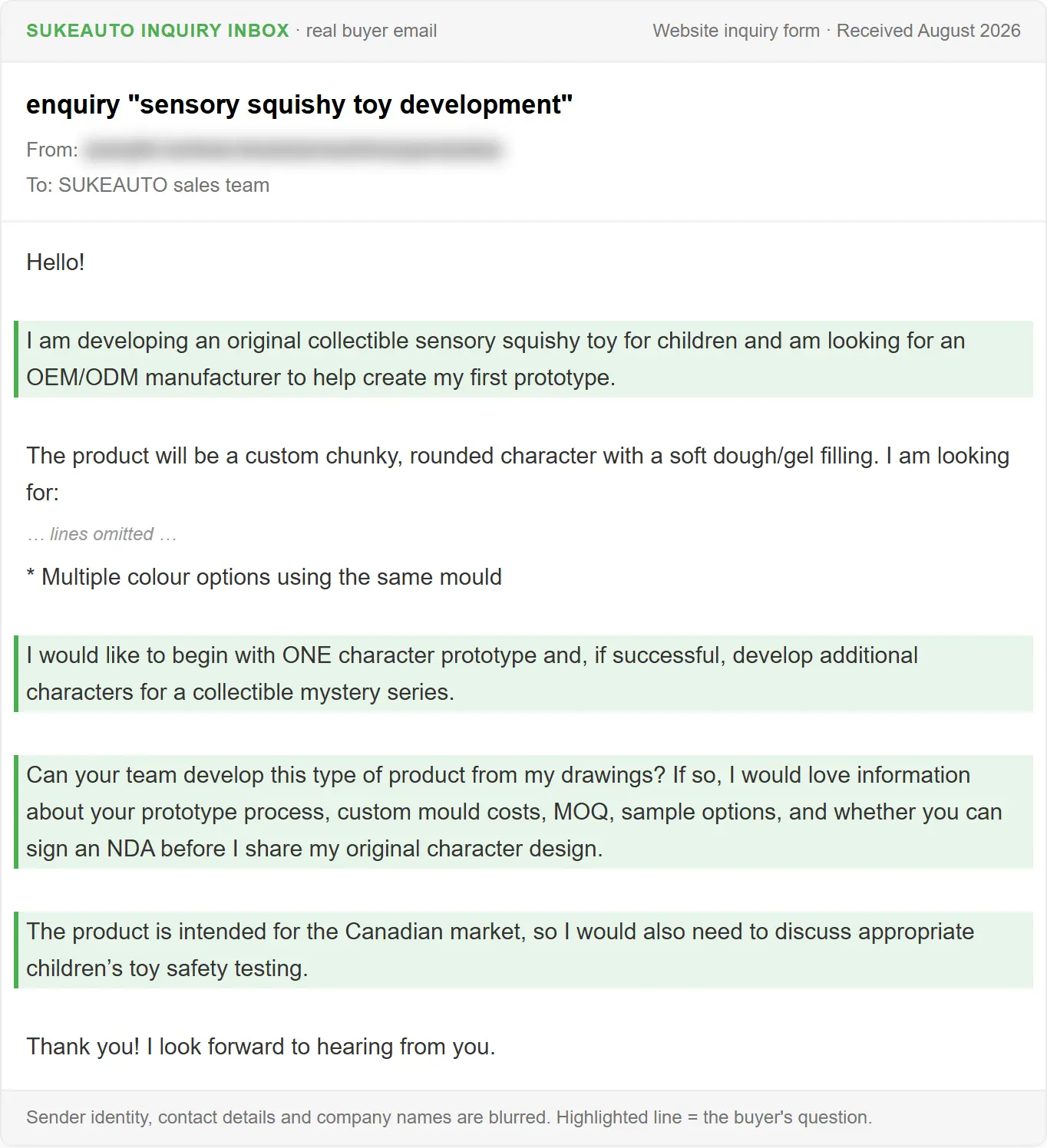
New toy brands write with original characters and big plans, and their questions are about development: prototypes, moulds, minimums, confidentiality and testing. Between July and October 2026, 110 of the 408 squishy buyers who contacted SUKEAUTO asked about custom shapes, 30 asked about tooling and 16 asked about NDAs before sharing designs.
From Concept to a Manufacturable Squishy
An original character becomes a squishy in stages:
- Concept — drawings and a character story.
- 3D model — made by your designer, sized and shaped for soft material.
- Engineering review — wall thickness, fill point, details that will or will not mould.
- Prototype — the first physical sample.
- Revisions — changes to shape, colour and feel.
- Approved sample — the standard for production.
- Testing — for your market.
- Production — the first run.
Most delays happen between stages 2 and 5, when the design meets the reality of soft material. Simple, chunky shapes with moulded-in details move fastest.
Write Down What You Approve
A new brand should approve each stage in writing, against a physical reference:
- Final design — the 3D file version that goes to tooling.
- Pre-production sample — shape, feel and finish.
- Colours — Pantone references and an approved colour sample.
- Size and weight — measured on the approved sample.
- Packaging — artwork, proof and printed sample.
Keep a sealed approved sample yourself. When a production question arises, the sample settles it, not memory.
Understanding Mould and Production Requirements
A new shape means a new mould, which is the largest single cost for a new brand: TPR from 10,000 pcs per design, slow-rise PU from 5,000. The mould is made for your design and used only for your orders. Reorders pay no new tooling, which is why many brands launch with one hero character and add others once it sells.
Testing for Your Market
Each market has its own rules. In Canada, toys must meet the Toys Regulations; in the US, ASTM F963 and CPSIA, with a Children’s Product Certificate; in Europe, EN 71 and the CE mark, moving to the new Toy Safety Regulation. A new design is tested on its own, so build testing time into the launch plan.
More New Toy Brand Questions
Can SUKEAUTO sign an NDA before I share my design? Yes, we are happy to sign a mutual NDA first.
Can you develop from drawings only? A new shape needs a 3D file; SUKEAUTO reviews and samples from it, so brief a 3D designer first.
Can I start with one character? Yes, many brands launch one hero character and add more later.
Who owns the mould? SUKEAUTO makes it for your design and uses it only for your orders.
Can I get several colours from one mould? Yes, custom colours from 2,000 pcs per colour.
How long from 3D file to production? About 25–35 days to the first sample, then 30–45 days after approval.
Retail-Ready From the Start
Retail buyers judge a new brand on more than the product. Before pitching, prepare:
- Test reports and certificates for each market.
- Product specifications — size, weight, material, age grade.
- Carton data — pieces per carton, carton size and weight.
- Barcodes — your own GTIN numbers, printed on every pack.
- A line sheet — wholesale price, suggested retail price, minimum order and lead time.
- Product liability insurance — many retailers ask for it.
- Photos and videos — clean product shots and a squeeze video.
Having these ready signals that a new brand can deliver like an established one.
Protecting Your Design
Register your brand name and, where useful, your design in the markets where you sell. Keep dated records of your design development: sketches, 3D files and approvals. These help if someone copies your character later. SUKEAUTO signs NDAs, keeps your files confidential and produces your design only for you.
Funding the First Run
The first run is the expensive one: mould, samples, testing and the first order arrive before any sales. New brands fund it through savings, pre-orders, crowdfunding or a retail commitment. Whichever route you choose, budget for the full launch cost, not just the factory quotation, and keep reserve funds for the first reorder; a successful launch that cannot be restocked loses momentum.
Building a Brand Family
Once the hero character sells, grow carefully: a second colourway, a seasonal edition, then a second character that shares the first one’s body or style. Each addition reuses what you already built, from tooling to packaging and testing knowledge, and keeps the brand recognisable on the shelf.
New Brand Launch Checklist
- Character finalised — 3D file approved for tooling.
- Sample approved in writing — shape, feel, colour, size.
- Testing booked — for every launch market.
- Packaging approved — proof and printed sample.
- Barcodes and labels ready — GTINs, warnings, importer details.
- Retail pack ready — line sheet, photos, video, documents.
- Launch stock and reorder budget set.
Common New Brand Mistakes
- Too many characters at once — each carries its own minimum and tooling.
- Fine detail in the design — it disappears on soft material.
- No written approvals — disagreements later with nothing to check against.
- Testing left until the end — a failed test delays the launch.
What a Factory Partner Expects From a New Brand
A good factory relationship works both ways. New brands that move fastest send complete files, give feedback in one clear list per sample round, approve in writing and plan orders around realistic lead times. They also share their launch plans early, so production can be scheduled before peak seasons. SUKEAUTO works with many first-time brands and is happy to explain each step; the clearer the brief, the faster the character reaches the shelf.
The Contract Terms a New Brand Should Not Skip
A first production order is often agreed on a proforma invoice and a few emails. For a new brand with its own designs, a short manufacturing agreement, or a clear set of terms on the PI, prevents most later disputes. The points to cover:
- Specification. Material, size, colours, filling and packaging, written out, with the approved sample as the reference. “Food grade” or “high quality” is not a specification.
- Intellectual property. You own your designs, artwork and moulds; the factory produces them only for you and does not use them for anyone else, in the same or a modified form.
- Samples and approval. Which samples are made, who approves them and how the approved sample is kept.
- Quality and inspection. The inspection method, the acceptable defect level and what happens to goods that fail.
- Lead time. What starts the clock, the shipping date and how delays are communicated.
- Payment and tooling. The payment split, the tooling fee as a separate line and mould ownership.
- Confidentiality. Your unreleased designs stay confidential, before and after launch.
- Disputes. Which law applies and where disputes are settled.
File Your Design Before You Show It
New brands often post renders and prototypes online to build interest. That can be a mistake: in many countries a design registration requires the design to be new when you file, and your own earlier posts can count against you. A safer order is:
- Finish the design and the 3D file.
- File the design registration and trademark applications in your key markets.
- Then show the design, start pre-orders and approach retailers.
Validating Demand Before the Mould
The biggest risk for a new brand is paying for tooling before knowing whether the product sells. Ways to reduce it:
- Start on a stock body. Put your brand and colours on an existing SUKEAUTO shape at 5,000 pcs per design, with no tooling, to test your packaging, price and channels.
- Collect pre-orders for the new design using renders and a sample, before committing to the full mould and minimum.
- Launch one hero design first, then expand the family once it sells, reusing packaging formats and colour standards.
What Retail Buyers Check Before Listing a New Brand
Shops and distributors often ask new brands for more evidence than established ones. Have ready:
- Test reports for the markets you sell in, covering every design.
- Product photos, carton specifications and barcodes for each item.
- Clear age grading and warnings on the pack.
- A reliable reorder lead time.
- Product liability insurance, which many retailers require.
Key Terms
- Manufacturing agreement — the contract setting out what a factory makes, to what standard and on what terms.
- Design registration — protection for a product’s appearance.
- Hero product — the lead item a new brand launches first.
- Pre-order — an order taken before the product is made.
Does SUKEAUTO sign an NDA before I share designs? Yes. SUKEAUTO signs an NDA before reviewing unreleased designs.
Can I start my brand on a stock squishy? Yes. SUKEAUTO puts your brand on stock bodies from 5,000 pcs per design, with no tooling fee.
Who owns my mould? You do; SUKEAUTO uses a mould made for your design only for your orders.
Sources: SUKEAUTO inquiry inbox — 408 squishy buyers by email and WhatsApp, July–October 2026 · Justice Laws Website: Canada Toys Regulations SOR/2011-17 · CPSC: Toy Safety business guidance · EU General Product Safety Regulation (EU) 2023/988.
Send your brand idea and first-line plan. We’re happy to sign a mutual NDA first. Back to custom squishy toy manufacturer.
Send Your Inquiry
Tell us the style, quantity, logo or packaging you need and your target date — we reply with the right route and a price range.
Leave A Comment