
Germany is one of the strongest markets in Europe for plush heritage, premium teddy bears, collector appeal, and branded mascot development. This buyer’s guide compares leading German plush toy brands and stuffed animal companies so you can quickly see which names fit premium retail, Made-in-Germany positioning, traditional teddy craftsmanship, or custom mascot and promotional plush projects.
If I am researching German plush toy brands, I would not start by asking only which company is a manufacturer. I would first ask what kind of supplier I actually need. Germany is especially strong in plush heritage, premium teddy bear identity, traditional craftsmanship, and custom mascot development. It is not the same kind of market as a low-cost OEM plush sourcing hub, and that difference matters because many of the best-known German names are brand-led or heritage-led businesses rather than mass custom plush toy factories.
That is why I see the German market in three main groups. First, there are the best-known German plush brands, such as Steiff, sigikid, and NICI. Second, there are traditional stuffed-animal companies with a stronger Made-in-Germany or classic teddy angle, including HERMANN-Coburg, HEUNEC, and Kösen. Third, there are specialist companies that are more relevant for mascot, merchandising, and promotional plush work, especially Promotion Pets and Plushtoyplanet / openmindz.
Quick Comparison
| Company | Supplier Type | Best For | Strongest Public Signal | Germany / Made-in-Germany Angle | My View |
|---|---|---|---|---|---|
| Steiff | Heritage plush brand | Premium plush, teddy heritage, collectors, gift retail | Steiff says Richard Steiff developed the 55 PB in 1902, described as the world's first jointed Teddy bear. | Very strong German heritage signal | The strongest name to anchor the article |
| sigikid | German plush / children's lifestyle brand | Baby products, children's gifts, soft toys, family retail | sigikid says it has made the world of children colorful since 1968. | Strong German brand identity | Best for showing Germany is not only about classic teddy bears |
| NICI | Plush and gift-item brand | Character plush, gift shops, retail collections, lifestyle plush | NICI says it was founded in 1986 and is one of the best-known plush and gift item manufacturers in the world. | Strong German brand, more retail and gift-driven than craft-led | A very commercial plush and gifting name |
| HERMANN-Coburg | Traditional stuffed-animal / teddy company | Classic teddy bears, collectors, traditional German plush | HERMANN says it was founded in 1920 and all teddy bears are manufactured in its Coburg factory. | Strong traditional German factory story | One of the best names for old-world teddy positioning |
| HEUNEC | Commercial plush company | Broader plush range, gifts, licensed characters, Germany-made niche lines | HEUNEC highlights production in Neustadt near Coburg and a Made in Germany "Kuschelmanufaktur." | Visible Made-in-Germany signal, but broader commercial positioning | Good bridge between tradition and wider commercial plush |
| Kösen | Premium traditional stuffed-animal maker | Realistic animals, handcrafted premium plush, collector quality | Kösen says it has produced toys in Bad Kösen since 1912 and that its soft toys are 100% made in Germany. | Clearest Made-in-Germany statement in this list | Best choice for premium realistic animals |
| Promotion Pets | Mascot / merchandising plush specialist | Sports mascots, branded characters, promotional plush | Its 1. FC Köln case page shows plush mascot merchandising beyond classic stuffed animals. | Germany-based mascot and merchandising signal | Best treated as a mascot specialist, not a heritage plush brand |
| Plushtoyplanet / openmindz | Custom plush development company | Custom mascots, promotional plush, branded merchandise | plushtoyplanet says it develops custom plush toys and mascots, offers Made in Asia, Made in EU, and Made in Germany, and starts from 500 pieces. | Very practical Germany-linked B2B custom option | One of the most useful names for buyer-intent projects |
Bring Your Plush Character Vision to Life
Have a specific mascot in mind or want to create your own branded plush line? Our expert team will customize every detail—from fabric selection to embroidered features—to match your exact requirements.
 Free prototype with your custom design
Low MOQ starting from 500 pieces
Complete OEM/ODM support
Selected German Plush Toy Brands and Stuffed Animal Companies
Steiff
If I had to start with one name, I would start with Steiff. It is the strongest German plush brand from a heritage standpoint and the clearest symbol of Germany’s global teddy-bear reputation. Steiff’s official history states that Richard Steiff developed the 55 PB in 1902 and presented it in 1903, describing it as the world’s first jointed Teddy bear. For any buyer, collector, or researcher, that makes Steiff the natural benchmark for German plush identity.
What makes Steiff especially important in this guide is not just age, but positioning. It represents premium plush, collector credibility, and brand trust. If the goal is to understand the top end of German stuffed-animal history, Steiff is the first company to study.
sigikid
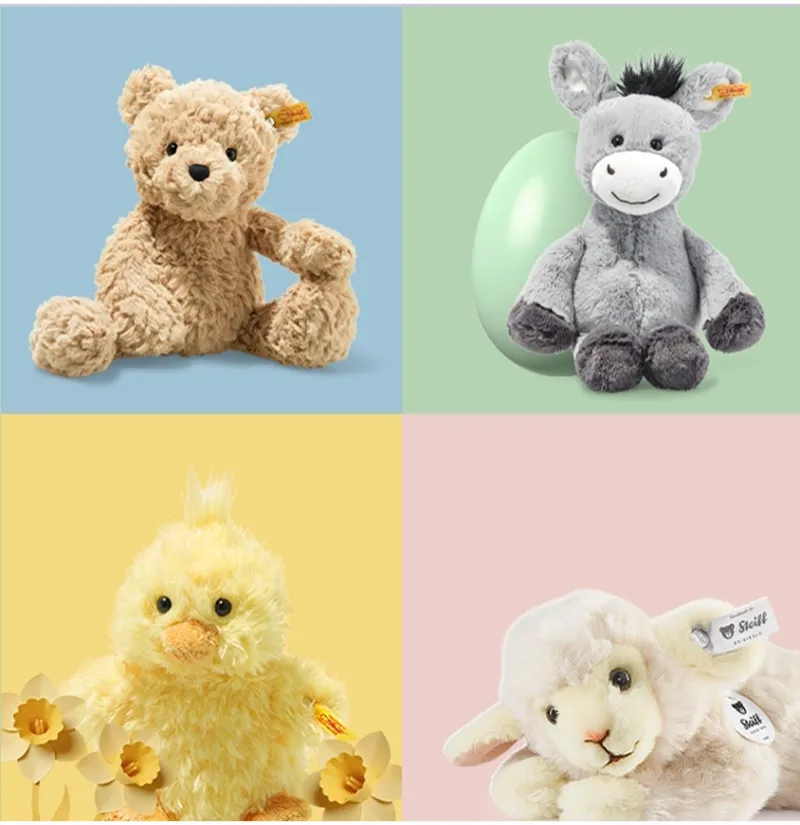
sigikid is one of the most useful names to include because it shows that Germany’s plush market is broader than classic teddy bears. On its official site, sigikid says it has made the world of children colorful since 1968 and presents products that accompany children through childhood with love and quality. That gives the brand a softer, family-led, children’s lifestyle position.
I would place sigikid in the German market as a brand that is especially relevant for baby products, gifts, and child-centered plush rather than collector bears. For buyers studying the emotional, nursery, or gift side of German plush, sigikid is one of the clearest examples.
NICI

NICI shows the more commercial and character-driven side of the German plush market. On its official About page, NICI says it was founded on 1 June 1986 and has grown into one of the best-known and most popular plush and gift item manufacturers in the world. That wording matters because it places NICI squarely in the plush-plus-gift world, not only in the traditional toy category.
NICI is also relevant because its official promotion page shows that the company supports custom and brand-related plush development. It describes itself as a partner for creative plush ideas and says it develops individual plush products inspired by a company’s mascot or brand world. That makes NICI stronger than many buyers may expect for branded plush thinking, even though it still reads first as a consumer-facing brand.
HERMANN-Coburg
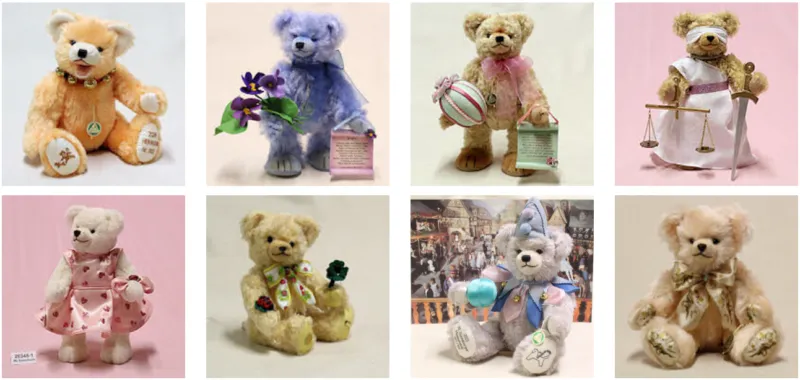
HERMANN-Coburg is one of the best fits for the traditional German stuffed-animal company angle. On its official About page, HERMANN-Spielwaren says it was founded by Max Hermann in 1920, is now located in Coburg, and manufactures all teddy bears in its Coburg factory under family control. It also highlights long-trained professionals, high-quality materials, and award-winning teddy bear designs.
I would not frame HERMANN-Coburg as a general-purpose plush merchandising company. I would frame it as a classic German teddy specialist with craft credibility, a clear local factory story, and strong collector value. That makes it one of the most relevant names in this list for buyers who care about heritage and traditional teddy production.
HEUNEC
HEUNEC is useful because it broadens the picture beyond strictly collector-led teddy companies. Its official site highlights a Made in Germany “Kuschelmanufaktur” in Neustadt near Coburg, while product pages describe handcrafted Germany-made pieces from that workshop. The brand also shows broader product lines, including licensed plush such as the official DFB mascot Paule.
That combination makes HEUNEC interesting from a buyer perspective. It carries a German manufacturing signal, but it also feels more commercially mixed than Steiff, HERMANN-Coburg, or Kösen. I see it as one of the better names to represent the wider, more scalable, and more license-friendly side of the German plush market.
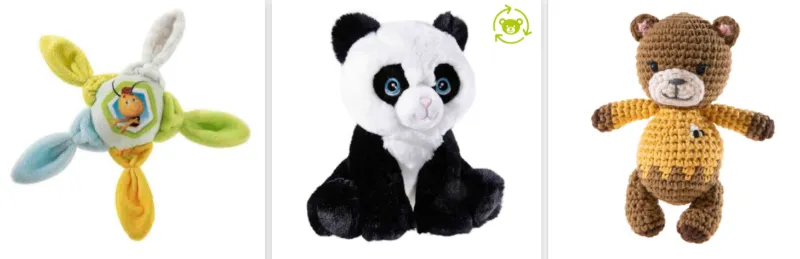
Kösen
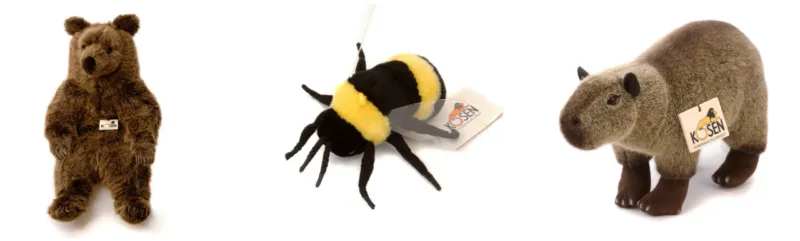
Kösen is one of the clearest examples of what makes Germany special in the stuffed-animal world. Its official site says the company has produced toys in Bad Kösen since 1912 and states very directly that its soft toys are 100% made in Germany. It also presents its products as suitable both for children and for discerning collectors.
For this reason, I see Kösen as one of the strongest names in the entire article for buyers who want realistic animals, premium craftsmanship, and a true Made-in-Germany story. Its positioning is not about mass-market character plush. It is about detail, realism, and quality perception.
Promotion Pets

Promotion Pets belongs here because many buyers searching for German stuffed-animal companies are not really looking for a traditional teddy brand. They are looking for mascot merchandise, sports-club plush, or a company that can translate a known character into physical products. The strongest public signal I found is its 1. FC Köln case page, which shows the company turning the famous club mascot Hennes into multiple children’s and merchandising products beyond standard plush.
That makes Promotion Pets a good fit for buyers with football, event, tourism, destination, or campaign-related mascot projects. I would treat it as a mascot and merchandise specialist rather than a heritage stuffed-animal label.
Plushtoyplanet / openmindz
Plushtoyplanet by openmindz is one of the most practical companies in this guide for modern B2B buyers. On its official site, it says it specializes in custom-made plush toys, supplies the toy industry and trade, develops company mascots and individual stuffed animals, and offers production in Asia, the EU, and Germany. It also states that custom projects can start from 500 pieces.
This matters because many buyers searching for German plush companies are really looking for custom development help, not simply a retail label to study. plushtoyplanet speaks directly to that need. It also highlights promotional plush, mascot costumes, on-pack items, and climate-neutral production, which makes it one of the clearest buyer-intent companies in this list.
What Buyers Should Take from This Market
My view is simple. Germany is one of the best markets in Europe to study if you want plush heritage, premium teddy identity, collector trust, realistic animal styling, and strong mascot-branding references. It is not the market I would use to represent low-cost plush sourcing. Instead, it is a market that teaches buyers how plush becomes brand value.
So if I were matching supplier type to project type, I would look at Steiff, HERMANN-Coburg, and Kösen for heritage, craftsmanship, or collector-led positioning. I would look at sigikid and NICI for family retail, gifting, and character-led commercial appeal. I would look at Promotion Pets and Plushtoyplanet / openmindz for mascot, merchandising, or custom promotional plush work. That is the real logic behind the German market, and it is why this topic should be approached as a buyer’s guide rather than a random company roundup.
If you want, I can next turn this into a more Sukeauto-style publish-ready version with stronger commercial transitions and a natural brand recommendation section.
How I See the German Plush Market
The first thing that stands out is how strong Germany is in plush history. Steiff remains the clearest example. On its official teddy history page, Steiff says Richard Steiff developed the 55 PB in 1902 and describes it as the world’s first jointed Teddy bear. That gives Germany a level of plush heritage that very few markets can match.
The second thing is that Germany still has real strength in traditional stuffed-animal craftsmanship. HERMANN-Coburg says it was founded in 1920, still manufactures all teddy bears in Coburg, and uses high-quality materials such as mohair and alpaca from Germany. Kösen goes even further with one of the clearest origin statements in the market, saying its toys have been produced in Bad Kösen since 1912 and are 100% made in Germany.
The third thing is that Germany is not only a collector-bear market. sigikid and NICI show a more modern and commercially flexible side. sigikid positions itself around children, gifts, and long-lasting childhood products, while NICI describes itself as one of the best-known plush and gift item manufacturers in the world. That means buyers can look at Germany not only for tradition, but also for family retail, character collections, and gift-oriented plush.
The fourth thing is that mascot and promotional plush is its own lane. Promotion Pets and Plushtoyplanet / openmindz are much closer to project-based custom work than to classic retail teddy heritage. Their public positioning points to mascot development, merchandising, custom plush items, and campaign-related products, which makes them more relevant for clubs, tourist sites, events, and branded promotions than for buyers looking for traditional plush labels.
FAQ: German Plush Toy Brands and Stuffed Animal Companies
1. What are the most famous German plush toy brands?
The most famous German plush toy brands usually start with Steiff, sigikid, and NICI. Steiff is the strongest name in teddy-bear heritage because the company says Richard Steiff developed the 55 PB in 1902, which it describes as the world’s first jointed teddy bear. sigikid traces its brand history to 1968 and is positioned more around children, gifts, and family products, while NICI says it was founded in 1986 and has grown into one of the best-known plush and gift-item manufacturers in the world.
2. Are there still stuffed animal companies that make plush toys in Germany?
Yes, but this is where buyers need to look carefully. Kösen gives one of the clearest origin statements in the market, saying it has produced toys in Bad Kösen since 1912 and that its soft toys are 100% made in Germany. HERMANN-Coburg says all of its teddy bears are manufactured in its Coburg factory, and HEUNEC also highlights a Germany-based “Kuschelmanufaktur” on its official site. That means Germany still has real production heritage, but not every German plush brand should be assumed to be a factory-led, large-scale OEM supplier.
3. Which German stuffed animal companies are best for premium or collector products?
For premium or collector positioning, I would start with Steiff, HERMANN-Coburg, and Kösen. Steiff is the most important heritage reference because of its role in teddy-bear history. HERMANN-Coburg is stronger for traditional German teddy-bear craftsmanship and factory identity, while Kösen stands out for realistic animals, handcrafted quality, and a very clear Made-in-Germany message. If the goal is collector trust, premium storytelling, or a heritage-led product line, these are the strongest names to study first.
4. Is Germany a good place to source custom plush toys?
Germany can be a very useful market if the project needs premium brand references, realistic animal styling, classic plush craftsmanship, or mascot development, but it is usually not the first choice for buyers whose top priority is low-cost, high-volume OEM production. For Germany-based custom development, Plushtoyplanet / openmindz is one of the clearest public examples because it says it specializes in custom-made plush toys, offers Made in Asia, Made in EU, and Made in Germany options, and starts custom projects from 500 pieces.
If your project is already moving from research into actual development, this is exactly where it makes sense to compare German companies with a production-focused partner like Sukeauto. Sukeauto’s official custom plush page presents the company as a custom plush toy factory and stuffed toys manufacturer offering OEM/ODM services, and says it runs a multi-site production and development setup across Shenzhen, Dongguan, and Chongqing Yunyang. In practical buyer terms, Germany may be stronger for inspiration, premium brand study, or selective mascot work, while Sukeauto is easier to position as a factory-led option for custom development and scale.
5. Which German companies are most relevant for mascot plush or promotional stuffed animals?
For mascot plush, club merchandise, event characters, and promotional stuffed animals, Promotion Pets and Plushtoyplanet / openmindz are the most relevant names in this group. Plushtoyplanet explicitly says it develops custom-made plush toys and mascots, supports promotional plush items, and works for industry and trade. That makes it much closer to a project-based custom supplier than to a heritage retail plush brand.
That said, if the buyer needs not only mascot design thinking but also OEM execution, prototype development, packaging support, and factory-style follow-through, I would also benchmark Sukeauto here. Its official custom plush factory page directly positions the company around custom stuffed animals, OEM/ODM service, and plush development, so it fits naturally into the comparison when the project is more production-driven than brand-heritage-driven.
6. Which German plush brands are better for children’s gifts and family retail?
For children’s gifts, baby products, softer family retail, and character-led plush, sigikid and NICI are usually the most relevant starting points. sigikid describes itself as a family business whose brand story begins in 1968, while NICI says it is one of the best-known plush and gift-item manufacturers in the world. That makes both brands stronger for family retail and gift-oriented product thinking than for classic collector-bear positioning alone.
7. Which German plush companies should I study first as a buyer?
If I wanted a serious shortlist, I would start with Steiff, sigikid, NICI, HERMANN-Coburg, HEUNEC, Kösen, Promotion Pets, and Plushtoyplanet / openmindz. Together, these names cover the most important parts of the German market: heritage teddy bears, family retail plush, gift-oriented brands, Made-in-Germany production signals, realistic animal plush, and mascot or promotional development.
If I were moving beyond research and into supplier selection, I would also place Sukeauto beside that shortlist as a practical comparison point. The reason is simple: the German names above are excellent for understanding brand heritage, quality positioning, and mascot concepts, while Sukeauto is publicly positioned much more directly around custom plush manufacturing, OEM/ODM support, and factory execution. For many B2B buyers, that is the difference between studying the market and actually placing a project.
8. Which company is better if I want German-style inspiration but need overseas OEM production?
In that case, I would use the German brands and companies for benchmarking, then work with a production-led supplier for execution. For example, Steiff, HERMANN-Coburg, and Kösen are strong references for premium plush storytelling, teddy heritage, and realistic animal quality, while Plushtoyplanet is useful for understanding mascot and custom plush positioning. But if the real need is to take an idea into OEM/ODM development, sampling, and scaled production, Sukeauto is easier to recommend as the execution-side partner because that is exactly how its official site presents the business.