
The U.S. custom plush market is strong, but supplier type matters. Some companies are true product developers, some focus on mascots and promotions, and some use U.S.-based teams with overseas production.
If you are searching for custom plush toy manufacturers in the USA, the biggest mistake is to assume every U.S.-facing plush company is the same. In this market, some suppliers are strong in retail and licensed development, some are best for mascot and event plush, some offer hybrid U.S. finishing with imported components, and some are really project managers or distributors rather than full domestic plush factories.
That is exactly why this article is not just a “top companies” list. I am treating the U.S. market as a project-fit market. The right supplier for a university mascot, a museum gift plush, a nonprofit campaign, or a private-label retail line is not always the same. Public evidence also shows that “USA supplier” and “Made in USA” are not interchangeable claims.
For U.S. buyers, this matters even more because compliance is not optional. CPSC guidance says firms must determine which ASTM F963 toy requirements apply to their product, and children’s products subject to applicable rules require third-party testing and a written Children’s Product Certificate.
Quick Comparison About American Plush Toy Manufacturers
| Company | Best For | U.S. Manufacturing Angle | Why It Stands Out |
|---|---|---|---|
| Beverly Hills Teddy Bear Company | Retail plush, private label, licensed and promotional programs | U.S. company with offices in New York, California, and Hong Kong | One of the strongest broad custom plush development profiles in this list |
| Joyus Toyus USA | Hybrid U.S. finishing, collectibles, crowdfunding, mixed USA/China options | Explicit hybrid U.S. factory claim | One of the clearest public hybrid-USA plush models |
| Mascot Factory | Schools, teams, charities, fundraisers, promo plush | U.S.-based operation in California | Strong fit for mascot and event-driven plush programs |
| Stuffed Animal Pros | Flexible custom orders, mascots, authors, nonprofits, gift shops | U.S.-based team with overseas production support | Strong service model and unusually broad order-size positioning |
| Vermont Teddy Bear | Corporate gifts, premium teddy programs, emotional brand campaigns | Real made-in-USA handcrafted lines plus custom program | Best fit when brand story matters more than pure factory scale |
| DOUGLAS Promotional Plush | Stock-plus-custom promotional plush | U.S. design with Asia manufacturing | Strong catalog depth for promo and breed-specific animals |
| Bears for Humanity | Organic, fair-trade, mission-led plush | U.S. brand, but production in India | Best eco and ethical positioning in this group |
| Custom Plush Innovations | Retail and promo custom plush for North American buyers | Canada-based, serving U.S. clients | Relevant to U.S. buyers, but not a U.S. manufacturer |
| Promo Bears USA | Schools, sports, mascots, giveaways | Netherlands-based company serving U.S. buyers | Useful for mascot-style projects, but not a U.S. factory |
Customize Your Toys Ideas for Your Needs
We deliver tailored solutions for every client and provide free plush prototypes or packaging samples to bring your vision to life. Explore our innovative approaches.
Best Custom Plush Toy Manufacturers USA Buyers Should Know
CustomPlush.com / Beverly Hills Teddy Bear Company
If I were choosing the strongest mainstream name to anchor this article, I would start with CustomPlush.com and Beverly Hills Teddy Bear Company. CustomPlush says it is a division of Beverly Hills Teddy Bear Company, describes itself as a custom toy manufacturer with 30 years of experience, and says it serves clients through offices in New York, California, and Hong Kong. Its pages also position the business around private label, retail, movie studios, promotions, and larger brand programs.
That matters because it reads more like a real plush development business than a simple promo-products reseller. For U.S. buyers building retail plush, licensed merchandise, or branded promotional lines, that kind of positioning is stronger than a generic “custom teddy” site with no sign of real development depth.
Joyus Toyus USA
Joyus Toyus is one of the most important names in this article because it openly describes a hybrid domestic model instead of simply claiming to be “USA-based.” Its site says it is an American custom plush toy factory, offers both China and USA manufacturing options, and explains that its U.S. operation can support hybrid production and certain “Made in USA with Imported Materials” projects.
For buyers, that is useful because it is more honest than a vague domestic claim. If your project needs a U.S. touchpoint, domestic finishing, warehousing, or a tighter origin-story angle, Joyus Toyus is worth attention. But it should still be understood as a hybrid model, not a blanket example of fully domestic plush manufacturing.
Mascot Factory
Mascot Factory is a strong fit for buyers focused on mascot plush, school programs, sports fundraising, charity giveaways, and simpler branded plush campaigns. The company says it has been manufacturing and personalizing plush animals since 1999, serves corporations, schools, teams, and charities, and operates from Poway, California.
It is also one of the more useful U.S. entries from a compliance-signaling standpoint. Its site says products are designed and manufactured to meet or exceed CPSC safety standards and that it uses third-party testing companies approved by the CPSC. That does not replace buyer due diligence, but it is still a meaningful public signal for school and community-focused plush projects.
Stuffed Animal Pros
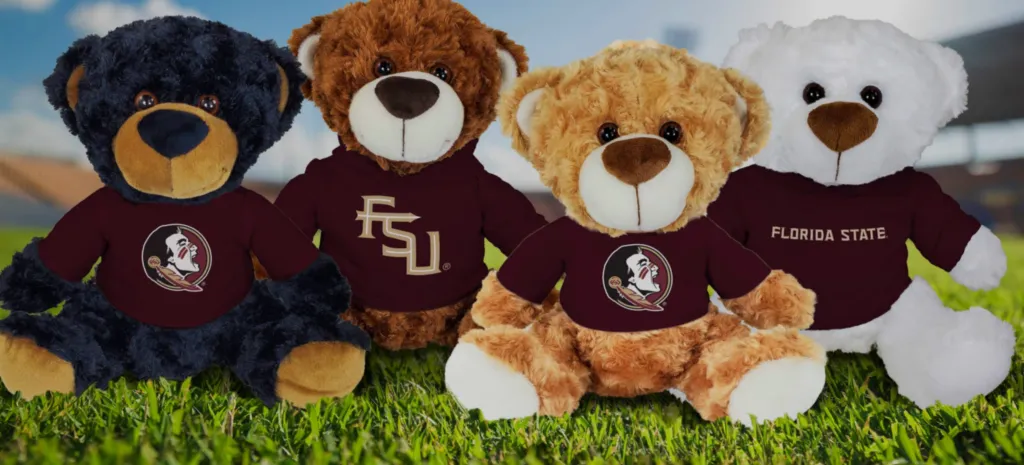
Stuffed Animal Pros deserves a place here because it represents a model many U.S. buyers actually use in practice: a U.S.-based team managing custom plush development with overseas production support. Its site says it is a U.S.-based team, provides project managers, supports basic product design, and can scale from very small orders up to large volumes.
That makes it especially relevant for authors, indie brands, nonprofits, gift shops, and mascot-led projects where the buyer wants more communication support than a pure factory-direct route. It is less about a “Made in USA” story and more about service, flexibility, and easier project handling for North American clients.
Vermont Teddy Bear
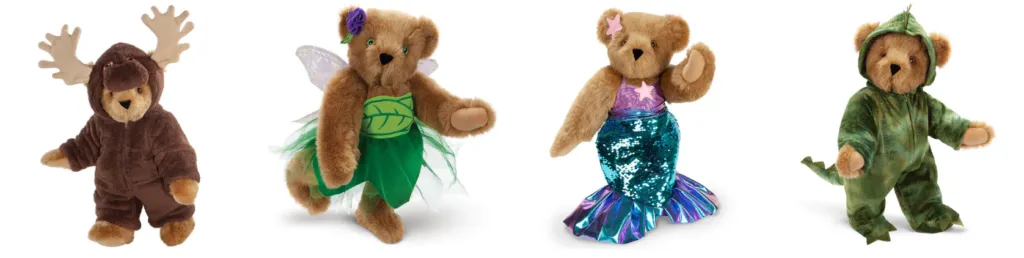
Vermont Teddy Bear adds a different but valuable angle to this page. Its site promotes made-in-the-USA handcrafted teddy bears and says its corporate gifts division offers custom plush manufacturing for company projects. That combination is unusual in a good way.
I would not treat Vermont Teddy Bear as the default answer for every plush OEM brief. I would treat it as a strong choice for premium gifting, anniversaries, employee-recognition programs, hospitality gifting, and brand campaigns where the emotional story of the product matters as much as the plush itself.
DOUGLAS Promotional Plush
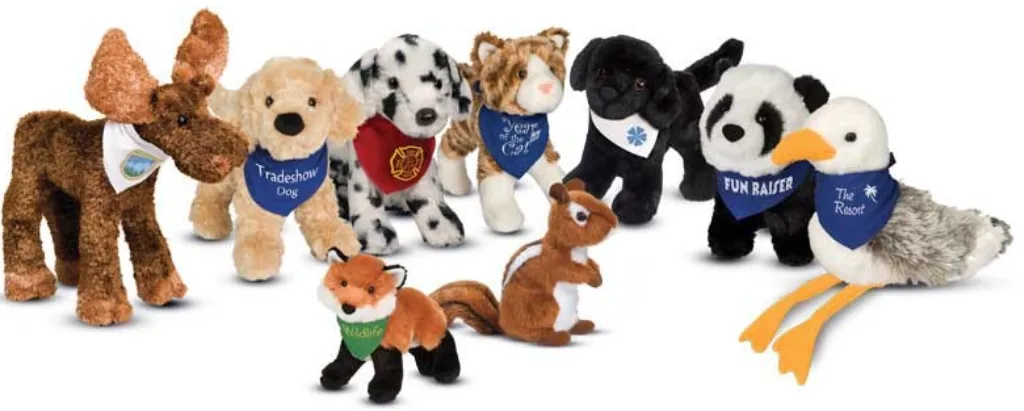
DOUGLAS is one of the best names for the promotional side of the U.S. plush market. Its promotional division says it has more than 400 stock stuffed animals, offers custom plush made to order, and uses a U.S.-based in-house design department. Its about page also says the company has been family-owned for more than 69 years.
That makes DOUGLAS especially useful for promo plush, breed-specific animal programs, stock-plus-custom campaigns, tourism gift lines, and event giveaways. It is not presenting itself as a fully domestic plush factory, but it is a very credible U.S. plush company for branded promotional work.
Bears for Humanity
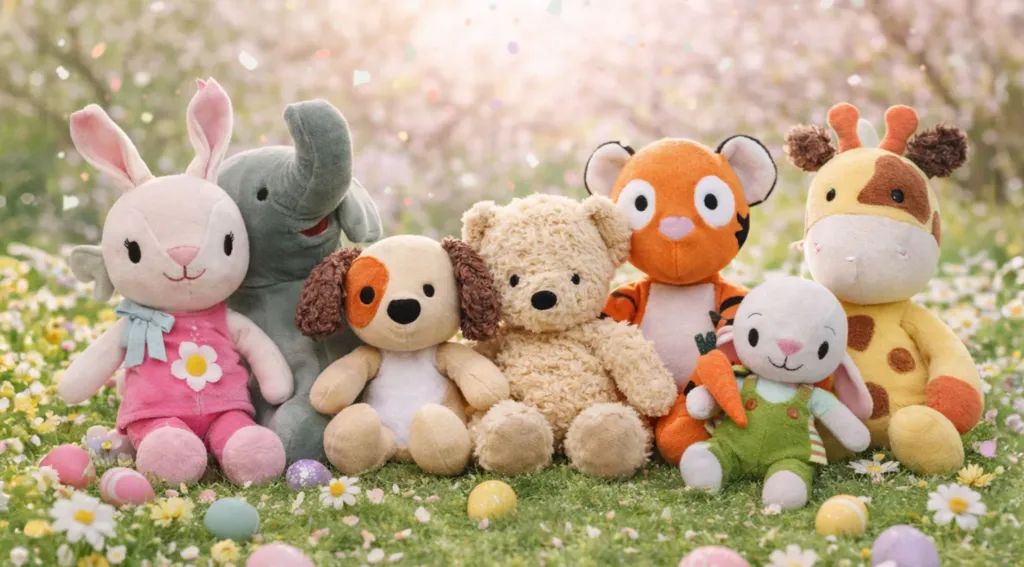
Bears for Humanity is worth including because it gives the article a strong ethical and organic sourcing angle. Its official pages say it offers custom plush manufacturing, uses organic materials, is a member of the World Fair Trade Organization, and makes its plush toys in fair-trade facilities in India.
That means it should not be framed as a U.S. factory. It is better understood as a U.S.-facing ethical plush brand with a custom program. For schools, mission-led brands, eco-conscious buyers, and nonprofit-style campaigns, that can still be a strong fit.
U.S.-Facing Names Buyers Will Also See, But They Are Not U.S. Manufacturers
Custom Plush Innovations is relevant because many U.S. buyers will find it during a search. Its official pages say it is a family-owned business in London, Ontario, serves clients across Canada and the United States, and offers retail and promotional custom plush with a published MOQ of 500 and prototype-stage support.
Promo Bears USA is similar. Its custom plush page is useful for schools, sports teams, and events, with a published MOQ of 500 and an ASTM/EN71 compliance claim. But its contact page identifies the company as Promo Bears B.V. in Groningen, Netherlands. That makes it relevant to U.S. buyers, but not a U.S. plush manufacturer.
Why Stuffed Animal Manufacturers Type Matters So Much in the USA
In the U.S. plush market, the real buying question is not just “Who can make plush?” It is “Who fits my project type?” A retail plush line, a school mascot plush, a museum souvenir plush, and a corporate teddy-bear gift program are four very different sourcing jobs. Public company positioning makes that clear.
That is also why buyers should separate four different supplier types: full custom development companies, mascot and promotional specialists, made-in-USA or handcrafted gift brands, and U.S.-managed overseas production teams. Once you split the market that way, the supplier list becomes much more useful and much more honest.
Trade Shows U.S. Plush Buyers Should Watch
If you are serious about the U.S. plush market, Toy Fair should stay on your radar. The 2026 edition took place February 14 to 17, 2026 at the Javits Center in New York City, and the official site now lists the next Toy Fair for February 20 to 23, 2027, also at the Javits Center. For plush suppliers, buyers, and brand teams, it remains one of the clearest places to watch product direction and market positioning.
Licensing Expo is also highly relevant, especially if your plush project involves characters, entertainment IP, sports properties, or branded collaborations. The official site lists Licensing Expo 2026 for May 19 to 21, 2026 at Mandalay Bay in Las Vegas. For custom plush, this matters because many of the best plush opportunities are not generic teddy-bear projects but licensed or brand-led character programs.
What U.S. Certification Really Means for Custom Plush
For custom plush in the U.S., buyers often say “certification,” but in practice they usually mean a compliance package rather than a single badge. CPSC guidance says firms must identify which ASTM F963 requirements apply to their product, and children’s products subject to applicable rules need third-party testing and a written Children’s Product Certificate.
For many plush toys intended for children, that package commonly includes ASTM F963 toy safety coverage, lead limits, paint limits, and phthalates compliance where applicable. CPSC guidance states that accessible component parts in children’s products must not exceed 100 ppm total lead, paint and similar surface coatings must not exceed 90 ppm lead, and firms are still expected to certify compliance with phthalate limits in the CPC.
Tracking labels are another part buyers often forget. CPSC says children’s products must bear distinguishing marks, generally called tracking labels, that are visible and legible, permanently affixed to the product and packaging where practicable, and provide identifying information for traceability.
Age grading also matters. CPSC business guidance notes that products intended for children under 3 must not contain small parts or liberate small parts after use and abuse testing. For plush, this is especially important when you use plastic eyes, hard accessories, decorative trims, or detachable add-ons.
If the plush includes electronics, sound modules, or button cell or coin batteries, extra rules may apply. CPSC’s guidance on button cell and coin battery products explains that 16 CFR part 1263 applies to consumer products containing or designed to use these batteries, and packaging-label rules also apply. That is very relevant for modern interactive plush and tech-enhanced toy projects.
Finally, buyers should be careful with any U.S.-origin claim. FTC guidance says an unqualified “Made in USA” claim requires the product to be “all or virtually all” made in the United States. That means buyers should not casually treat “USA-based company,” “U.S. warehouse,” or “hybrid finishing” as the same thing as a legally supportable unqualified made-in-USA claim.
| Category | Key Requirements |
|---|---|
| 1. Mechanical & Physical Properties | Small parts, sharp edges/points, projections, cords/straps, folding mechanisms, stability, wheels, holes/clearances, projectiles, magnets, expanding materials, battery compartments, sound-producing toys, etc. |
| 2. Flammability |
Solid materials must self-extinguish or burn at < 2.5 mm/s (tested per 16 CFR 1500.44). Note: Section 4.2 is not mandatory under CPSIA, but toys containing flammable solids are banned hazardous substances. |
| 3. Chemical / Toxicological |
|
So Which U.S. Supplier Type Fits Best?
If your project is retail-driven, licensed, or brand-heavy, CustomPlush.com / Beverly Hills Teddy Bear Company is one of the strongest names on public evidence. If you want a hybrid USA/China production story, Joyus Toyus is especially relevant. If your project is mascot-, school-, or fundraiser-led, Mascot Factory and Stuffed Animal Pros make more sense. If your priority is premium gifting or a handcrafted domestic story, Vermont Teddy Bear stands out. If you need stock-plus-custom promo plush, DOUGLAS is very strong. If sustainability and fair-trade positioning matter most, Bears for Humanity is the most distinct option here.
Conclusion
The best version of a “custom plush toy manufacturers USA” article is not a random top-10 list. It is a buyer guide that separates real plush development companies from promo sellers, hybrid operators, ethical brands, and non-U.S. firms serving U.S. clients. That is the only way this keyword becomes useful instead of generic.
If I were building a shortlist from public evidence, I would start with CustomPlush.com / Beverly Hills Teddy Bear Company, Joyus Toyus, Mascot Factory, Stuffed Animal Pros, Vermont Teddy Bear, DOUGLAS Promotional Plush, and Bears for Humanity. That mix gives this page real range across OEM, mascot, promo, gifting, hybrid U.S. production, and ethical plush sourcing.
From a conversion point of view, this is also where Sukeauto can be recommended naturally. Many U.S. buyers will still compare these suppliers with an overseas OEM partner when they need better scale pricing, multi-character development, wider material options, more packaging coordination, or smoother factory-side execution. That comparison is natural here because the public record already shows that many “USA” plush options are actually hybrid, import-led, or project-managed models rather than purely domestic plush factories.
FAQ: Real Buyer Questions About Custom Plush Toy Manufacturers USA
1. Who do I think is the best custom plush toy manufacturer in the USA for a serious brand project?
If I am comparing custom plush toy manufacturers in the USA for a real brand project, I start with CustomPlush.com / Beverly Hills Teddy Bear Company because its public positioning is the strongest for branded development, private label, retail, promotions, and custom toy execution. I do not treat it like a small promo-only supplier. I treat it like one of the strongest broad-market custom plush development names in this space.
2. Do I believe most “USA plush manufacturers” are actually fully domestic factories?
No. I do not treat most plush toy manufacturer USA claims as proof of fully domestic manufacturing. In this market, I separate U.S. office, U.S. warehousing, U.S. finishing, and true U.S. manufacturing because they are not the same thing. That is exactly why I pay attention to companies like Joyus Toyus, which openly describes a hybrid U.S. factory model instead of hiding behind vague “USA-based” language.
3. Which U.S. suppliers would I choose for mascot plush, school merchandise, or fundraising projects?
If I am sourcing custom stuffed animals in the USA for schools, teams, mascots, fundraisers, or community campaigns, I go first to Mascot Factory and then to Stuffed Animal Pros. I see Mascot Factory as the cleaner fit for school spirit, mascot, and event-style plush. I see Stuffed Animal Pros as the better fit when I want more project guidance and more flexibility around custom development flow.
4. Can I turn my drawing or mascot artwork into a custom stuffed animal with a U.S. supplier?
Yes. I absolutely can turn a sketch, character drawing, mascot concept, or brand illustration into a plush product through a U.S.-facing supplier. But I never stop at “yes, we do custom plush.” I ask who handles prototype development, who manages revisions, whether the supplier supports design feedback, and whether packaging is included. A supplier that only says “send me your art” is not enough for me. A supplier that can explain the workflow from concept to prototype to bulk order is the one I trust. CustomPlush’s published workflow is a good example of that process-oriented approach.
5. What MOQ do I expect from custom plush toy manufacturers USA buyers usually find online?
I do not expect one standard MOQ because the U.S. plush market is too mixed for that. Some suppliers are promo-led, some are project-management-led, and some are closer to retail development. I treat MOQ as a function of supplier type, plush complexity, and how much development support I need. If I only chase the lowest MOQ, I usually increase project risk. If I want a serious product outcome, I compare MOQ together with prototype cost, revision process, packaging support, and lead time. Joyus Toyus publicly markets lower-entry options, while broader custom programs often work on a more project-specific basis.
6. Is a U.S. plush supplier better than an overseas plush factory?
No. I do not believe a U.S. supplier is automatically better. I believe a U.S. supplier is better when I want domestic communication, a local touchpoint, a hybrid U.S. story, or easier coordination for a simpler project. I believe an overseas OEM factory is better when I need stronger cost control, multi-character consistency, custom packaging, broader materials, and factory-led execution at scale. That is why I naturally compare U.S. suppliers with Sukeauto when I am planning a collection, not just one mascot plush, because Sukeauto makes more sense to me when the job is bigger than a simple one-item program.
7. Which U.S. plush company would I pick for Kickstarter, creator merch, or influencer plush?
If I am launching a creator plush, Kickstarter item, or influencer merchandise line, I want a supplier that can handle communication clearly and move from concept to production without confusion. In that case, I look closely at Stuffed Animal Pros for project support and at Joyus Toyus for its hybrid U.S. angle and creator-friendly positioning. But if I know I will need display packaging, inserts, multiple SKUs, and tighter unit economics, I compare those U.S. options against Sukeauto very early, because that is where an overseas OEM partner usually becomes more competitive for me.
8. Who do I trust for promotional plush, event giveaways, or animal-themed gift-shop plush in the USA?
If I am buying for giveaways, tourism, events, or stock-plus-custom animal plush, I trust DOUGLAS Promotional Plush more than a random “custom teddy bear” site with no real market identity. I see DOUGLAS as a strong answer for branded promo plush because it already sits naturally in the promotional stuffed animal space and has a deep stock animal base. That makes it more practical for museums, zoos, aquariums, tourism retail, and giveaway campaigns where I do not need to build every product completely from zero.